In detail
What's here
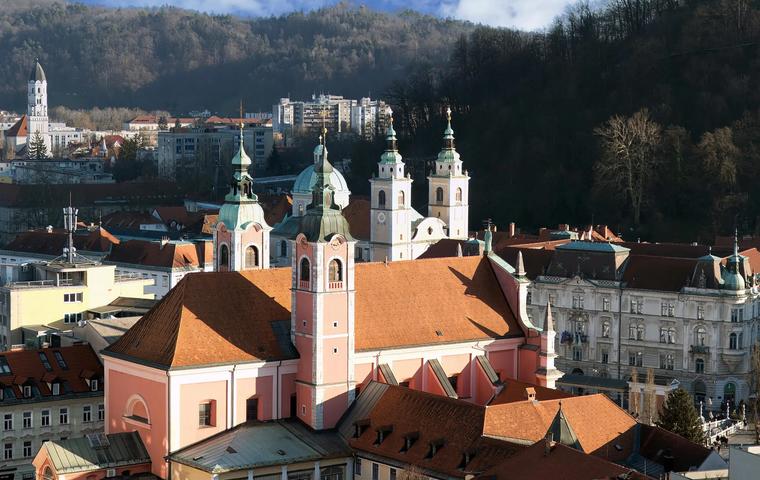
From outside, the cathedral is identifiable by three features: the green dome (added in 1841 – prior to that, a painted trompe-l'oeil dome covered the crossing), two symmetrical clock bell towers, and a yellow facade with niches containing 19th–20th century sandstone statues of bishops and saints. On the southern wall: a Gothic pietà (replica) and an 1826 sundial with a Latin inscription.
The main entrance features bronze doors by Tone Demšar (1996), depicting 1,250 years of Christianity in Slovenia. The side doors (the Ljubljana Door) are by Mirsad Begić, with portraits of 20th-century bishops. Both sets were commissioned for Pope John Paul II's 1996 visit.
Inside: classic Baroque – pink marble, gilt stucco, white plasterwork. Ceiling frescoes by Giulio Quaglio (1703–1706 and 1721–1723) cover the entire central nave vault. The dome fresco is by Matevž Langus (1844): the Holy Spirit, angels, and the Coronation of the Virgin Mary. At the altar: angels by Francesco Robba (1745–1750) on the left and by the Groppelli brothers (1711) on the right. Carved choir stalls and an organ complete the decor. Light enters through the high nave windows – the interior is well-lit even on overcast days.
Highlights
Why visit
Bronze doors – two pairs from 1996: the main doors (Tone Demšar, Slovenian history) and side doors (Mirsad Begić, bishop portraits), commissioned for the Pope's visit
Quaglio frescoes – ceiling paintings by Italian Giulio Quaglio (1703–1723) covering the entire central nave
Dome fresco – by Matevž Langus (1844): the Holy Spirit and the Coronation of the Virgin Mary, dome diameter approximately 15 m
Green dome – copper-clad since 1841, one of Ljubljana's most recognizable skyline features
Bells – six bells across two towers, including Slovenia's second-oldest bell (dated 1326)
History
Past & present
A three-nave Romanesque church stood on the site from 1262. After a fire in 1361, it was rebuilt in Gothic style. In 1461, the Ljubljana Diocese was established and the church became a cathedral. In 1469, the building burned again – likely during a Turkish raid. The current Baroque cathedral in the shape of a Latin cross was built in 1701–1706 to designs by Jesuit architect Andrea Pozzo. Interior painting was carried out by Italian artist Giulio Quaglio.
The dome was a later addition: until 1841, only a painted trompe-l'oeil ceiling covered the crossing. The actual dome was then constructed, with Slovenian painter Matevž Langus completing its fresco in 1843–1844. After the 1895 earthquake, the semicircular Baroque gable was replaced with a triangular one, but the original form was restored in 1989. In 1996, two pairs of bronze doors were installed for Pope John Paul II's visit – today considered among the cathedral's most significant features.
Getting there
Transport & directions
From central Ljubljana (on foot):
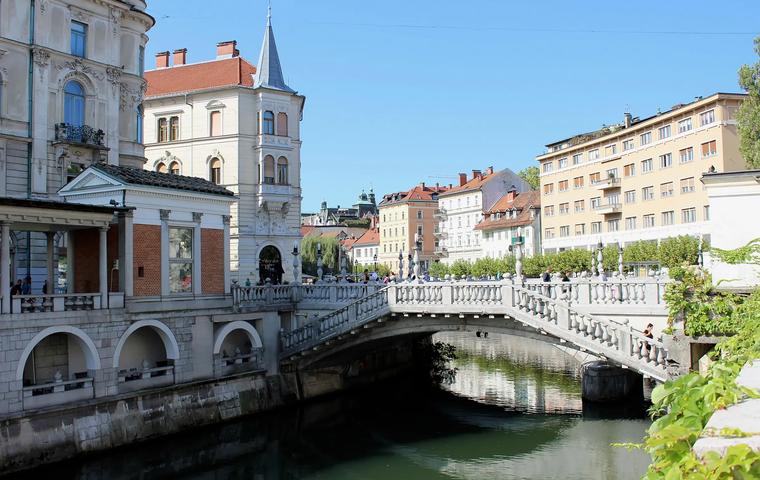
– From Prešeren Square – 3 minutes across the Triple Bridge and right along the riverbank
– From the Central Market – 1 minute, the cathedral is adjacent to Pogačarjev trg
– From the railway/bus station – 12–15 minutes
By public transport:
– LPP buses: stops Krekov trg or Zmajski most (lines 2, 13, 20), then 2–3 minutes on foot
– Free Kavalir electric shuttle through the pedestrian zone
From Ljubljana Airport (LJU, 27 km / 17 mi):
– Shuttle – €5–10 ($5–11), 30–45 minutes
– Taxi – €30–40 ($33–44)