Tickets & prices
Free entry. The square is open 24/7. No admission fees – expenses only for surrounding cafés and shops.
Prešernov trg
Ljubljana's central square with a monument to the national poet and Art Nouveau architecture
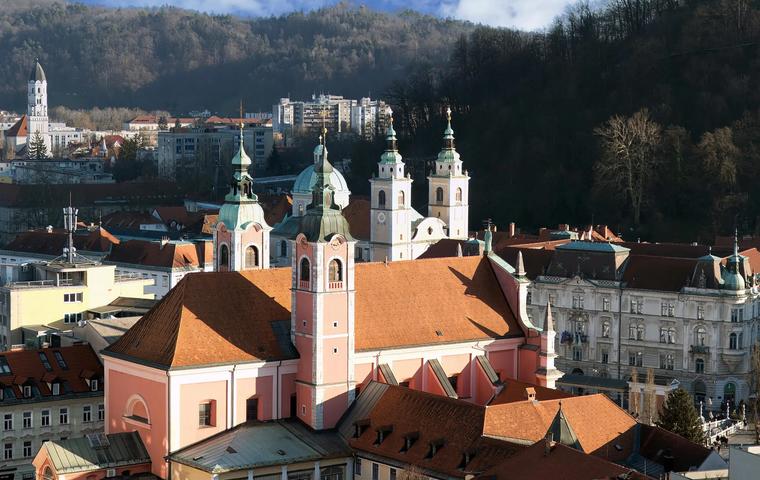
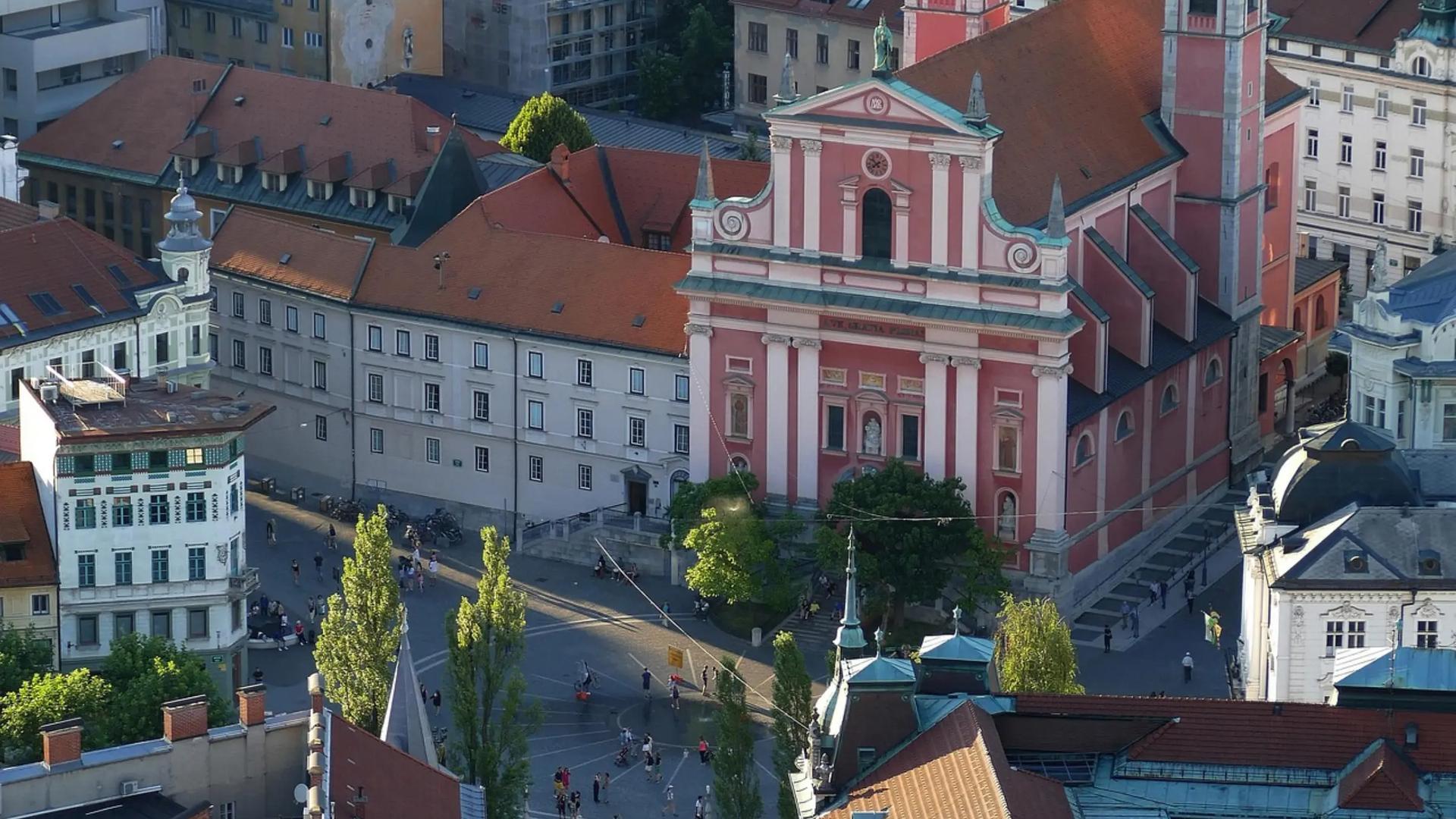
Prešeren Square (Prešernov trg) is the main square of Ljubljana, situated where the medieval Old Town meets the 19th–20th century districts. The oval-shaped square is paved with granite and white Sivec marble rays, with a bronze monument to Slovenia's national poet France Prešeren (1800–1849) at its center, unveiled in 1905. The square is framed by Baroque and Vienna Secession buildings, including the pink facade of the Franciscan Church of the Annunciation.
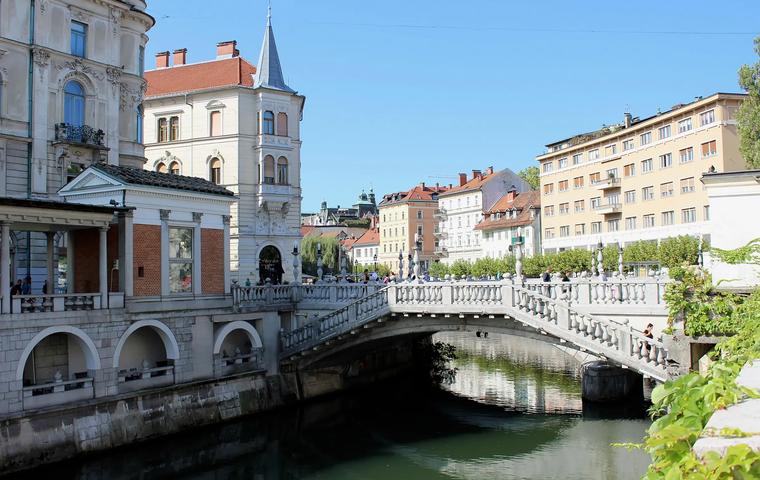
Key routes radiate from the square: across the Triple Bridge to the Old Town and Ljubljana Castle, along Čopova Street to Congress Square, and via Miklošičeva to the railway station (10–15 minutes on foot). The square has been fully pedestrianized since 2007.
Free entry, open 24/7. Allow 15–20 minutes for the square itself, or 1–1.5 hours combined with a stroll along the riverbank and surrounding streets.
Prešeren Square is compact – roughly 50 m across – but every surrounding facade is worth attention. The dominant feature is the 17th-century Franciscan Church of the Annunciation with its distinctive pink facade, pilasters, and onion-shaped spires. To its left stands Urbanc House (1903), one of Ljubljana's finest Art Nouveau examples: the city's first department store with an elegant facade and wrought-iron details. To the right is Hauptmann House (1873, rebuilt in 1904 in Secessionist style). The paving consists of grey granite blocks with radiating white Macedonian Sivec marble lines, designed by architect Edvard Ravnikar (1987–1988).
The bronze Prešeren Monument occupies the southeastern corner: the poet with head bowed, above him a bare-breasted muse holding a laurel branch. Sculptor Ivan Zajec; pedestal by architect Max Fabiani. Across the square, on a building facade on Wolfova Street, a small statue of Julija Primic – the poet's unrequited love – gazes back at him. At the upper edge of the square sits a 2.2 × 2.2 m bronze scale model of central Ljubljana.
The square serves as Ljubljana's main event venue: Christmas market in December, Carnival in February, summer concerts. On regular days, street musicians perform and cafés with terraces line the Ljubljanica riverbank. In summer, a misting system provides cooling – complete with a playful 'Always Raining' sign.
Prešeren Monument – 1905 bronze sculpture by Ivan Zajec on a Max Fabiani pedestal, declared a national cultural monument in 1991
Architectural ensemble – buildings from the 17th–20th centuries: Baroque Franciscan Church, Secessionist Hauptmann House, Art Nouveau Urbanc House
Paving design – granite blocks with Sivec marble rays by Edvard Ravnikar (1987–1988), renovated in 2007
Triple Bridge – unique three-lane bridge across the Ljubljanica connecting the square to the Old Town
Julija Primic statue – small figure on a building facade opposite the monument, toward which the poet's gaze is directed
The square formed at a crossroads in front of the medieval city gates. Until the 19th century, it was known as St. Mary's Square after the Franciscan Church. After the city walls were demolished in the mid-19th century, the space expanded and became a proper square. The 1895 Ljubljana earthquake destroyed part of the surrounding buildings – architect Max Fabiani designed a new ensemble in Secessionist and Art Nouveau styles to replace the medieval houses. The Prešeren Monument was ceremonially unveiled in 1905.
In 1987–1988, architect Edvard Ravnikar proposed the circular layout with granite paving and marble rays, replacing the former funnel-shaped configuration. In 2007, the square was fully closed to motor traffic and its surface was renovated. In June 1991, alongside Slovenia's declaration of independence, the square and monument were designated a cultural monument of national significance. Since 2008, a model of the square has been displayed at Mini-Europe in Brussels.
Free entry. The square is open 24/7. No admission fees – expenses only for surrounding cafés and shops.
No specific restrictions. The square is pedestrianized – no vehicle access except the free Kavalir electric tourist shuttle. Photography unrestricted. A misting system operates in summer for cooling.
On the square:
Tourist Information Center (TIC) at the edge of the square
Cafés and restaurants with riverbank terraces (average check €10–20)
Shops and souvenir stores
Parking: Square is pedestrianized. Nearest underground garages: Trdinova, Dvorni trg, Kongresni trg (5–10 min walk, from €1.50/hour)
Wi-Fi: Free city-wide WiFree Ljubljana network
Accessibility: Fully accessible for visitors with reduced mobility. Level paving, no steps
From central Ljubljana (on foot):
– From the railway station – 10–15 minutes via Miklošičeva Street
– From the bus station – 10–12 minutes
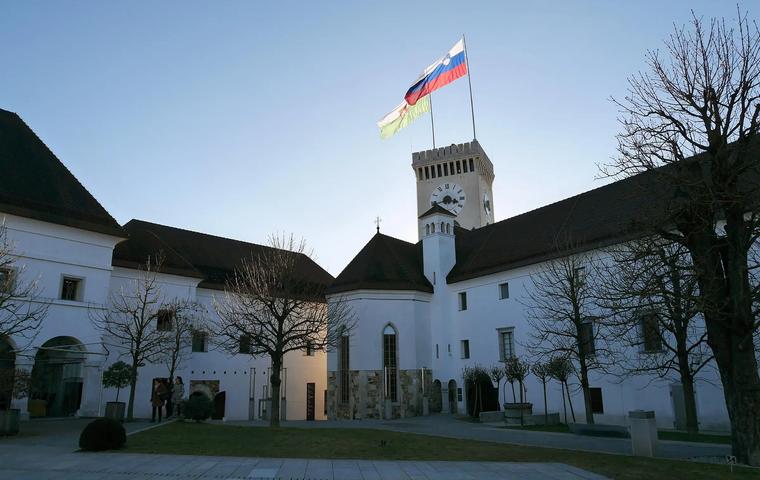
– From Ljubljana Castle – 10 minutes through the Old Town
By public transport:
– LPP buses: nearest stops Krekov trg and Zmajski most (lines 2, 13, 20), then 3–5 minutes on foot
– Free Kavalir electric shuttle – runs through the pedestrian zone, stops on request
– Bus ticket – €1.30 with Urbana card
From Ljubljana Airport (LJU, 27 km / 17 mi):
– GoOpti/shuttle bus – €5–10 ($5–11), 30–45 minutes
– Taxi – €30–40 ($33–44)
Season: Open year-round. Best time: May–September (warm weather, street musicians, events). December brings the Christmas market with festive lights and a tree.
Time of day: Morning (before 10:00 AM) – fewest tourists, best for photos. Evening – building illumination, atmospheric riverbank cafés.
Duration: 15–20 minutes for the square itself. 1–1.5 hours with a stroll across the Triple Bridge, along the riverbank, and surrounding streets.
Avoid: July–August, 11:00 AM–4:00 PM – peak tourist group hours. In rain the square is less impressive, though galleries and cafés provide shelter.
Practical answers about visiting, routes and time on site.
No, the square is free and open 24/7. It's a public pedestrian space with no access restrictions.
About 15–20 minutes for the square itself. If you combine it with a walk across the Triple Bridge, the riverbank, and the Old Town – allow 1–1.5 hours.
Walk 10–15 minutes along Miklošičeva Street – it leads directly to the square. The route is straightforward and well-signed. No taxi needed.
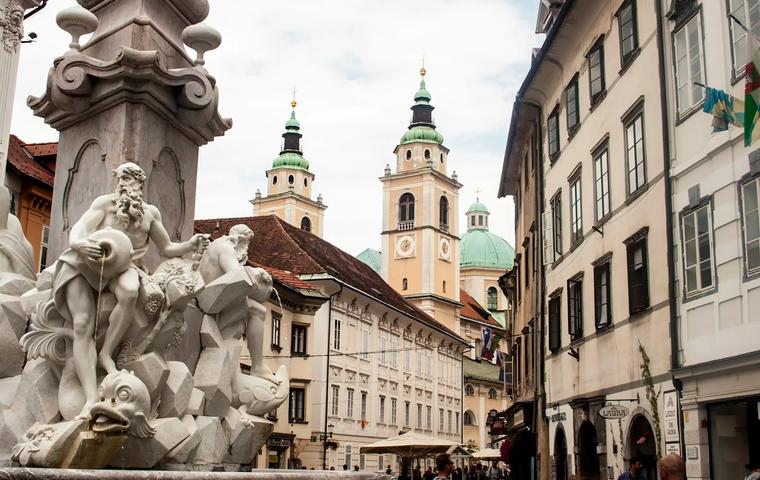
Across the Triple Bridge: the Old Town and the path to Ljubljana Castle. Within 100 m: St. Nicholas Cathedral and the Central Market. Via Čopova Street: Congress Square.
The square is fully pedestrianized. The nearest underground garages are Trdinova, Dvorni trg, and Kongresni trg (5–10 min walk, from €1.50/hour).
Christmas market in December. Carnival in February–March. Summer concerts June–August. Every Friday from March to October, the Open Kitchen (Odprta Kuhna) food festival runs on nearby Pogačarjev trg.
Yes. Flat paving, no traffic, and a misting system in summer that kids love running through. The free Kavalir electric shuttle runs through the pedestrian zone nearby.
France Prešeren (1800–1849) was Slovenia's national poet. His poem 'Zdravljica' (A Toast) became the national anthem. The 1905 monument shows him gazing at a small statue of Julija Primic – his unrequited love – on a building facade across the square.