Tickets & prices
Free access. The bridge is open 24/7.
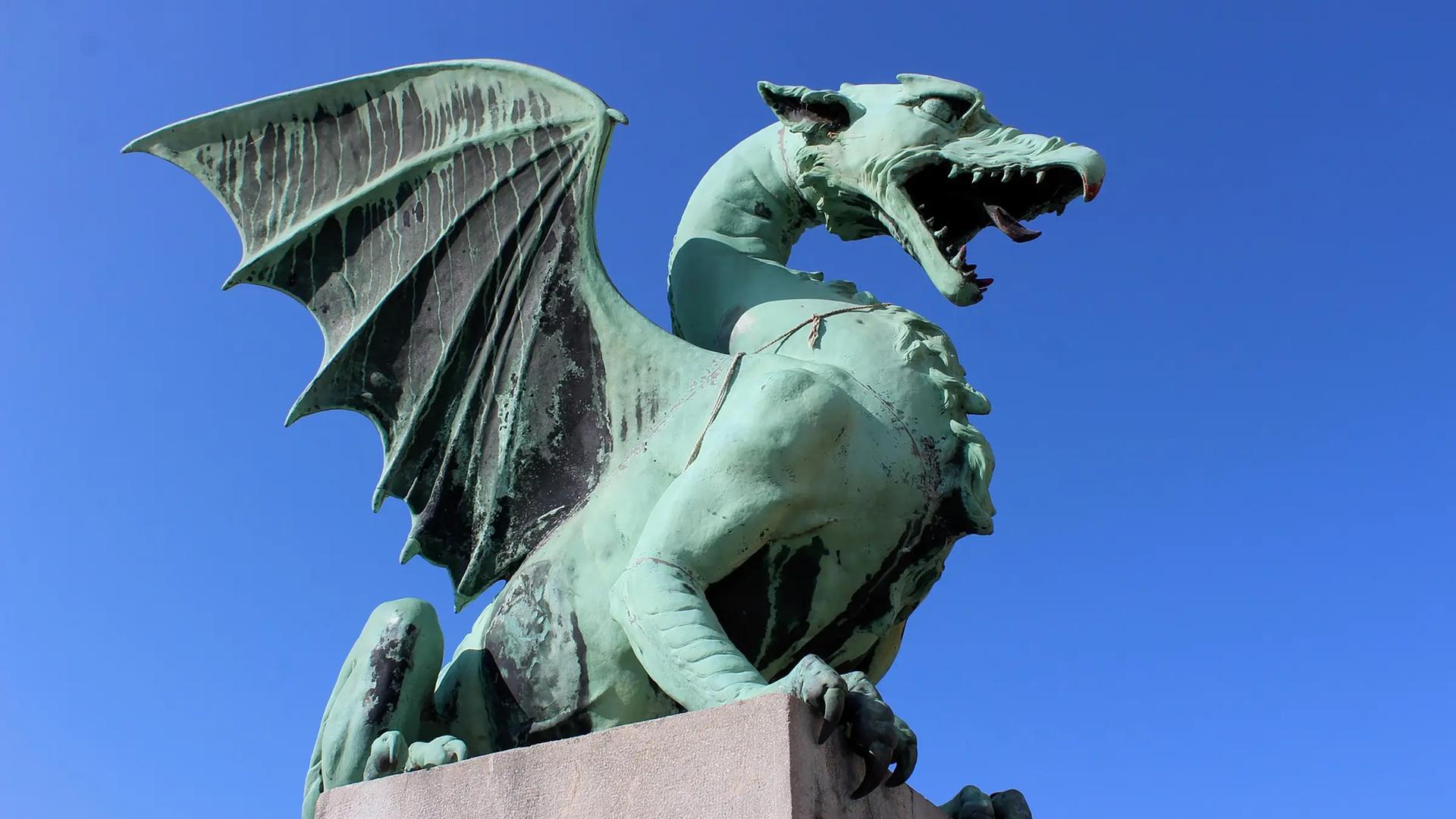
Zmajski most
A 1901 Art Nouveau bridge with four copper dragon statues – the symbol of Ljubljana
The Dragon Bridge (Zmajski most) is a road and pedestrian bridge over the Ljubljanica River in central Ljubljana, built in 1900–1901. Four copper dragon sculptures on its corners have become the city's defining visual symbol – the dragon features on Ljubljana's coat of arms and flag. The bridge is one of the earliest reinforced concrete bridges in Europe and a prime example of Vienna Secession architecture.
The bridge stands 200 m northeast of the Triple Bridge, next to the Central Market and Vodnik Square. Ljubljana Castle is a 10-minute uphill walk from here.
A visit takes 5–10 minutes. Free access, open 24/7. The bridge carries car traffic – pedestrian pavements run on both sides.
The Dragon Bridge stretches 45 m across the Ljubljanica, with a width of 15.2 m. The structure is a triple-hinged arch with a 33.34 m span – one of Europe's largest at the time of construction. The load-bearing framework uses steel trusses encased in reinforced concrete following the Melan System. The surface was paved with asphalt – the first bridge in Slovenia to have an asphalt road.
Four dragons made of sheet copper sit on pedestals at the bridge's corners. Each sculpture stands roughly 4.5 m tall including its pedestal. The dragons face outward: open jaws, outstretched wings, curving tails. Beyond the four main statues, 16 smaller dragons appear in the decorative balustrade elements. The balustrades feature Art Nouveau ornamentation; original lamp posts line the parapets (originally gas-lit, now electric), and the inscription '1848–1888' marks the jubilee years of Emperor Franz Joseph I's reign.
The bridge rests on wooden piles (150 on each side) driven into the Ljubljanica riverbed. From the bridge, you can see the river, the embankments, and Castle Hill with its fortress. The best close-up view of the dragons is from the bridge's pavements, right next to the sculptures. The bridge is particularly photogenic at sunset, when the copper catches warm light.
Dragons – four copper sculptures ~4.5 m tall on pedestals, designed by architect Giorgio Zaninovich, plus 16 smaller dragons in the decorative elements
Engineering – one of Europe's first reinforced concrete bridges (1901), with a 33.34 m arch span – the third-largest at the time of completion
Style – Vienna Secession (Art Nouveau), ornamented balustrades, original lamp posts
Status – a protected technical monument of Slovenia
Legend – linked to the myth of Jason and the Argonauts who slew a dragon here; local folklore says the dragons wag their tails when a virgin crosses the bridge
The bridge was built in 1900–1901 as part of a major reconstruction of Ljubljana following the devastating 1895 earthquake. It replaced the wooden Butchers' Bridge that had stood on this site since 1819. The project was carried out by the Vienna-based firm Pittel+Brausewetter, based on a patent by engineer Josef Melan. The architectural design was created by Dalmatian architect Giorgio Zaninovich, a graduate of Otto Wagner's school. The bridge was ceremonially opened on 4 October 1901 and originally named the Jubilee Bridge of Emperor Franz Joseph I.
After the dissolution of Austria-Hungary in 1918, the bridge was renamed Dragon Bridge (Zmajski most) in July 1919. The new name emphasised its connection to city symbolism: the dragon has appeared on Ljubljana's coat of arms since the 15th century, and according to legend, Jason and the Argonauts slew a dragon here on their journey from Colchis. Over more than 120 years, the bridge has been restored multiple times but retains its original sculptures, balustrades, and lamp posts. Today it is a protected technical monument and one of the most photographed landmarks in Slovenia.
Free access. The bridge is open 24/7.
The bridge carries car traffic – stay on the pavements. Photography is unrestricted. When photographing the dragons up close, watch out for passing vehicles. The bridge has no barriers between the pavement and the roadway – take care with children.
Nearby:
Central Market and Vodnik Square – 50 m (cafés, restaurants, farmers' produce)
Slovenian Tourist Information Centre – 100 m
Butchers' Bridge – 150 m (modern bridge with love locks)
Toilets – at the Central Market (€0.50)
Accessibility: The bridge pavements are flat with no steps – accessible for wheelchairs and pushchairs. Kerbs at the pavement transitions are gently sloped.
Location: Central Ljubljana, between Kopitar Street and Ressel Street (Resljeva cesta). GPS: 46.0519, 14.5104.
On foot:
– From the Triple Bridge – 200 m, 3 minutes along the embankment
– From Ljubljana train station – 500 m, 7 minutes
– From Prešeren Square – 300 m, 4 minutes
By public transport:
– Bus to Zmajski most or Krekov trg stop
– Single ticket – €1.30 with an Urbana card
Season: Year-round. The bridge is weather- and season-independent.
Time of day: Sunset – the copper dragons catch warm light beautifully. Evening – the bridge is illuminated. Morning – less traffic and fewer pedestrians for clean photos.
Duration: 5–10 minutes for viewing and photos. Easily combined with a walk through the Old Town and a visit to the Central Market.
Avoid: Nothing specific. During rush hours (8:00–9:00, 17:00–18:00), car traffic is heavier.
Practical answers about visiting, routes and time on site.
No, it's free. The bridge is an active city crossing and accessible 24/7.
Four large copper sculptures on pedestals at the corners (~4.5 m tall each), plus 16 smaller dragons in the decorative balustrade elements.
The dragon has been Ljubljana's symbol since the 15th century. According to legend, Jason and the Argonauts defeated a dragon on the banks of the Ljubljanica. The dragon appears on the city's coat of arms and flag.
Yes, the sculptures sit on pedestals right next to the pavements and are within arm's reach. Watch out for passing cars – the bridge carries vehicle traffic.
Yes, there are pavements on both sides. Car traffic runs along the centre, but the pavements are wide enough. Keep an eye on children near the roadway.
Central Market – 50 m (Open Kitchen on Fridays). Triple Bridge – 200 m. Ljubljana Castle – 10-minute walk uphill. St. Nicholas Cathedral – 150 m.
Sunset – the copper dragons glow in warm light. Evening – the bridge is beautifully lit. Early morning – minimal traffic and people for clean shots.
From the Ljubljanica embankment – the arch and dragons are visible against the sky. From the Butchers' Bridge (150 m away) – a side view of the entire bridge.