Blog · Tours
Montenegro Markets (Pijaca): How to Buy Real Cheese at €8/kg, Kajmak and Wine
 Tours
ToursIn this article
- 01Which Montenegrin markets are actually worth visiting
- 02Cheese: what you're really paying for
- 03Kajmak: what it is and why you want it
- 04Pršut: how to get the right slice
- 05Wine: Vranac, Kratošija, and the "homemade" trick
- 06Honey, olive oil, rakija, and the rest
- 07Market vs. supermarket: side-by-side
- 08Etiquette, bargaining, and language
- 09FAQ
- 10Conclusion
- 11Read also
- 12Sources
Some links are affiliate links. You pay the same, and we may earn a commission.
Budva's market is 1.5–2× more expensive than supermarkets, while Podgorica sells the same cheese at half price. Where to buy real Njeguški cheese, kajmak, pršut and Vranac without the tourist markup.
A market – called *pijaca* in Montenegrin – in coastal resort towns is a tourist format, not a place where locals do their shopping. At the Budva pijaca, prices run 1.5–3 times higher than at the wholesale market in Podgorica, and often above the supermarket next door. That's still not a reason to skip it: this is where you can sample real Njeguški cheese, kajmak from mountain villages, and homemade wine you won't find in any chain. But you need to come prepared – know where the locals actually shop, what to ask for as a tasting, and what counter-price to name when the seller starts high.
Key takeaways
- Budva, Kotor, Tivat, and Herceg Novi run tourist-oriented markets. Prices here are 1.5–3× higher than at the wholesale market in the capital, because locals rarely shop here – they drive to Podgorica or load up at Voli and Idea supermarkets.
- The most honest markets are the green market in Podgorica and the pijaca in Bar. Restaurateurs from Budva and Kotor source there; prices are 30–50 % lower and the selection is wider.
- Njeguški cheese was ranked the world's #2 hard cheese in 2022. It's cheapest bought directly in Njeguši village near Cetinje – about €10/kg, against €12–15 in Budva and up to €80/kg for aged versions at the pijaca.
- Kajmak is neither sour cream nor butter. It's a triple-cooked clotted cream skimming, slightly salty, eaten with bread, potatoes, or meat. Budva market: €12/kg, supermarket: €10/kg, mountain markets (Kolašin, Žabljak): €5–7/kg.
- Pršut at the pijaca is often "swapped". They give you a tasting from an aged €25/kg leg and weigh out a younger €12/kg one. Watch the scales and ask them to vacuum-pack the exact slice you tasted.
- Montenegro's flagship wine is Vranac. A 1L wine carton in supermarkets is €4–6, a Plantaže bottle €5–8, and homemade bulk wine at the market €4–7/L – but with no quality guarantee.
- Sunday is the wrong day for the market. Budva pijaca runs 7:00–15:00, closes by noon on Sundays; the best day for fresh stock is Saturday.
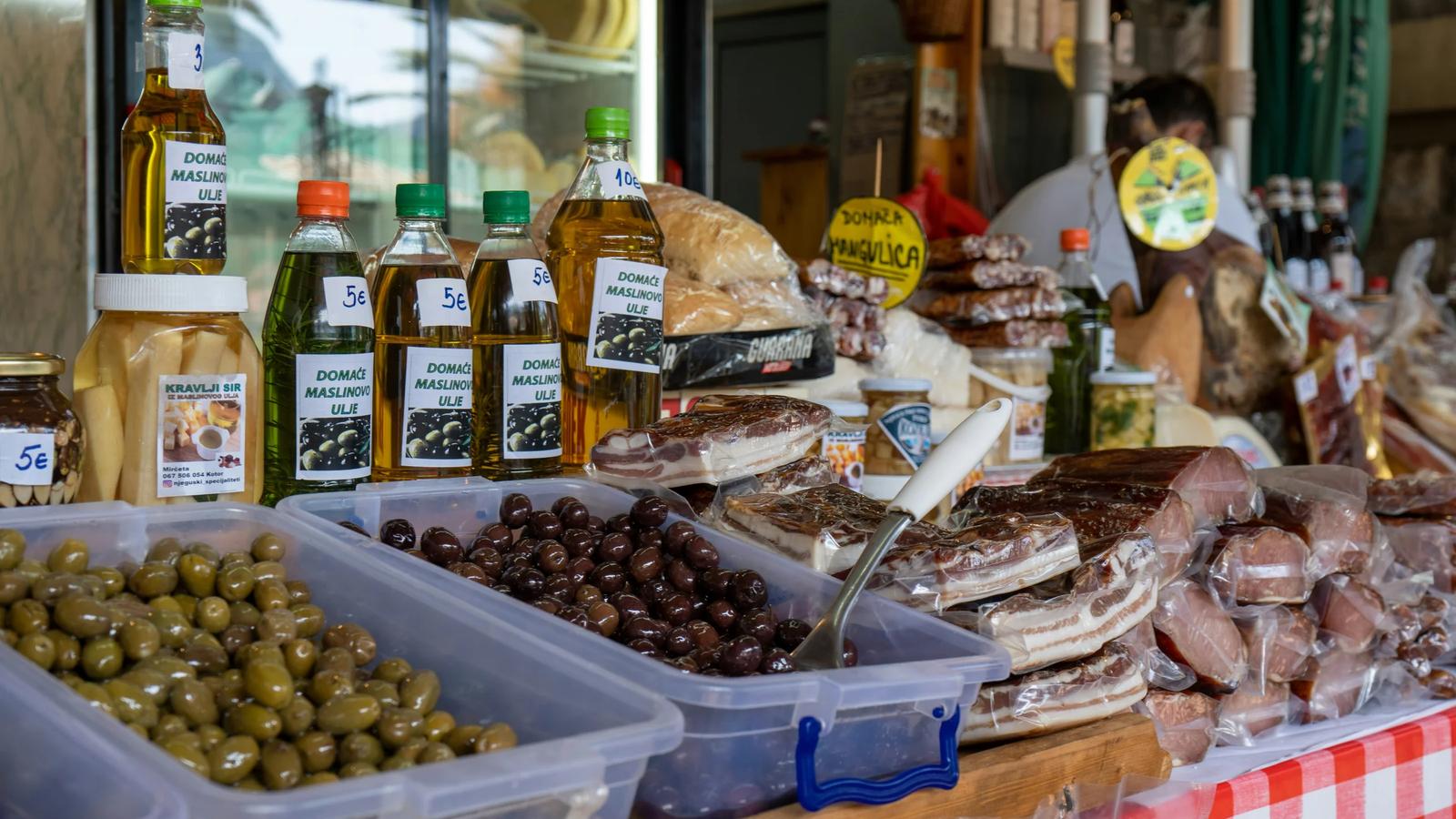
Which Montenegrin markets are actually worth visiting
Not all pijacas are created equal. Each major town has its own trading character, price tier, and degree of tourist orientation. Understanding this hierarchy saves both time and money.
| City | What to buy | Price level | Best for |
|---|---|---|---|
Budva (Zelena pijaca) | tasting & souvenir set | high (+50–100 %) | short-stay tourists |
Kotor | small farmer items | high | cruise visitors, Old Town stays |
Tivat | limited selection | high | guests staying nearby |
Bar (green market) | olive oil, fish, vegetables | medium | apartment renters |
Podgorica (Mall of Montenegro) | bulk volumes, meat, cheese | low | longer-stay residents |
Virpazar (fish & wine) | smoked carp, homemade wine | medium | as part of a Skadar Lake trip |
Podgorica and Bar are cheaper because small restaurants and local families shop there in bulk. Resort-town markets survive on tourists, expats, and second-home owners – rents are high, turnover is lower, hence the markup. According to Budva sellers themselves, around 90 % of their customers aren't local.
If you're staying a week and don't plan to cook, the Budva pijaca covers all the food-souvenir needs. If you're in an apartment for two weeks or more, plan a day trip to Podgorica or Bar – the savings on groceries alone exceed the cost of renting a car for that day.
Cheese: what you're really paying for
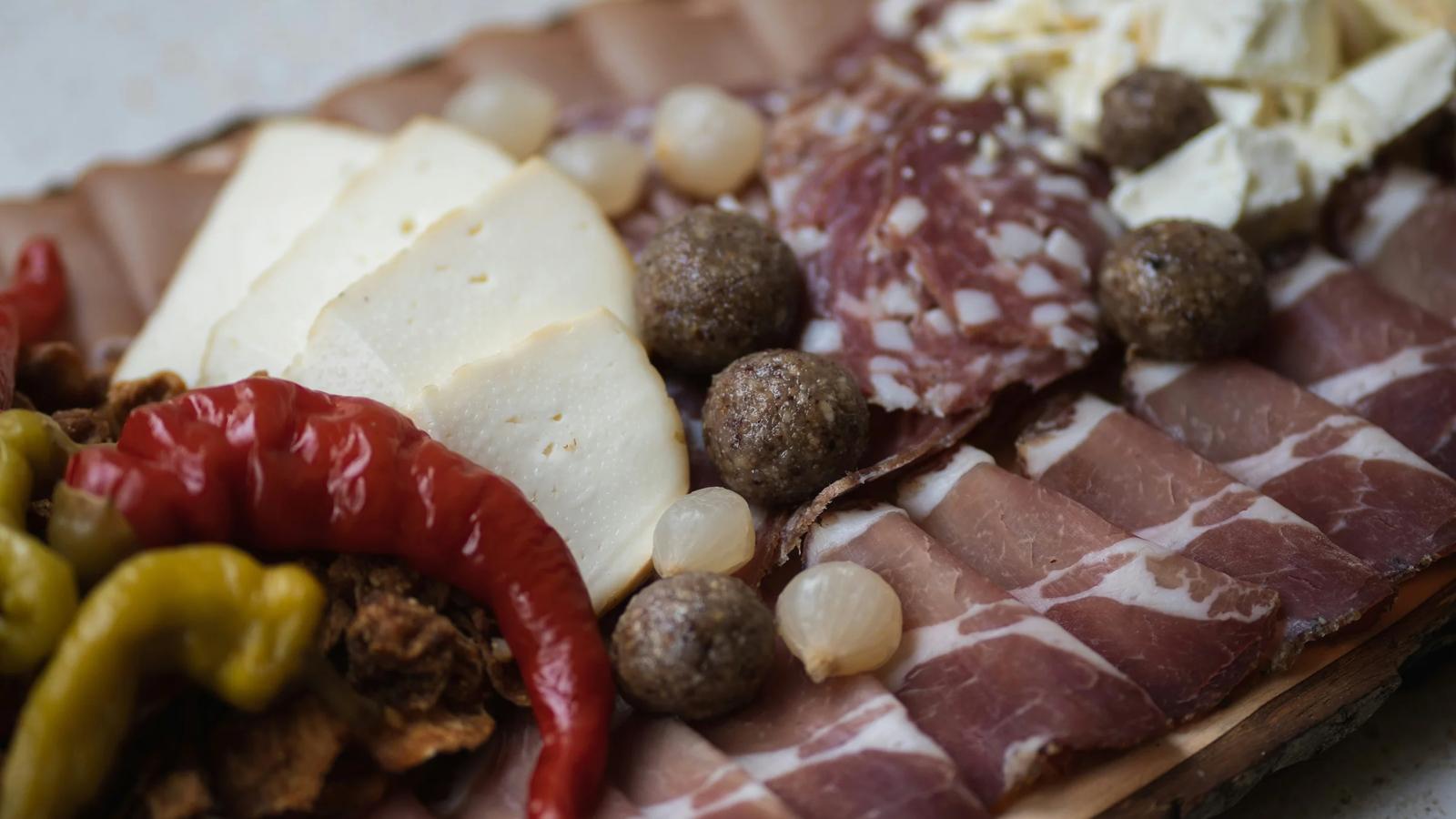
Montenegrin cheese isn't one product but a regional map. Each mountain area has its signature variety, and knowing the differences keeps you from overpaying for "premium" that's actually just young.
Njeguški sir. Made in Njeguši village on the slopes of Lovcen, between Kotor and Cetinje. Semi-hard, mainly sheep's milk (often blended with cow's), salty, mildly tangy. In 2022 it was ranked the world's #2 hard cheese. At the Budva market: €12–15/kg (young) and up to €80/kg (aged, *stari sir*). In Njeguši family shops: about €10/kg.
Kolašinski lisnati sir. Made around Kolasin and Mojkovac in the north. PDO-protected (Protected Designation of Origin). Stretchy, layered like pasta filata. According to traveler feedback, it costs about €5.5/kg in Kolašin itself, €12/kg in Budva.
Pljevaljski sir. Fatty, aged, brined, from the Zabljak and Pljevlja region in the north. Less common on the coast; €8–12/kg.
Goat and Krajina goat cheese. Fresh, soft, spreadable. Excellent for breakfast with figs and honey. At the Bar market: €6–8/kg, in Budva: €10–12/kg.
| Cheese type | Region | Budva pijaca | Supermarket | At source |
|---|---|---|---|---|
Njeguški young | Cetinje/Lovćen | €12–15/kg | €8–10/kg | €8–10/kg |
Njeguški aged | Cetinje/Lovćen | €25–80/kg | €18–25/kg | €15–20/kg |
Kolašinski layered | Kolašin/Mojkovac | €10–12/kg | €7–9/kg | €5–6/kg |
Goat (soft) | Bar/coast | €10–12/kg | €6–8/kg | – |
Generic cow | – | €8–10/kg | €5–7/kg | – |
(Updated: April 2026)
How to choose at the market. Asking for a sample is normal, not pushy. A good seller will cut you a thin slice on the knife blade. Ask for *mladi* (young) or *stari* (aged) – the latter is more aromatic and salty, the former creamier. Aged cheese should have an even golden-yellow rind without cracks or edge mold; young cheese should be dense, not watery, with no large holes. If a vendor refuses a tasting, that's the wrong stall.
Kajmak: what it is and why you want it
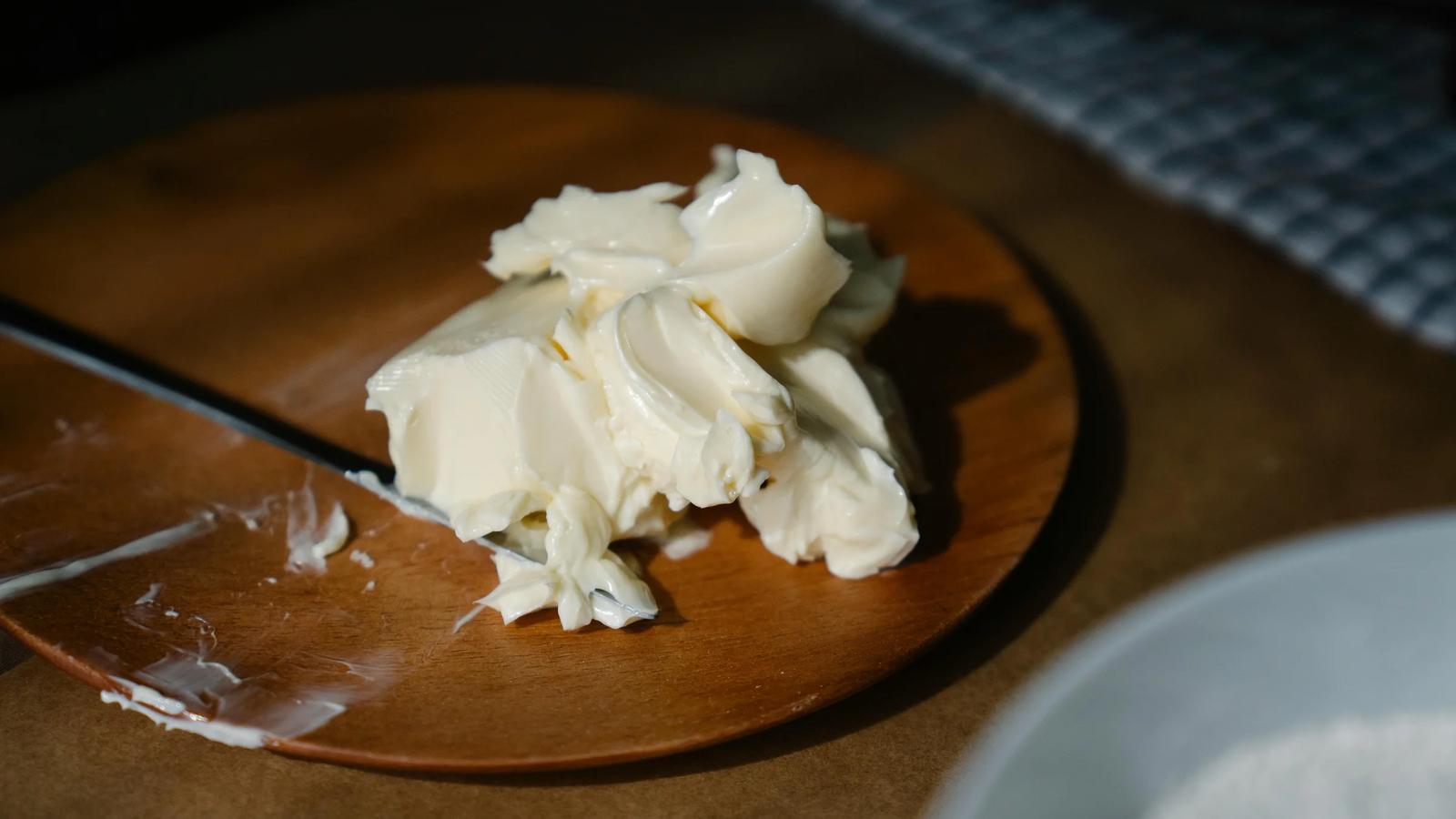
Kajmak is the most underrated product in Balkan cuisine for tourists. Texture-wise, it sits between sour cream, mascarpone, and salted butter. It's made by triple-skimming cream from very high-fat milk: bring milk to a boil, cool, skim the cream layer, repeat over several days, lightly salt, and let it ripen.
Locals eat kajmak straight with warm bread, with boiled potatoes, in Njeguški steak (thin meat stuffed with cheese and kajmak), or in *kačamak* – a cornmeal porridge. By texture: *fresh* (delicate, like whipped cream) and *aged* (denser, saltier, longer shelf life).
| Where | Price/kg | Quality |
|---|---|---|
Budva pijaca | €10–12 | tourist tier, variable |
Voli/Idea supermarket | €8–10 | stable, factory-grade |
Kolašin or Žabljak market | €5–7 | homemade, top quality |
Bar market | €7–9 | good middle ground |
(Updated: April 2026)
Fresh kajmak doesn't keep more than 4–5 days in the fridge; aged keeps 2–3 weeks. A vacuum-sealed jar holds up for two weeks of travel, but glass or ceramic only – plastic alters the flavor.
Pršut: how to get the right slice
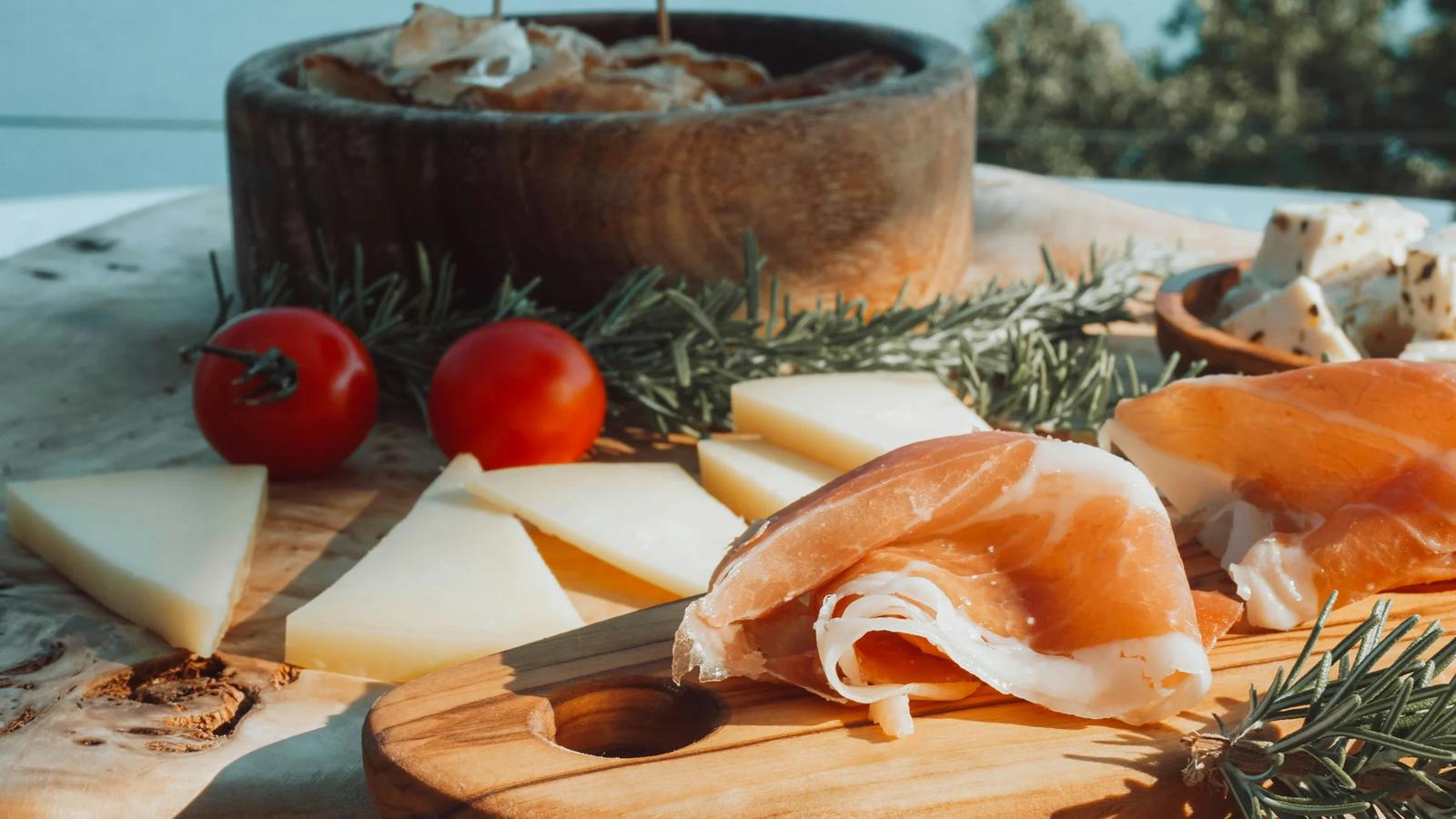
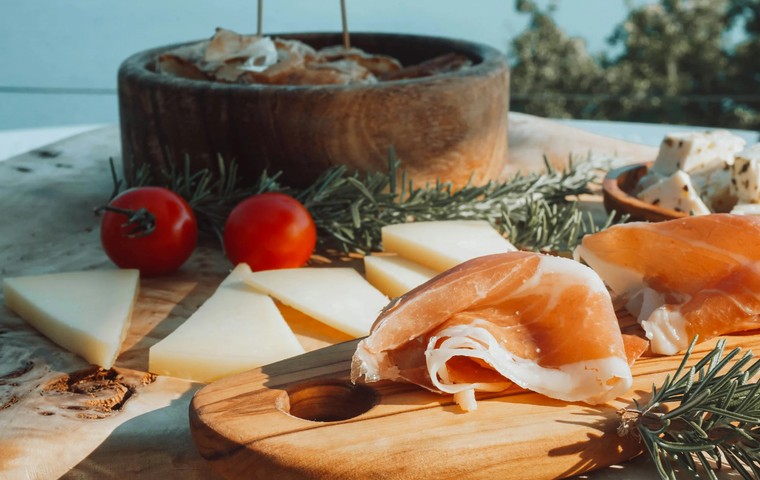
Pršut is air-dried smoked pork ham, cousin to Italian prosciutto and Spanish jamón – but with its own character: saltier, denser, with a smoky note from beechwood. The protected variety is Njeguški pršut, from Njeguši village; one ham takes at least a year to produce. At the pijaca it's hand-cut by knife or slicer, with paper-thin slices.
Main risks at the market. The most common tourist swap: the seller offers a tasting from an aromatic, aged €25/kg piece, then slices a younger, cheaper one into your bag while charging the higher price. The defense is simple – insist that the slice and the weight come from the same ham you tasted, and don't take your eyes off the scale. Second flag: price. Real Njeguški pršut can't cost less than €12/kg; anything cheaper is either lowland pršut or an under-aged version.
Prices (April 2026):
- Njeguški pršut at the pijaca: €18–25/kg
- Njeguški pršut at specialty butcher shops (mesara): €14–18/kg
- Generic pršut at the supermarket: €12–14/kg
- Direct from Njeguši family producers: €12–14/kg
If you're taking it home, ask for vacuum packing (*vakum*); a good seller does it for free. Without vacuum, pršut keeps at room temperature for up to a month, but loose-wrapped it loses aroma and dries out.
Wine: Vranac, Kratošija, and the "homemade" trick
Montenegro's flagship red is Vranac, an indigenous variety grown here since the 14th century. Its homeland is the Crmnica region on the western shore of Skadar Lake; the gateway town for tourists is Virpazar. Vranac covers 70 % of all Montenegrin vineyards. State-owned Plantaže produces the basic Crnogorski Vranac – the most common, stable option, sold in any supermarket. Premium tier: Vranac Pro Corde and Vranac Barrique, oak-aged 12+ months.
| What to buy | Where | Price |
|---|---|---|
Plantaže Vranac | Voli, Idea, Mega supermarkets | €5–8/bottle |
Plantaže Vranac Pro Corde | supermarkets, wine shops | €12–18 |
Plantaže Krstač (white) | supermarkets | €5–7 |
Homemade Vranac at the pijaca | Budva, Bar, Kotor | €4–7/L bulk |
Family wineries in Crmnica | Virpazar, Godinje, Bukovik | €8–25/bottle |
1L wine carton | supermarkets | €4–6 |
(Updated: April 2026)
The "homemade" wine catch at the pijaca. Bulk wine from large plastic jerrycans isn't always genuine family wine from Crmnica. Often it's a mix of bulk winery material and local "improvement". Real homemade wine: dense sediment, uneven color, a natural-cork stopper, and a seller willing to name a specific village and family. If the answer is "I have my own vineyard, very good" – there's an 80 % chance of substitution.
Kratošija. Close cousin of Italian Primitivo and Californian Zinfandel. Lighter and fruitier than Vranac. Made in small family wineries – Garnet (Godinje), Cermeniza (Virpazar), Buk (Bukovik). This is no longer a market purchase but a proper cellar tasting on site.
Krstač. Montenegro's main white grape, golden, with apple notes. Pairs beautifully with Skadar Lake fish and Njeguški cheese. Supermarket: €5–7, winery: €8–12.
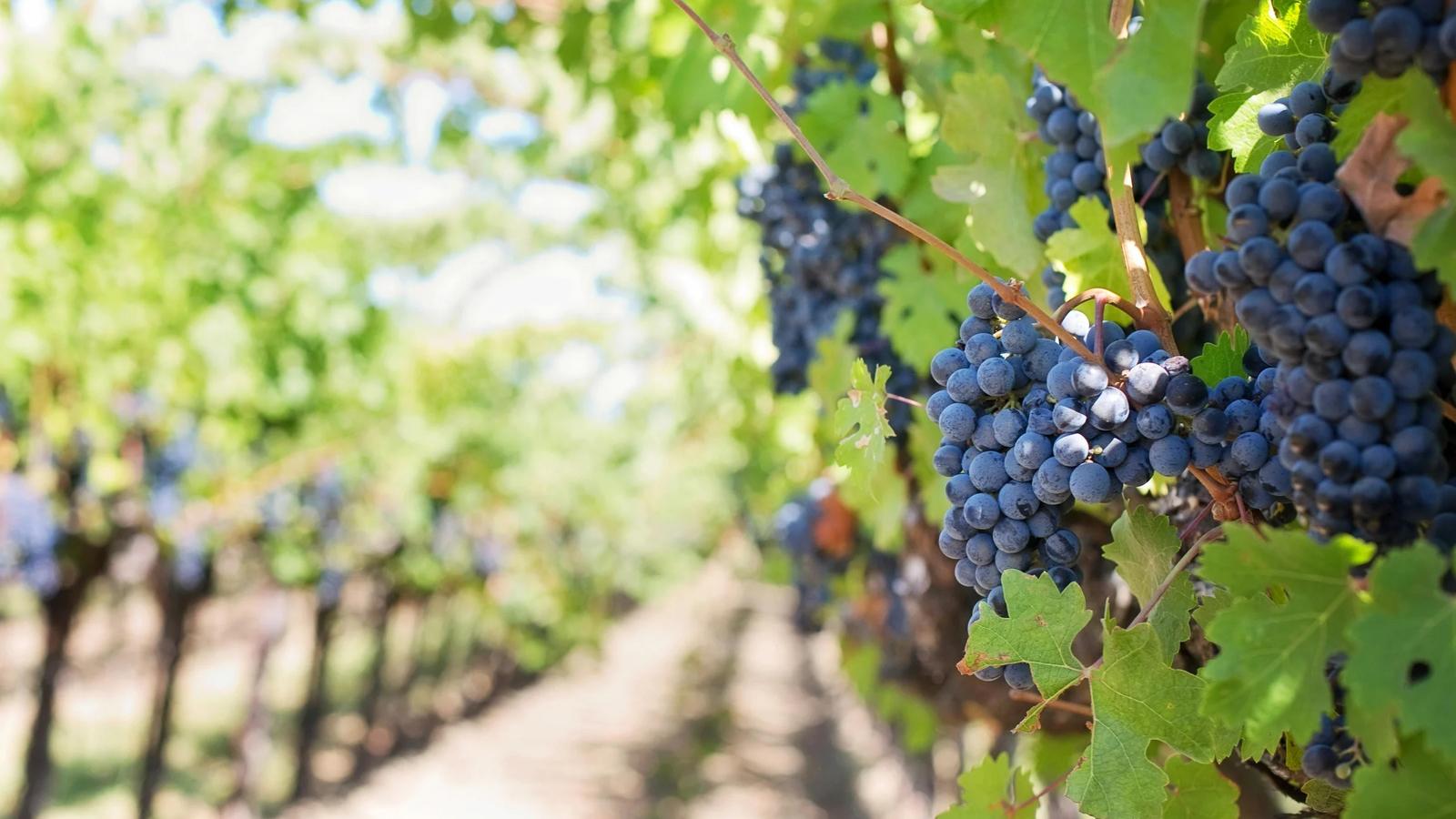
To bundle wine, cheese, and pršut into one trip, the logical route runs through Virpazar with a Crmnica detour. For a structured experience, a private walking food and wine tour in Kotor starts from €94 per group and combines pršut, cheese, olive oil and Vranac tastings inside the Old Town.
Honey, olive oil, rakija, and the rest
Beyond the cheese-kajmak-wine trinity, four more market categories deserve attention.
Honey. Montenegro is a small but dense beekeeping country; apiaries cluster around Cetinje, Skadar Lake, Žabljak, and Bjelasica. At the Budva pijaca: €8–12 per 0.5L depending on type (linden, chestnut, lavender, sainfoin). At the Cetinje market – particularly during the long-running Balšić honey fair – prices drop 20–30 % and selection broadens.
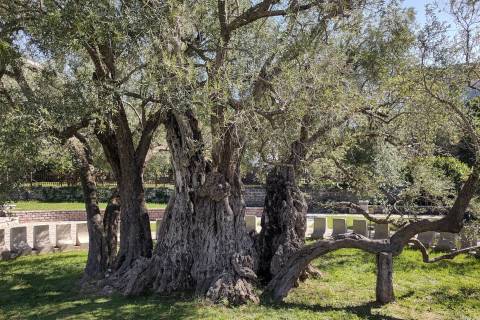
Olive oil. The main region is Bar and its surroundings; the Stara Maslina here is one of the world's oldest olive trees, over 2 000 years old. Cold-pressed homemade oil at the Bar pijaca: €8–12 per 0.5L; in Budva: €10–15; bottled supermarket oil: €5–7 (no longer "homemade" but factory-grade).
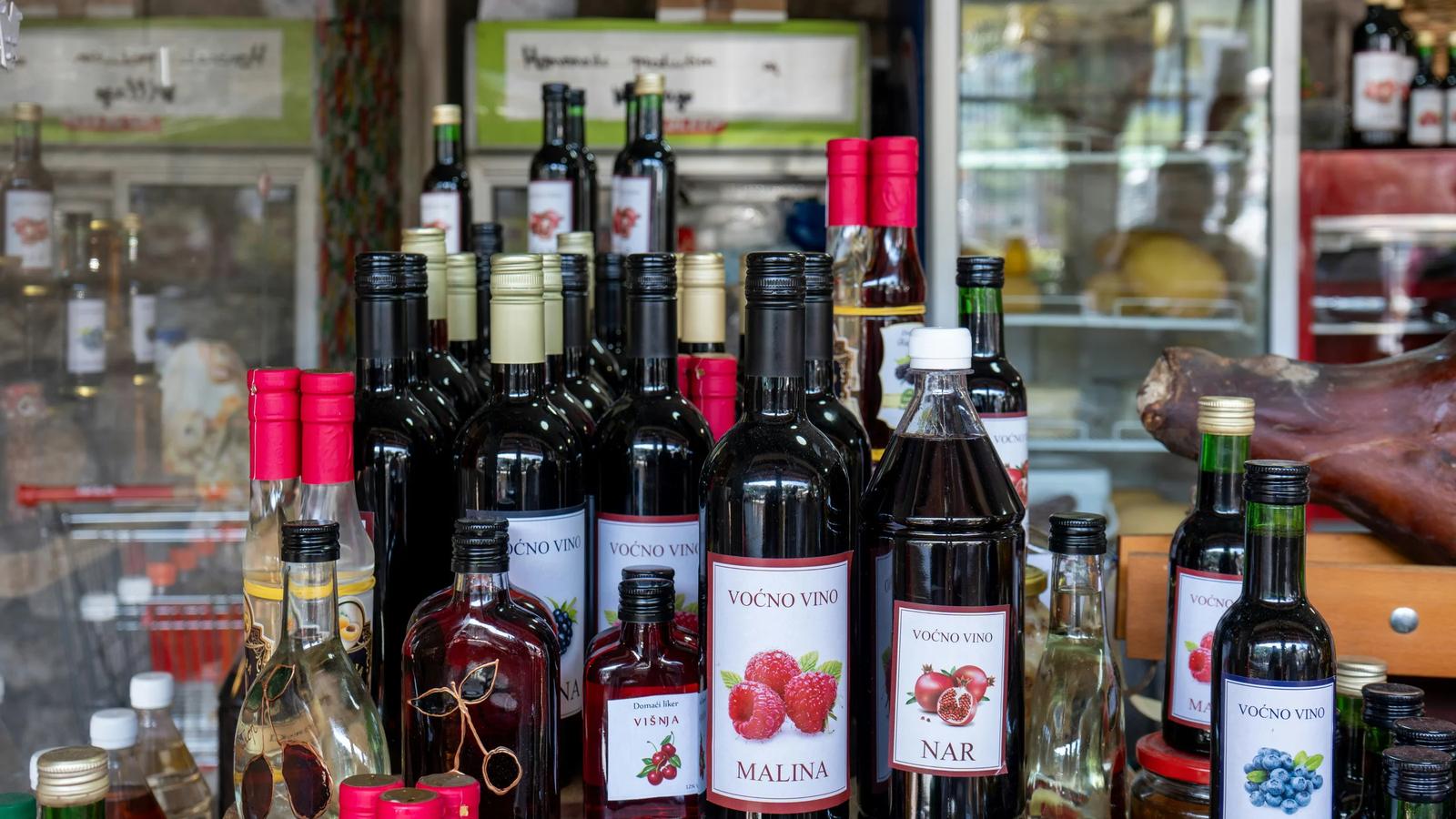
Rakija and liqueurs. *Lozovača* (grape), *kruškovača* (pear), *borovnica* (blueberry), *travovica* (mountain herbs). Pijaca prices: €8–15 per 0.5L bottle. Check duty-free limits for your destination – most jurisdictions cap strong alcohol at 1L per traveler.
Seafood. At the Budva fish market, fishermen drop fresh catch around 16:00–17:00, but only on successful days. Fresh mussels and oysters are best bought at farms in the Bay of Kotor – roughly €0.7–1 per oyster, €4–6/kg for mussels. Always ask whether the fish is local Adriatic or imported (Greece, Albania, Argentina) – the price should differ by half.
Market vs. supermarket: side-by-side
According to consumer-price aggregators, average supermarket prices in Montenegro in 2026 look like this. It's a useful baseline – if a market price is more than 1.5× the supermarket price, the seller is targeting tourists, not quality.
| Product (1 kg) | Supermarket avg | Range | Budva market | Podgorica/Bar market |
|---|---|---|---|---|
Local cheese | €7.85 | €5.50–14 | €10–15 | €6–10 |
Chicken fillet | €6.93 | €4–10 | – | €6–9 |
Beef | €10.19 | €8–13 | – | €8–11 |
Tomatoes | €2.27 | €1.30–3 | €2.5–4 | €1.5–2.5 |
Potatoes | €0.87 | €0.65–1.10 | €1.2–1.8 | €0.7–1 |
Apples | €1.22 | €0.80–2 | €1.5–2.5 | €1–1.5 |
Bottle of wine (mid) | €5+ | – | €4–7 (bulk) | €4–7 |
(Updated: April 2026)
The logic is clear: vegetables and fruit are cheaper at the market only in Podgorica and Bar, not in Budva or Kotor. Cheese and kajmak have wider variety at the pijaca but are cheaper and more consistent at the supermarket. Pršut is equally good in supermarkets and specialty shops, but only the market lets you taste before paying.
Etiquette, bargaining, and language
Prices at Budva, Kotor, and Tivat pijacas are often opening prices. Locals haggle modestly between themselves, but a 10–20 % discount on a large purchase (1+ kg cheese, a whole pršut leg, a crate of tomatoes) is fair to ask. On small items – a single cucumber, a bunch of herbs – haggling isn't done.
Useful phrases:
- *Koliko košta?* – How much?
- *Mogu li probati?* – May I try?
- *Domaće?* – Homemade?
- *Stari ili mladi?* – Aged or young?
- *Vakum, molim* – Vacuum-pack, please.
- *Može popust?* – Can I get a discount?
Most sellers in coastal towns speak at least basic English; many also speak Russian (the country has a large post-Soviet expat community, and many sellers themselves are immigrants). Local guides note that a polite tone outperforms aggressive bargaining – a friendly "hmm, that's expensive" tends to drop the price faster than confrontation.
Don't trust the *domaće* (homemade) label on every other jar – it's marketing, not a certificate. Real "homemade" means the seller can name a specific village, a producer's name, sometimes show a photo of the farm. If the answer to "where does your cheese come from?" is just "it's all homemade, don't worry" – odds are the stock came from the same Podgorica wholesale market as the supermarket across the street.
FAQ
1. What's the best day and time for a market in Montenegro?
Saturday, 7:00–10:00. Resort-town markets run roughly 7:00–15:00 (Budva closes at 15:00 sharp), Sunday until noon. The freshest selection of vegetables, fish, and meat lands on Saturday morning, when farmers bring their peak weekly stock.
2. Can I pay by card at the market?
No, the pijaca is almost universally cash-only in euros. Cards are accepted only by a few large vendors and some specialty shops with a POS terminal and a €10–20 minimum. Withdraw cash in advance – ATMs at market entrances often charge €3.5–5 fees and offer poor exchange rates. Specialty butchers and wine shops nearby do accept Visa/Mastercard for larger purchases.
3. Can I take Montenegrin cheese and pršut home?
Within the Schengen Area, dairy and meat from Montenegro (a non-EU country) are formally restricted, though land-border enforcement is patchy. For other destinations, check your country's rules on personal animal-product imports. In carry-on luggage on planes – usually no issue; liquids (honey, olive oil, rakija) – checked baggage only, due to the 100ml carry-on rule.
4. Where is the Budva market and how do I get there?
The green market (Zelena pijaca) in Budva sits a few minutes off the Adriatic Highway, about 800 m from the Old Town and the bus station, coordinates 42.2845, 18.8368. Right next door: TQ Plaza shopping center and the large Mega supermarket – convenient for comparing prices on the spot.
5. What's a solid €30–50 edible-souvenir set?
A baseline kit: 0.5 kg vacuum-packed Njeguški cheese (€5–7), 300 g vacuum-packed pršut (€4–6), 0.5 L Bar olive oil (€8–12), 0.5 L lozovača or kruškovača rakija (€8–12), a 0.5 L jar of mountain honey (€8–12), one bottle of Plantaže Vranac or Vranac Pro Corde (€5–15). Total: €38–64 and a near-complete gastronomic postcard of Montenegro.
Conclusion
Montenegro's resort-town pijacas are a tourist format with a built-in markup, but they're the only place to taste real Njeguški cheese, homemade kajmak, and local liqueurs before buying. The smart buyer's strategy: taste at the Budva or Kotor market, then stock up at Voli/Idea, in Podgorica, or directly from producers in mountain villages. The most honest pijacas are in Bar and Podgorica; the best day is Saturday morning; the staple souvenirs are vacuum-packed Njeguški cheese, pršut, Bar olive oil, and a bottle of Vranac. And remember: the *domaće* label is marketing, not a certificate – taste everything offered, and never hesitate to ask which village a product comes from.
Read also
- Montenegro Prices in 2026: How Much Does a Week Really Cost
- The Taste of the Country: Wine and Culinary Tours in Montenegro
- Lake Skadar: Kayaking, Pelicans, and the Best Fish Restaurants in Virpazar
- Montenegrin Language for Tourists: Basic Phrasebook
Sources
- Wine of Montenegro – Crmnica region and Vranac variety
- Plantaže – official Crnogorski Vranac producer
- Montenegro Travel (national tourism board) – cheese, honey and pršut routes
- Decanter – Montenegro wine region overview
- Numbeo – live cost-of-living data for Montenegro
Places to see in Montenegro
You may also like
What to Eat in Montenegro: 10 Dishes Worth Ordering (With 2026 Prices)
Montenegrin food isn't seafood first – it's meat, cheese and bread from the mountain villages. 10 dishes worth ordering, where to find the real versions, and what they cost in 2026.
April 24, 2026
Travel Apps for Montenegro 2026: No Uber, No Wolt, Glovo Delivers, eSIM Saves
Uber and Bolt don't work in Montenegro, Wolt left, Google Maps gets addresses wrong. The 7 apps that actually work in 2026, with prices and local quirks.
April 26, 2026
Lake Skadar: €5 Kayaks, Pelicans, and the Real Virpazar Fish Dinner
The Balkans' largest lake, one hour from Budva: group boats from €15, kayaks from €5/hr. Where to eat fresh carp, when pelicans actually show up, and what to skip.
April 22, 2026
Montenegro Prices 2026: Real Weekly Budget – From €480 Bare-Bones to €2 000 Comfort
What a week in Montenegro costs in 2026: lodging, food, car rental, tours.
April 27, 2026
Montenegro Tourist Tax & White Card: Step-by-Step Registration Guide to Avoid Fines
Complete 2026 guide to tourist registration in Montenegro – how to pay the tourist tax, what the "White Card" (Bijeli Karton) is, deadlines, fines, and practical tips for every traveller.
February 24, 2026
Solo Female Travel in Montenegro: Real Safety Stats, Dress Codes & Hidden Traps
Montenegro ranks #14 globally for female solo travel safety. Honest take on what works, where to watch out, and why Ostrog Monastery turns away tourists in shorts.
April 25, 2026