In detail
What's here
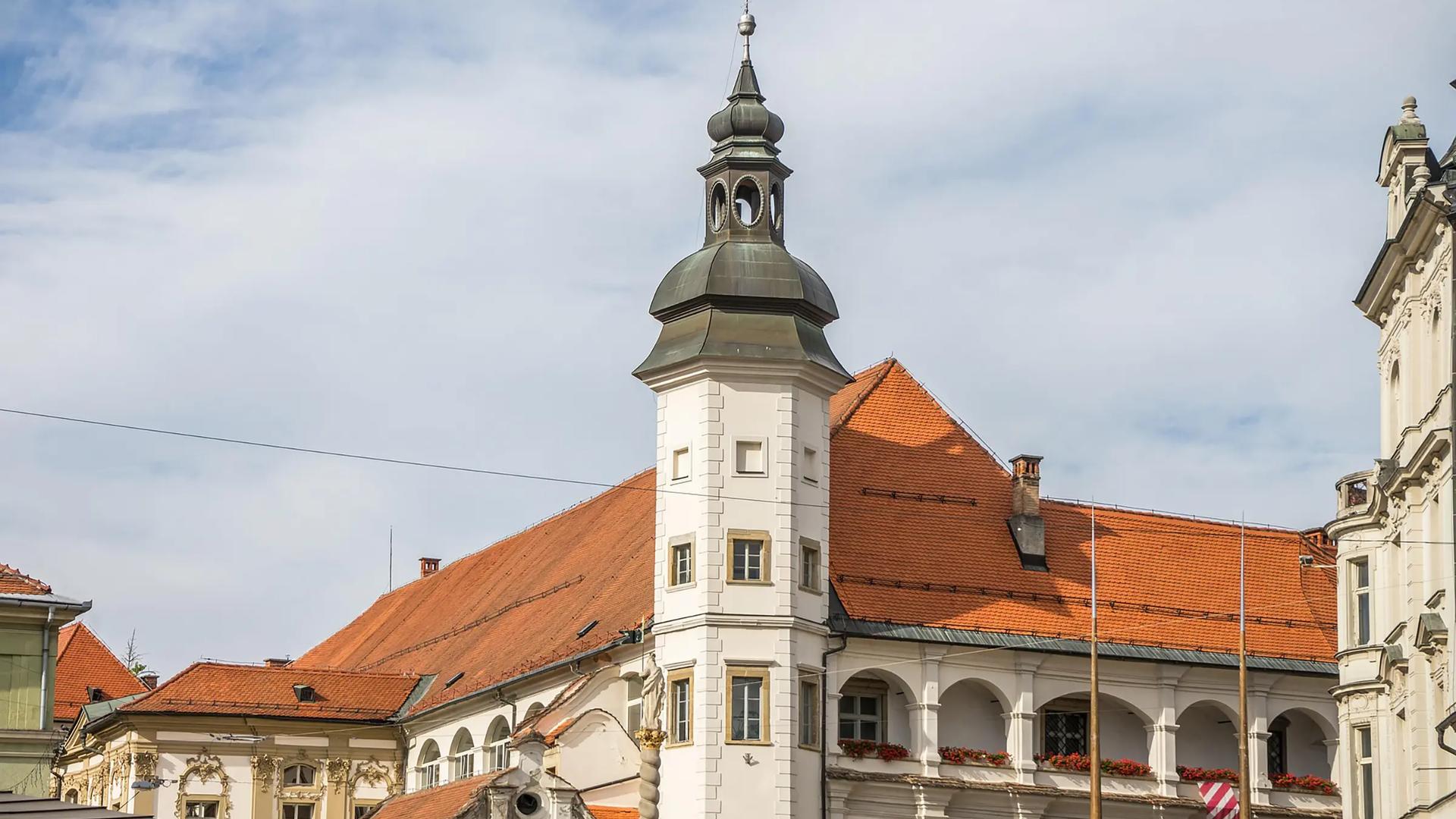
The castle complex consists of two parts: the 15th-century administrative court and the northeastern bastion built in 1555–1562 by Italian architect Domenico dell'Alio. In 1871, Grajska ulica street was cut through the complex, splitting it in half – still visible today. The facade blends baroque, Renaissance, and Gothic elements – the result of 500 years of rebuilding.
The castle's highlight is the Knights' Hall (Viteška dvorana) on the second floor. Its ceiling features stucco work by Alessandro Sereni (1680) and paintings by Laurenzo Laurigo. The central oval composition depicts a battle between Christians and Turks, painted by Josef Gebler in 1763. Franz Liszt performed here in 1874. The Loretto Chapel – a closed 17th-century chapel with frescoes and a Madonna statue – can be viewed through an interior window.
The museum's chronological exhibition starts with Neolithic and Bronze Age archaeological finds on the bastion's ground floor, moving through medieval Maribor to ethnographic collections, a reconstructed 19th-century pharmacy, and a painting gallery. The costume collection is the only one of its kind in Slovenia, featuring military uniforms including Tito's. The 18th-century Rococo staircase provides a grand exit from the castle.
Highlights
Why visit
Age – built 1478–1483 by Emperor Frederick III, remodelled in the 17th–18th centuries
Knights' Hall – 1680 baroque ceiling with Sereni stucco and Laurigo paintings; Liszt performed here in 1874
Collections – 18 museum collections, over 100,000 exhibits from the Neolithic to the 20th century
Bastion – designed by Italian architect Domenico dell'Alio (1555–1562), part of the city's defence system
Pharmacy – restored 19th-century apothecary with original equipment from Maribor and Lendava
Interactive – visitors can try on medieval armour for photos
History
Past & present
The castle was commissioned in 1478 by Holy Roman Emperor Frederick III to reinforce the northeastern corner of Maribor's city walls. Construction was completed by 1483. The bastion was added in 1555–1562, designed by Domenico dell'Alio. In 1620, the Counts Khiessl acquired the castle and converted it from a fortress into a noble residence – adding the Loretto Chapel and constructing the Knights' Hall. After 1727, the new owners, Counts Brandis, built the baroque staircase and completed the Knights' Hall decoration.
In 1871, Grajska ulica street was cut through the complex, splitting it in two. The Municipality of Maribor purchased the castle in 1933, and the Regional Museum moved in by 1938. During World War II, Adolf Hitler visited the castle while Maribor was under German occupation. A major renovation of the building and exhibitions began in 2004 and was completed by 2012, when Maribor served as European Capital of Culture.