Tickets & prices
Free access. The monument stands in the open on a public square. Available 24/7.
Orfejev spomenik
A 5-metre Roman marble stele from the 2nd century AD – Slovenia's oldest monument in situ
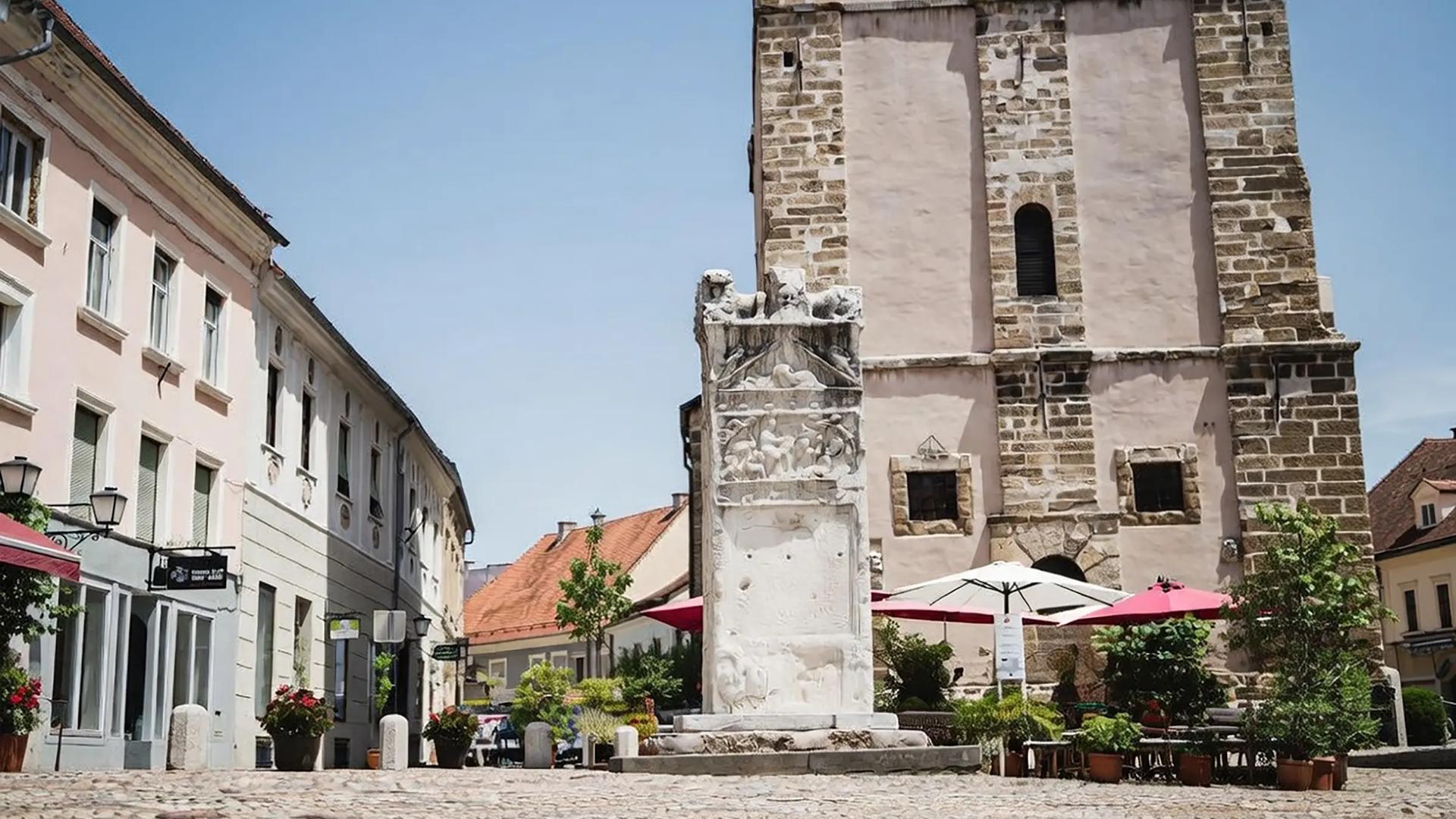
The Orpheus Monument (Orfejev spomenik) is a 2nd-century AD marble stele standing on Slovenski trg square in central Ptuj. It measures nearly 5 metres in height and 1.8 metres in width. It is the oldest public monument in Slovenia preserved in its original position and the largest discovered monument from the Roman province of Upper Pannonia. The stele was carved from white Pohorje marble as a grave marker for Marcus Valerius Verus, duumvir (mayor) of Roman Poetovio.
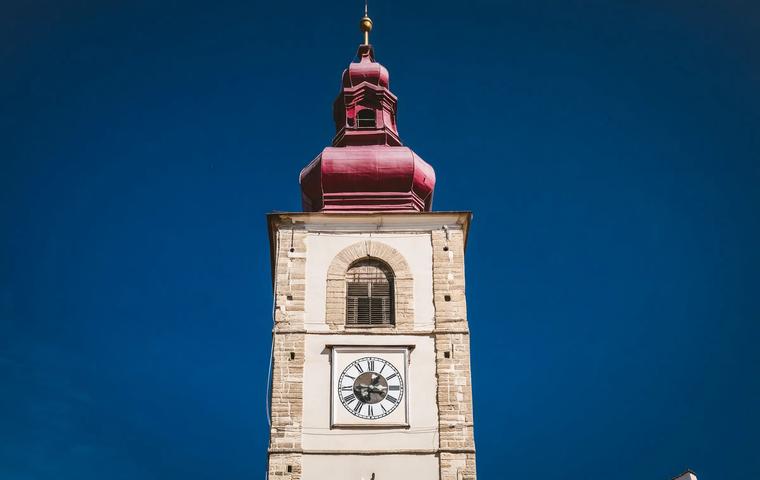
The monument stands 20 metres from the City Tower and a 10-minute walk from Ptuj Castle. Slovenski trg is a pedestrian zone lined with restaurants and cafés.
Free access, open around the clock. Allow 10–15 minutes. Nearby is the Povoden Museum – Slovenia's oldest open-air lapidary, with Roman stones built into the walls of the City Tower.
The stele is a monolith of white marble quarried in the Pohorje mountain range. The central relief depicts Orpheus playing a lyre and mourning Eurydice – hence the monument's popular name. Beneath a stone vault, wild and domestic animals gather around Orpheus, mesmerised by his music. On the right side of the base, Orpheus is shown in the underworld, playing before the gods Pluto and Proserpine, with Mercury standing behind the throne wearing a hat and holding a herald's staff. The left side depicts Heracles leading Eurydice out of the underworld.
In the Middle Ages the stele was used as a pillory: iron rings for shackling criminals were driven into the lower section, damaging part of the inscription. Holes from the iron clamps are still visible at the base. Around the stele stand several Roman altars and tombstone fragments forming the Povoden Museum (Povodňov muzej), named after curate Simon Povoden, who in 1830 had ancient finds from Ptuj and its environs built into the City Tower walls.
Despite nearly 2,000 years of exposure and medieval reuse, the reliefs are sufficiently preserved for identification of the mythological scenes. Since 2008 the monument has held the status of a national cultural monument of Slovenia.
Age – 2nd century AD, nearly 2,000 years in the same location
Dimensions – approximately 5 m tall, 1.8 m wide – the largest monument of Roman Upper Pannonia
Material – white marble from the Pohorje mountain range
Subject – reliefs depicting the Orpheus and Eurydice myth, the underworld scene, and Heracles
Medieval reuse – served as a pillory; iron clamp marks remain visible on the base
The stele was erected in the 2nd century AD as a grave marker for Marcus Valerius Verus, duumvir (head of the city council) of the Roman city of Poetovio. At its peak, Poetovio was one of the largest cities in the province of Upper Pannonia with a population of up to 40,000. Emperor Trajan granted it colony status in AD 103, naming it Colonia Ulpia Traiana Poetovio. The monument most likely stands at the site where it was originally found – and therefore in its original position.
In the Middle Ages the monument was used as a pillory (pranger): iron rings for restraining convicts were hammered into the lower part, damaging the inscription. In 1830, curate Simon Povoden arranged the open-air lapidary around the stele and the tower using ancient finds from Ptuj and its surroundings – the first of its kind in Slovenia. In March 2008 the monument was designated a national cultural monument of Slovenia.
Free access. The monument stands in the open on a public square. Available 24/7.
The monument is unenclosed. Touching the reliefs is discouraged – the marble is nearly 2,000 years old. Photography without restrictions.
On the square:
Restaurants and cafés with terraces
Tourist Information Centre (TIC) at Mestni trg 4 (50 m away)
Toilets in nearby restaurants or at the Mestni trg market
Parking: Metered spaces on the square. Free on Sundays.
Accessibility: The square is flat and fully accessible for wheelchairs and pushchairs.
Location:
Slovenski trg, 2250 Ptuj – the old town's central square, in front of the City Tower.
From Maribor (30 km, 25–40 min):
– Train (SŽ) – 35–40 min, €4–11
– Bus (Arriva) – 40 min, €3–5
– By car – 25 min
From Ljubljana (130 km, 1.5–2.5 hours):
– Train – 2 h 15 min, €12–28
– By car – approx. 1.5 hours. Road vignette required
Within Ptuj:
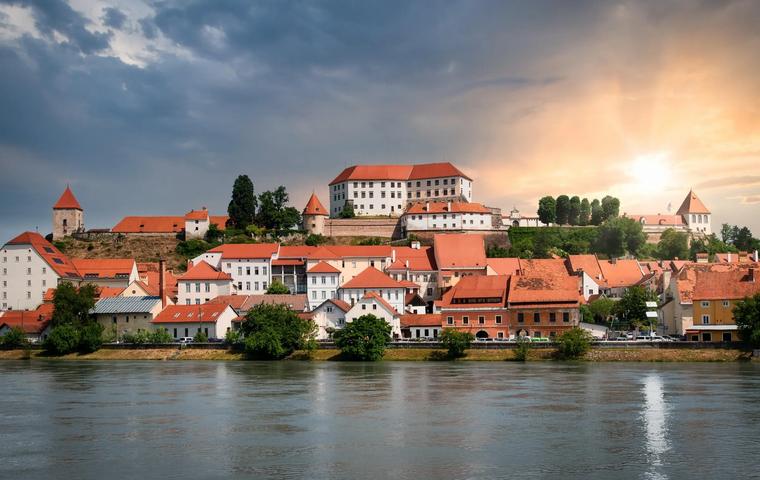
From the bus station – 10 min on foot. From Ptuj Castle – 10 min downhill.
Season: Accessible year-round in any weather.
Time of day: Mornings offer the best light on the reliefs (the monument faces south-east). Evenings are pleasant for sitting at the square's cafés.
Duration: 10–15 minutes for the monument itself. Combine with the City Tower (30–45 min) and a walk up to Ptuj Castle (1.5–2.5 hours).
Avoid: No restrictions. The square is lively in summer and quiet in winter.
Practical answers about visiting, routes and time on site.
No. The monument stands on an open square and is free to view at any time.
10–15 minutes. The reliefs are visible from 1–2 metres away. Information panels in Slovenian and English stand nearby.
The central relief shows Orpheus playing a lyre surrounded by animals. The sides depict a scene before Pluto in the underworld and Heracles rescuing Eurydice.
In the Middle Ages, the stele was used as a pillory. Iron rings for shackling criminals were hammered into the marble, damaging part of the inscription.
Slovenia's oldest open-air lapidary. Roman altars, tombstone fragments, and dedication stones are built into the walls of the City Tower. Named after curate Simon Povoden (1830).
Yes. Slovenski trg square is flat and fully accessible for wheelchairs and pushchairs.
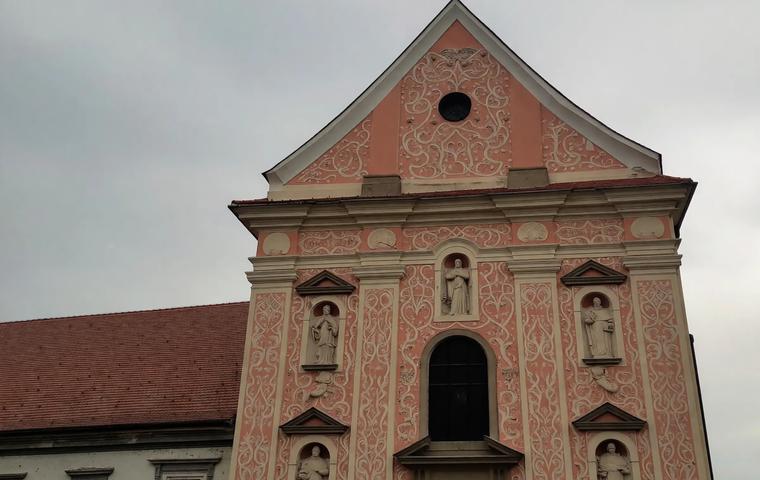
The City Tower (€7, 30–45 min) is 20 metres away. The Gothic St George's Church (13th–14th century) adjoins the tower. From the square, it's a 10-minute walk to Ptuj Castle.