Hero background

Tartini Square

Tartinijev trg

Piran's main square – a former fishing harbor turned Venetian piazza with a monument to Tartini

Tartini Square (Tartinijev trg) is the central and largest square in medieval Piran, built on the site of a former fishing harbor. The square has a distinctive elliptical shape, paved with white Istrian stone and surrounded by Venetian-style buildings. It is named after Piran-born violinist and composer Giuseppe Tartini (1692–1770), whose bronze monument stands at the center.

From Ljubljana, Piran is 130 km away – buses take 2–2.5 hours (from €12). From Portorož – 3 km along the waterfront promenade or 5 minutes by bus. Cars must be parked at the Fornače garage (€1.20/hr) or Arze (€20/day) – the old town is car-free. From the parking to the square – 10 minutes on foot or a free shuttle.

The square is open 24/7 with free access. It is a pedestrian zone with cafés, restaurants, and souvenir shops. A visit to the square itself takes 20–30 minutes; with a stroll through the surrounding streets – 1–1.5 hours.

Location

On the Map

About

What's Here

The square is an oval space measuring roughly 100×60 m, open toward the sea on the southwest side. The central feature is the bronze statue of Tartini by Venetian sculptor Antonio Dal Zotto (1896), placed on a stone pedestal at the focal point of the ellipse. The white Istrian stone paving with its elliptical pattern was designed by architect Boris Podrecca in the 1990s. In the evening, the square is softly lit, and cafés set out outdoor tables.

The northeast side is dominated by the Venetian House (Benečanka), a 15th-century palace and the square's main architectural highlight. Its red façade in Venetian Gothic style features a triple lancet window, stone rosettes, and a corner balcony with a balustrade. Between the second-floor windows is a stone relief of a lion with the inscription "Lasa pur dir" ("Let them talk"). Legend says the inscription defended the love of a local girl and a Venetian merchant from town gossip. The northwest side is formed by the neoclassical Town Hall (1877–1879, architect Giovanni Righetti), which now houses the tourist information center.

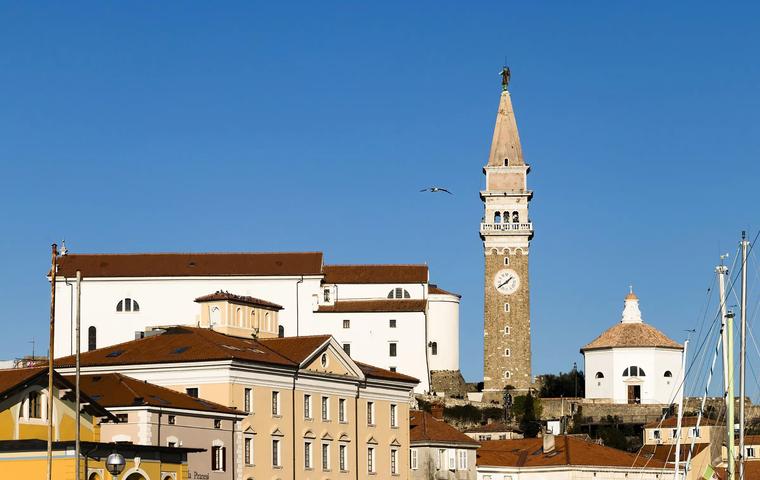
On the western edge stands the Church of St. Peter (1818). From here, a path leads uphill to the Church of St. George – a 10–15-minute walk along stone lanes. Steps from the square, you can find the Tartini House (composer's museum), the Maritime Museum in Palazzo Gabrielli, and the Piran Aquarium.

Why Visit

The Highlights

Age – the square was created in 1894 when the old fishing harbor was filled in; surrounding buildings date from the 15th century

Venetian House – a 15th-century Gothic palazzo built by the Del Bello family, the only building on the square retaining its original façade

Tartini Monument – bronze statue from 1896 by Venetian sculptor Antonio Dal Zotto

Paving – elliptical platform of white Istrian stone designed by architect Boris Podrecca (1992)

Town Hall – neoclassical building from 1877–1879, now the tourist information center

History

Past & Present

Before the late 19th century, the site of today's square was an inner harbor (mandraç) for fishing boats, located outside the first city walls. During the Middle Ages, palazzi and public buildings grew up around the harbor, making it a center of town life. However, sewage turned the bay into a health hazard, and in 1894 the authorities filled it in to create a proper square. In 1896, the Tartini monument was erected at the center.

From 1909 to 1912, a trolleybus line ran through the square, connecting Piran with the railway station in Lucija. In 1912 the trolleybus was replaced by a tram that operated until 1953 – its turning loop defined the square's elliptical shape. In 1992, for the 300th anniversary of Tartini's birth, architect Boris Podrecca led a major reconstruction: the elliptical platform was paved with white Istrian stone and the monument repositioned at the focal point of the ellipse. Since the 2000s, the square has been fully closed to cars from July 1 to September 1.

For Visitors

Visitor Information

Tickets & Prices

Free entry. The square is a public space, open 24/7.

Nearby (paid):

Tartini House Museum – €3

Piran Aquarium – check on site

Maritime Museum (Palazzo Gabrielli) – €5

Tourist information center in the Town Hall – free maps and brochures.

Rules & Restrictions

No specific restrictions. The square is pedestrianized – cars are banned from July to September. Outside these months, parking on the square is limited. Photography is unrestricted. Bicycles must be walked across the square.

On-Site Facilities

On the square:

Cafés and restaurants around the perimeter (average meal €15–25 / ~$16–27)

Tourist information center in the Town Hall

Souvenir shops, Piran salt shop

Restrooms: Public restrooms on the waterfront near the square (free).

Wi-Fi: Free city Wi-Fi on the square (WiFree Piran).

Accessibility: The square is flat with no steps. Suitable for strollers and visitors with limited mobility. The path up to St. George's Church involves stairs.

Getting There

Transport & Directions

From Ljubljana (130 km, 1.5–2.5 hours):

– Bus (Arriva/FlixBus) – from €12 (~$13), several daily departures, 2–2.5 hours

– GoOpti (shared transfer) – from €15 (~$16), 1.5 hours

Car rental – 1.5 hours via A1 motorway, eVinjeta toll sticker required (from €15/week)

From Portorož (3 km):

– On foot along the waterfront – 30–40 minutes

– City bus – €1.50 (~$1.60), 5 minutes

– Free shuttle from Fornače parking – every 15 minutes

From Koper (17 km, 20 minutes):

– Bus – €3.60 (~$3.90), every 30–60 minutes

– Taxi/Bolt – €15–20 (~$16–22)

Parking:

Fornače – €1.20/hr, 800 m from the square, free shuttle

Arze – €20/day (~$22), 500 m from center

No car access to the old town.

When to go

Best time to visit

Season: May–October – warm weather, all venues open. July–August – peak tourist season, cafés open late. Winter is quiet, some cafés closed, but a Christmas market runs in December.

Time of day: Morning (before 10:00 AM) – the square is nearly empty, soft light for photos. Evening (after 6:00 PM) – best atmosphere, building illumination, live music in summer.

Duration: 20–30 minutes for the square itself. With an old town stroll – 1.5–2 hours.

Avoid: July–August at midday – hot, little shade on the square. Tour bus groups arrive between 10:00 AM and 2:00 PM.

FAQ

Common Questions

No, the square is a public space – free and open 24/7. Paid attractions nearby include Tartini House Museum (€3 / ~$3.30) and the Maritime Museum (€5 / ~$5.50).

About 20–30 minutes for the square itself. With an old town walk, a climb to the Church of St. George, and a coffee stop – 1.5–2 hours.

Bus from Ljubljana – from €12 (~$13), 2–2.5 hours. From Koper – €3.60 (~$3.90), 20 minutes. From Portorož – walk 30 minutes along the waterfront or take a city bus (€1.50).

The old town is car-free. Use Fornače garage (€1.20/hr, free shuttle to center) or Arze (€20/day / ~$22). In summer they fill up by midday – arrive early.

Benečanka is a 15th-century Gothic palazzo with a red façade, triple lancet window, and a stone lion relief inscribed "Lasa pur dir" ("Let them talk"). It is the only building on the square with its original exterior.

Yes, several cafés and restaurants with terraces line the square. Average meal €15–25 (~$16–27). For fresh seafood, try Fritolin pri Cantini on nearby 1st May Square.

Yes. It is pedestrianized, flat, and safe. Nearby family attractions include the Piran Aquarium and the Shell Museum.

A 10-minute uphill walk leads to the Church of St. George with its bell tower and panoramic views. Further up – the Town Walls (€3). Along the waterfront – the Maritime Museum and the lighthouse at Punta cape.

Social

Share