Hero background

Church of St. George

Cerkev svetega Jurija

Piran's main 16th-century church with a San Marco bell tower replica and views of three countries

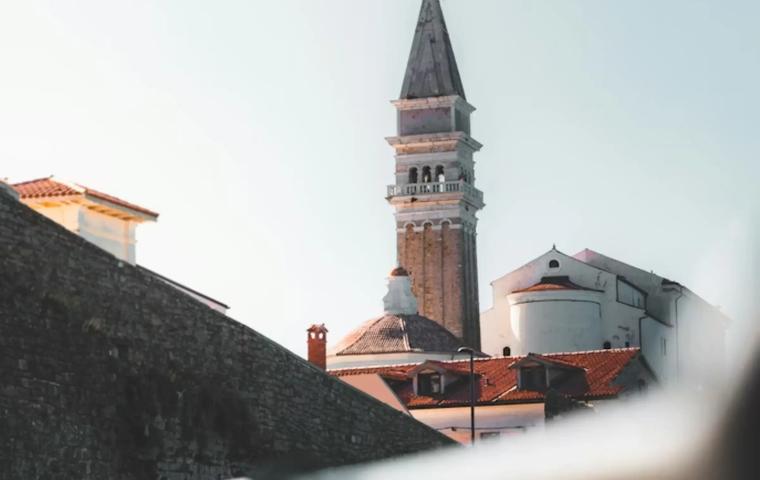
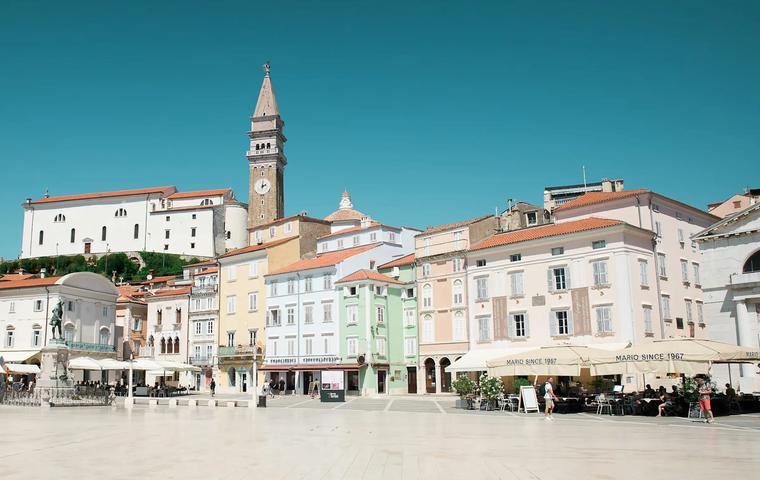
The Church of St. George (Cerkev sv. Jurija) is the largest church in Piran, perched on a hilltop above the town. Built between 1592 and 1614 in Venetian Renaissance style on the site of an earlier 12th-century church. Next to it stands a freestanding 46.5 m bell tower (1608–1615), a scaled-down replica of the San Marco Campanile in Venice.

From Tartini Square – a 10–15-minute uphill walk along cobbled paths. Two routes: via IX Korpusa Street (past the Town Walls) or through the old town's narrow lanes. The climb is moderate but involves steps.

Entry to the church is free (view through a metal grille). Full access to the interior, treasury, and crypt – via the Parish Museum (€4 / ~$4.40). Bell tower climb – €3 (~$3.30). Allow 40–60 minutes for the church and bell tower.

Location

On the Map

About

What's Here

The church sits at the hilltop and is visible from virtually every point in Piran – its massive silhouette with the bell tower dominates the tile rooftops below. The Renaissance façade (1608) follows models by Andrea Palladio. Inside – seven altars, a painted wooden ceiling, paintings from the Venetian school, and an early Gothic wooden "Crucifix of Piran" from the 14th century. The main altar (1788, Gasparo Albertini) features a painting of the Madonna with Child, Saints George, Nicholas, and Mark. Baroque marble side altars were crafted by Venetian masters including Bonfante Torre and the Gropelli brothers.

The freestanding bell tower is the main draw for visitors. 146 wooden steps along a narrow spiral staircase lead to a viewing platform at about 46 m height. At the top – four bells (the oldest from the 15th century) and a 3.6 m weathervane depicting the Archangel Michael. From the platform – a 360° panorama: Piran's tile rooftops and the Adriatic to the west, the Italian coastline toward Trieste to the north, Croatia to the south. On clear days, the Julian Alps are visible on the horizon.

In front of the church entrance is a broad lawn, once a cemetery. From here you get an open view over the Bay of Trieste, Tartini Square, and neighboring coastal settlements. Nearby – the octagonal Baptistery of St. John the Baptist (1650), which uses a 1st-century Roman tombstone as its baptismal font.

Why Visit

The Highlights

Bell tower – 46.5 m, a replica of Venice's San Marco Campanile, 146 steps to the viewing platform

Panorama – views of three countries: Slovenia, Italy (Trieste), and Croatia on clear days

Age – first church on the site dates to the 12th century; current building from 1592–1614

Interior – 7 altars, Baroque marble works by Venetian masters, painted wooden ceiling

Organ – 1746 instrument by Venetian master Petar Nakić, one of the oldest on the Adriatic

Crucifix of Piran – early 14th-century wooden sculpture, the church's most important artwork

History

Past & Present

The first church on the hill was built in the 12th century. It was rebuilt in 1344, and in 1592 construction began on the current building, designed by Venetian stonemason Bonfante Torre. Construction was completed in 1614, and the bell tower was erected in 1608–1615 as a scaled replica of Venice's San Marco Campanile. The Renaissance façade followed Palladian models. Interior furnishings, including altars and frescoes, were completed by 1637 when the church was consecrated.

During the 17th–18th centuries the church gained its Baroque character: marble altars were installed, the ceiling painted, and in 1746 organ builder Petar Nakić created the instrument. The organ was damaged in World War I but later restored. Earthquakes revealed foundation problems on the unstable hilltop – the bell tower began to lean. A major restoration from 1986 to 2005 reinforced the foundations. Archaeological excavations beneath the nave uncovered remains from the Roman period through the Gothic era. Today the church is both an active parish and one of the main cultural monuments of the Slovenian coast.

For Visitors

Visitor Information

Tickets & Prices

Church (view through grille): Free, 7:00 AM–10:00 PM.

Parish Museum of St. George (full interior access, treasury, crypt):

Adults – €4 (~$4.40)

Children – €2 (~$2.20)

Open 10:00 AM–4:00 PM, closed Tuesdays.

Bell tower:

€3 (~$3.30, as of 2025)

Open daily, hours vary by season.

Cash payment recommended – bring small bills.

Rules & Restrictions

Dress code: covered shoulders and knees to enter the church. Photography inside – no flash. Photos allowed on the bell tower. The bell tower staircase is narrow and wooden – not suitable for those with claustrophobia. Tourist access is restricted during services.

On-Site Facilities

On site:

Parish museum with treasury and archaeological excavation

Small souvenir shop at the entrance

Restrooms: None – nearest at Tartini Square (10 minutes downhill).

Accessibility: Ramps lead to the church (installed 2015). The bell tower is stairs only (146 steps, narrow passage). Not suitable for visitors with limited mobility.

Connectivity: 4G works reliably.

Getting There

Transport & Directions

From Tartini Square (on foot, 10–15 minutes):

– Via IX Korpusa Street – past the Town Walls, then down to the church

– Through old town lanes – from the Venetian House up the stone steps

From Portorož:

– Bus or walk to Piran, then walk uphill from the square

Tip: Ask your taxi or driver to drop you at the upper walls. Explore the walls, walk down to the church, then descend to the square – avoids the uphill climb.

When to go

Best time to visit

Season: April–October – comfortable weather for the climb. Winter can be windy on the bell tower.

Time of day: Morning (before 10:00 AM) – soft light on the façade, few visitors. Sunset – best light for panoramic photos from the bell tower.

Duration: 40–60 minutes (church + museum + bell tower). With the walk from the square and photos – 1.5 hours.

Avoid: Midday in summer – hot climb on an exposed hillside. Windy days – the bell tower platform is cold and uncomfortable.

FAQ

Common Questions

€3 (~$3.30). The Parish Museum with full church interior, treasury, and crypt access costs €4 (~$4.40). Viewing through the grille is free.

146 steps up a narrow wooden staircase. The climb takes 5–7 minutes. There are rest landings, but passing other climbers is tricky – the staircase is narrow.

A 360° panorama: Piran's rooftops, the Adriatic Sea, the Italian coastline toward Trieste, and Croatia's coast. On clear days, the Julian Alps are visible on the horizon.

Children manage fine – the staircase is narrow but safe. Strollers can reach the church (ramp access) but not the bell tower.

Covered shoulders and knees to enter the church interior. No restrictions for the grounds (lawn) or bell tower.

Morning before 10:00 AM – few tourists, soft light. Sunset – best photos from the bell tower. Avoid midday in summer – the hillside climb is hot with no shade.

Yes. Best route: start at the Town Walls (entrance on IX Korpusa St.), then walk down to the church and bell tower, then descend to Tartini Square. Total – 1.5–2 hours.

Not on the hill. The nearest cafés and restaurants are at Tartini Square (10 minutes downhill) or at 1st May Square.

Distance

Travel Time

On foot from Piran center 3-5 min.
From Portorož by car ~8 min.
From Postojna by car ~1 h 25 min.
From POW airport (Portorož Airport (POW)) by car ~12 min.
From LJU airport (Ljubljana Airport (LJU)) by car ~2 h 33 min.
Social

Share