Tickets & prices
Admission is free. The chapel is accessible 24 hours.
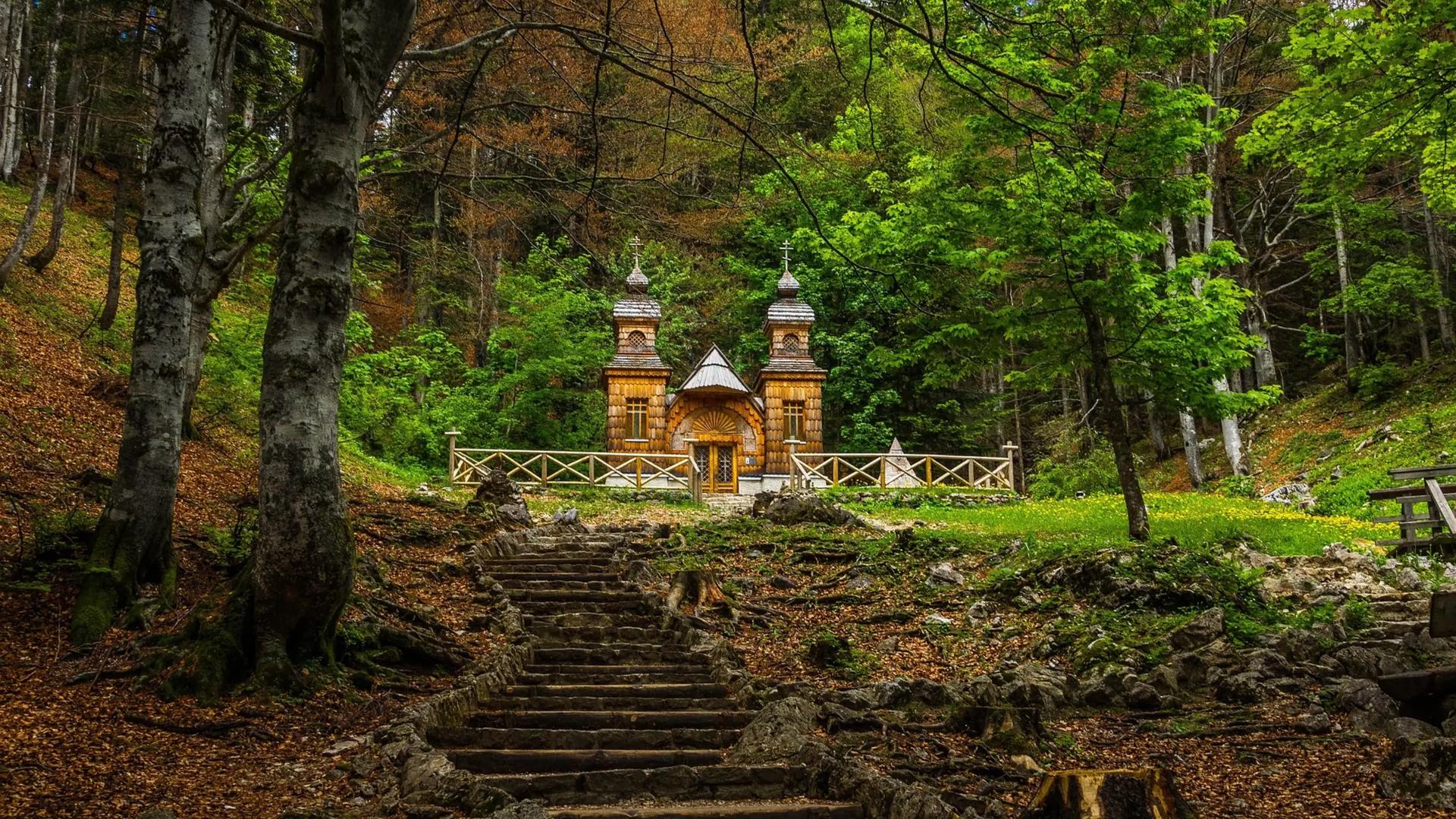
Roadside parking is free (limited to a few spaces; fills quickly in summer). From the parking area, 30 steps lead up to the chapel.
Ruska kapelica
Wooden Orthodox chapel built in 1916 – a memorial to Russian POWs who died building the pass road
The Russian Chapel (Ruska kapelica) is a small wooden Russian Orthodox chapel dedicated to Saint Vladimir, located on the northern slope of Vršič Pass in the Julian Alps. It stands at hairpin turn #8, at approximately 1,100 m elevation, 6 km from Kranjska Gora. The chapel is a memorial to Russian prisoners of war who built the road over the pass in 1915–1916 and perished from avalanches, disease, and harsh conditions.
From the roadside parking area, a short climb of about 30 steps through forest leads to the chapel. By car from Kranjska Gora, the drive takes 10–15 minutes along the Russian Road (Ruska cesta). In summer, you can walk from town – 6 km, roughly 1.5 hours along the switchbacks. The summer bus from Kranjska Gora to Vršič stops 300 m from the chapel (July–September, 2 departures daily).
Admission is free, and the chapel is accessible around the clock. A visit takes 15–20 minutes. Every year in late July or early August, a traditional memorial ceremony is held at the site, attended by Slovenian and Russian delegations.
The chapel stands in a quiet spruce forest on the mountainside, just a few dozen metres from the road. The wooden structure sits on a stone foundation in typical Russian style, with two small towers flanking the nave. Originally clad in bark, the exterior was later covered with planks. The copper roof was stolen and restored in 2010. Inside, a modest altar with an iconostasis, wrought-iron chandeliers, and candlesticks fill the small space.
To the right of the chapel, a pyramid-shaped stone memorial and ossuary bears the Cyrillic inscription "To the sons of Russia." It was built by master builder Josip Slavec in 1937–1938 and contains remains discovered during road construction between the chapel and the Koča na Gozdu hut. Beside it lies the grave of POW Peter Polowchev. Scattered along the roadside are mass graves of unknown Russian soldiers.
The site invites quiet reflection. The forest muffles sound; the only noise is wind in the spruce canopy. Information panels in several languages tell the story of the road's construction and the 1916 avalanche tragedy. An augmented reality (AR) experience is available via an app – details on the Kranjska Gora tourism website.
Year built – 1915–1916, wooden construction on a stone foundation
Dedication – Saint Vladimir; memorial to Russian POWs of World War I
Ossuary monument – stone pyramid inscribed "To the sons of Russia," 1937–1938
Location – hairpin turn #8 on Russian Road, 6 km from Kranjska Gora, ~1,100 m elevation
Restoration – 2005 (€90,000), 2010 (copper roof replaced after theft)
Annual ceremony – memorial service in late July or early August
In early 1915, Kranjska Gora became strategically important due to its proximity to the Isonzo Front. Austria-Hungary deployed over 10,000 Russian prisoners of war, captured on the Eastern Front, to build a road over Vršič Pass for supplying troops in the Soča Valley. The POW camp was located roughly midway up the slope. Local residents warned engineers to build avalanche barriers, but the warnings were ignored. In March 1916, an avalanche from the slopes of Mount Mojstrovka engulfed the camp, killing over 300 Russian prisoners and 10 guards.
By November 1916, surviving prisoners built a small wooden chapel in memory of their fallen comrades. In the years following the war, Russian émigrés in Slovenia visited the chapel on the last Sunday of every month. The tradition of memorial ceremonies continues today. The chapel was restored in 2005 (€90,000) and again in 2010 after the copper roof plates were stolen. In 2006, the road from Kranjska Gora to the summit was officially named "Russian Road" (Ruska cesta). The chapel is part of the Walk of Peace trail – an international memorial route along the former Isonzo Front.
Admission is free. The chapel is accessible 24 hours.
Roadside parking is free (limited to a few spaces; fills quickly in summer). From the parking area, 30 steps lead up to the chapel.
This is a memorial site – observe silence and show respect. Photography is permitted outside. Inside the chapel, flash is not allowed. Comfortable shoes recommended for the steps. Weather on the pass changes quickly – bring a windbreaker.
On site:
Information panels in several languages
Augmented reality (AR) option via app
No toilets, cafés, or shops at the chapel. Nearest mountain hut: Koča na Gozdu, 15-minute walk (food, toilets). Erjavčeva koča – 20 minutes away.
Connectivity: Mobile signal available but may be patchy.
Accessibility: 30 steps from the road. Not wheelchair accessible.
From Kranjska Gora (6 km):
– By car along Russian Road (Ruska cesta) – 10–15 min, at hairpin turn #8. Roadside parking
– On foot – 1.5 hours along the switchbacks (6 km, ~300 m elevation gain)
– Summer bus toward Vršič stops 300 m away (July–September, 2 departures/day)
From the summit of Vršič Pass (5.4 km):
– By car – 10 minutes downhill on the north side
– On foot – 1–1.5 hours
From Ljubljana:
– Drive to Kranjska Gora (~1 hour), then 10–15 minutes to the chapel
– Full-day guided tour – most itineraries include the chapel
Season: May–October when the Vršič road is open. In winter, access is on foot only or by snowmobile (arranged through Erjavčeva koča).
Time of day: Morning – quiet, few visitors. The chapel faces east, and morning light illuminates its wooden walls.
Duration: 15–20 minutes for the chapel and memorial. Best combined with a drive over Vršič Pass.
Annual ceremony: Late July or early August. Exact date published on the Kranjska Gora tourism website.
Practical answers about visiting, routes and time on site.
Admission is free, accessible 24 hours. Roadside parking is free but limited to a handful of spaces.
15–20 minutes for the chapel, pyramid memorial, and information panels. Most visitors stop here while driving to Vršič Pass.
The Vršič road is closed to vehicles in winter (typically November–May). You can reach the chapel on foot from Kranjska Gora (1.5 hours) or by snowmobile arranged through Erjavčeva koča.
Themed tours run in summer – check the Kranjska Gora tourist office. The chapel is part of the Walk of Peace trail, an international memorial route along the former Isonzo Front.
Yes, the climb is just 30 steps from the road. Information panels help explain the history. Note: the road is nearby – supervise children near traffic.
Koča na Gozdu mountain hut – 15-minute walk (food, accommodation). Lake Jasna – 6 km downhill toward Kranjska Gora. The summit of Vršič Pass – 5.4 km uphill (mountain huts, hiking trailheads).
Late July or early August each year. Slovenian and Russian delegations attend. The exact date is published on kranjska-gora.si. Events include music, speeches, and a service – open to the public.
For the chapel alone – regular closed shoes are fine for the 30 steps. If continuing to the pass or mountain huts, hiking boots and a windbreaker are essential.