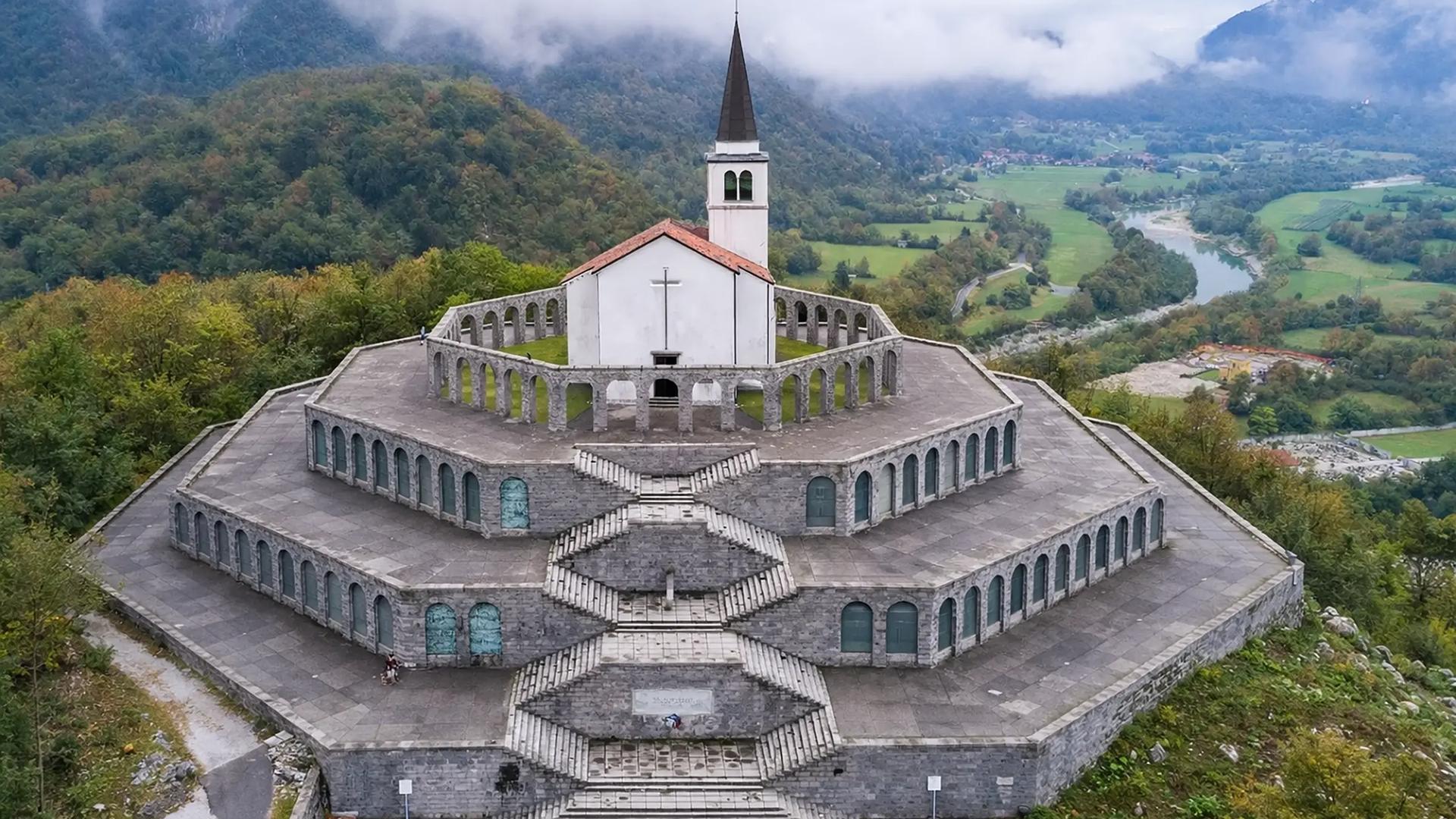
The Italian Charnel House (Sacrario Militare di Caporetto) is the largest Italian military memorial outside Italy. It stands on Gradič Hill (309 m) above the town of Kobarid in western Slovenia. It holds the remains of 7,014 Italian soldiers killed on the Isonzo Front between 1915 and 1917.
From Kobarid's centre, it's a 15–20-minute walk up a paved switchback road. You can also drive – there's a small car park at the top. The charnel house is the second stop on the Kobarid Historical Trail.
Admission is free. The grounds are accessible during daylight hours. Allow 30–45 minutes for a visit. The viewpoints offer panoramic views of the Soča valley and the Julian Alps.
Transport
Travel time
On foot from Kobarid center7–10 min.600 m
By car from Kobarid2 min.810 m
From the airport Ljubljana Airport (LJU) · LJU1 h 39 min.91 km
The road to the charnel house begins at Trg Svobode square in Kobarid. At the start of the climb, two stone pillars stand at the entrance – one bearing a cross, the other the Star of Italy. Along the switchback road, 14 sculptural Stations of the Cross by Giannino Castiglioni are placed at intervals. Each station is a stone bas-relief that can be studied on the way up.
The ossuary itself is built as three concentric octagons, narrowing upward. The lower tiers have green serpentine marble slabs set into the walls, inscribed with the names of 5,266 identified soldiers. Below each name appears the word 'Presente' ('Here') – a characteristic fascist commemorative device implying the dead remain 'on duty'. Six tombs flanking the central staircases hold the remains of 1,748 unidentified soldiers.
At the summit stands the Church of St. Anthony of Padua, consecrated in 1696 – predating the ossuary by 240 years. Inside, a fresco of the Last Judgement by local artist Luna Šarf survives. Behind the charnel house are memorials to soldiers killed in a gas attack during the 12th Battle of the Isonzo near Bovec. A former custodian's house next door hosts a private museum collection, 'Kobarid During the Great War 1917'.
Highlights
Why visit
Scale – remains of 7,014 Italian soldiers, including 1,748 unidentified, gathered from military cemeteries across the Soča valley
Architecture – three concentric octagons designed by architect Giovanni Greppi and sculptor Giannino Castiglioni
Stations of the Cross – 14 stone bas-reliefs along the switchback road to the hilltop, also by Castiglioni
Church of St. Anthony – built in 1696 atop the hill, with a surviving Last Judgement fresco
Panorama – views of the Soča valley, the town of Kobarid, and the Julian Alps from 309 m elevation
Status – the only Italian military memorial located on foreign soil and maintained by the Italian government
History
Past & present
The charnel house was built between 1936 and 1938, commissioned by Italy's Extraordinary Commissioner for the Honouring of the War Dead, Ugo Cei. Construction was carried out by Costruzioni Marchioro of Vicenza, which simultaneously worked on memorials at Redipuglia and Monte Grappa. The architect was Giovanni Greppi; the sculptor, Giannino Castiglioni. Remains were transferred from military cemeteries at Drežnica, Kamno, Bovec, Kobarid, and other Soča valley towns. The inauguration took place on 20 September 1938, officiated by Benito Mussolini.
The memorialisation of Caporetto posed a challenge for Italy: the 1917 defeat was seen as a national disgrace. Mussolini's approach to war memorials was assertive rather than mournful – they were conceived as 'watchtowers of the nation' (sentinelle della patria). After WWII, the territory passed to Yugoslavia, but Italy retained maintenance rights over the ossuary. In 1981, memorials from the Bovec military cemetery were relocated here. Since 1991, the charnel house has stood in independent Slovenia and remains the only Italian military memorial outside Italian territory.
For visitors
Visitor information
Tickets & prices
Free admission. The charnel house grounds are open during daylight hours.
- Advance booking required through the Kobarid Museum website
Private museum 'Kobarid During the Great War 1917':
- Located in the former custodian's house beside the charnel house
- Check hours and admission on-site
Rules & restrictions
The charnel house is an active military memorial maintained by the Italian state. Maintain silence and respectful behaviour. Dress modestly (no beachwear). Photography is permitted on the grounds and exteriors. Inside the church – no flash. The access road to the summit is narrow – vehicles may need to yield to oncoming traffic. There are no barriers at steep drop-offs on the grounds – supervise children closely.
On-site facilities
On-site: benches at viewpoints. No cafés, restaurants, or toilets at the charnel house. The nearest are in Kobarid centre (15–20-minute walk downhill).
Parking: small free car park at the hilltop near the charnel house (5–10 spaces). When full, park in Kobarid centre.
Accessibility: the hilltop parking area and the main ossuary structure are generally accessible for visitors with limited mobility. However, the walk up from the centre involves steep switchbacks.
Getting there
Transport & directions
On foot from Kobarid centre (15–20 minutes):
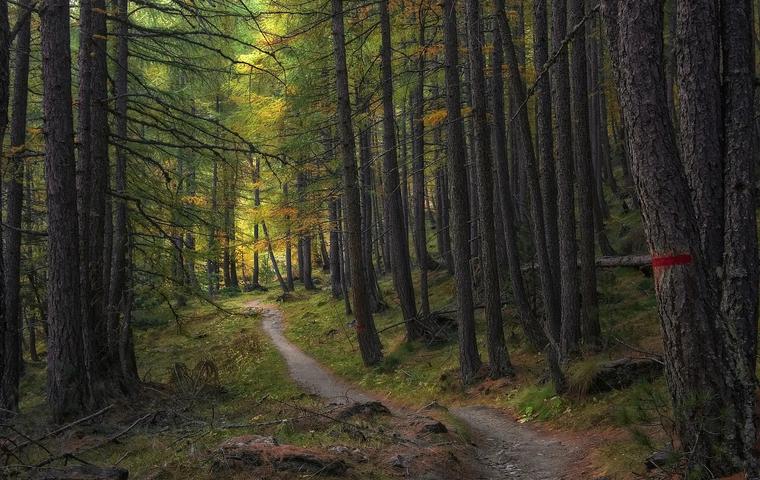
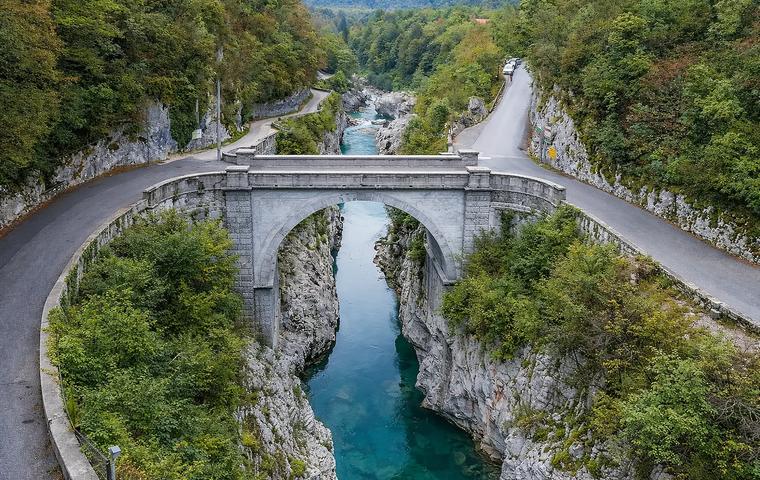
From Trg Svobode square, take Gregorčičeva ulica to the two stone pillars marked with a cross and star. Follow the road Pot na Gradič up the switchbacks past the Stations of the Cross. An alternative approach is from Napoleon Bridge via a path along the right bank of the Soča.
By car:
The road to the summit is paved but narrow – single lane with passing places. Parking at the top for 5–10 cars.
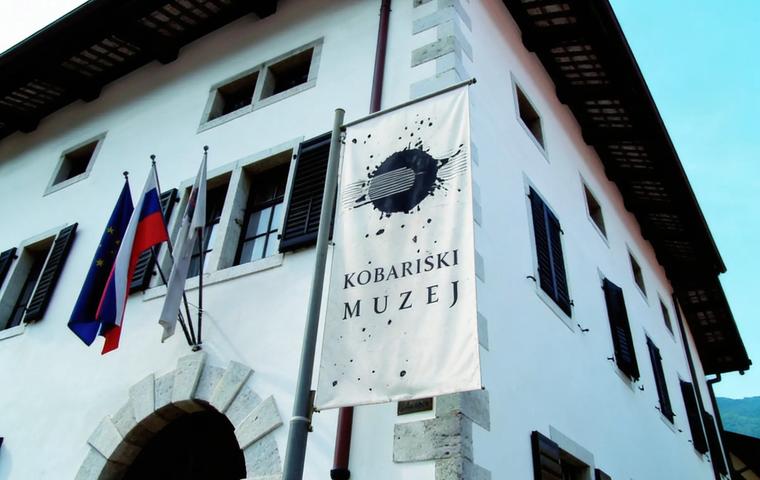
The charnel house is the second stop on the 5 km circular route. From the museum, the climb takes 15 minutes.
From Ljubljana: first reach Kobarid (105 km, 1 h 40 min by car or 3 hours by Nomago bus, €14–25 / ~$15–27 USD)
When to go
Best time to visit
Season: accessible year-round, though the road may be icy in winter. Best from May to October.
Time of day: early morning (before 9:00 AM) for panoramic photos in soft light and without crowds. Sunset light is also photogenic, but the grounds close at dusk.
Duration: 30–45 minutes for the charnel house and panorama. Combined with the Historical Trail, it's part of a 3–5-hour route.
Avoid: on hot days, the uphill walk is tiring – better to drive up or go early in the morning.
Questions & answersFAQ
Popular questions
Practical answers about visiting, routes and time on site.
Is there an entrance fee for the Italian Charnel House?+
No, admission is free. The grounds are open during daylight hours. A guided tour via the Kobarid Museum costs €40 (~$44) per group and must be booked in advance.
How do I get to the charnel house from Kobarid centre?+
On foot – a 15–20-minute walk up switchbacks from Trg Svobode square. By car – a paved but narrow road leads to a small car park (5–10 spaces) at the top.
How much time should I allow for a visit?+
30–45 minutes for the ossuary, church, and viewpoints. Including the walk up and the private museum, allow about 1.5 hours.
Is photography allowed?+
Yes, photography on the grounds and exteriors is permitted. Inside the Church of St. Anthony, use no flash. Behave respectfully throughout.
Is this suitable for children?+
Yes, but it's a memorial to fallen soldiers – give children context beforehand. Watch children near steep unguarded slopes on the grounds.
Should I visit the charnel house on its own or as part of the trail?+
Ideally, visit as part of the Kobarid Historical Trail. If short on time, a standalone visit takes 30–45 minutes (on foot or by car).
What is the private museum next to the charnel house?+
The collection 'Kobarid During the Great War 1917' is housed in the former custodian's building. It displays artefacts from the battles around Kobarid. Check hours and admission on-site.
What views can I expect from the hilltop?+
A 360° panorama of the Soča valley, the rooftops of Kobarid, the Julian Alps, and the Kolovrat ridge. One of the best viewpoints in the area.