Hero background

Batonis Tsikhe

ბატონის ციხე

17th-century royal fortress – residence of the Kakhetian kings in the heart of Telavi

Batonis Tsikhe ("the lord's fortress") is a fortified palace complex in the center of Telavi, the capital of the Kakheti wine region. Built in 1667–1675 by King Archil and expanded by King Erekle II in the late 18th century, the 3-hectare compound includes a palace, two churches, royal bathhouse ruins, defensive walls with towers, and the Telavi Historical-Ethnographic Museum.

The fortress is an easy walk from anywhere in Telavi – it sits right in the city center on King Erekle II Street. From Tbilisi: shared minibus (marshrutka) from Ortachala bus station – 15 GEL (~$5.50), 2–2.5 hours, or rent a car via the scenic Gombori Pass.

Allow 1–2 hours for the complex and museum. Entrance: 7 GEL (~$2.50). Nearby: Nadikvari Park overlooking the Alazani Valley and a 900-year-old plane tree.

Location

On the Map

About

What's Here

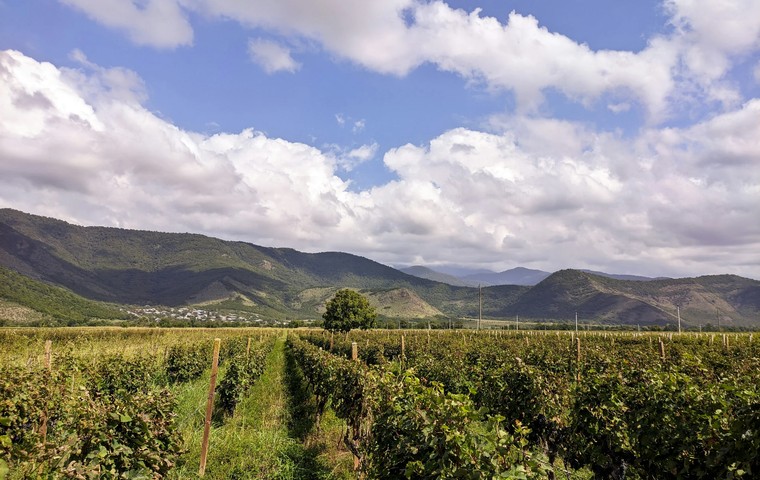
The 5-meter-high fortress wall of rough limestone encircles a rectangular compound. At the southeast corner stands a round bastion 14 meters in diameter – unique in Georgia – which held 7.5-meter cannons in the early 19th century. The western gate features ornamental red brickwork. The dark cobblestone wall with sections of red brick creates a distinctive contrast. From the ramparts, the Alazani Valley stretches north toward the snow-capped Greater Caucasus.

Inside the walls, Erekle II's palace follows Persian architectural models, inspired by the Arg of Karim Khan in Shiraz. Round corner towers, massive stone walls, and the layout speak more of Isfahan than the Caucasus – the architecture reflected Georgian kings' diplomatic balancing act between Persia and the Ottoman Empire. The palace halls now house the Telavi Historical-Ethnographic Museum (operating since 1927): Erekle II's throne and ceremonial sword, a numismatic collection, 18th-century manuscripts, and royal household items.

A separate wing holds an art gallery featuring Georgian, Italian, Russian, and Dutch masters. Look for paintings by Jemal Khutsishvili, a Telavi-born artist who captured Kakhetian daily life – grape harvests, bread-baking, village scenes. Outside the walls, a bronze statue of Erekle II with a raised hand stands beside a viewpoint overlooking the city.

Why Visit

The Highlights

Area – the fortress compound covers 3 hectares in central Telavi

Walls – 5 m limestone battlements with watchtowers and two main gates

Bastion – circular artillery platform, 14 m in diameter, unique in Georgia

Architecture – Persian-style palace modeled on the Arg of Karim Khan (Shiraz)

Museum – operating since 1927, 19,628 items: Erekle II's throne, manuscripts, coins

Restoration – major renovation in 2018, new museum building added

History

Past & Present

The fortress was built in two phases: the first in 1667–1675 under King Archil, the second in the late 18th century under Erekle II. Archil constructed the original palace and chapel; Erekle II erected the city wall around all of Telavi, built a second church (1758), expanded the palace, and added a bathhouse and underground tunnel. The complex served as the main residence of Kakhetian kings until Russia annexed the Kartli-Kakheti kingdom in 1801. In 2018, Georgia's fifth president, Salome Zourabichvili, was inaugurated here.

After the Russian annexation, the fortress was handed to the Kabarda Regiment (1802), then transferred to the Imperial treasury (1805). Russian troops used the palace as barracks until 1845. During the 1812 Kakhetian uprising, rebels besieged the fortress for 15–20 days, causing serious damage. In 1865, architect Albert Salzmann rebuilt it for St. Nino's Women's College. In 1935, the palace became the Telavi Historical Museum. The 2018 restoration returned the complex to its historical appearance and added a new exhibition building.

For Visitors

Visitor Information

Tickets & Prices

Entrance tickets:

Adults: 7 GEL (~$2.50 / €2.30)

Students: 5 GEL (~$1.80)

Children under 6: free

Guided tours:

Museum guide: 18 GEL (~$6.50)

Free admission for museum staff, ICOM members (with ID), people with disabilities, refugees. Ticket office open 10:00–18:00. The fortress grounds (courtyard, walls, churches) are free to enter during opening hours.

Rules & Restrictions

No major restrictions. Photography allowed in the museum and on the grounds. Comfortable shoes recommended for climbing the walls. Modest dress required for the churches within the compound (covered shoulders and knees).

On-Site Facilities

On site:

Toilets near the entrance (free)

Gift shop at the museum

Park with benches inside the western part of the fortress

Nearby (100–300 m):

Cafés and restaurants on King Erekle II Street

Nadikvari Park – 200 m east

900-year-old plane tree – behind the fortress

Parking: Free on the square in front of the fortress.

Accessibility: Grounds are mostly flat. Ground-floor museum is accessible. Wall walkways require stairs, not adapted.

Getting There

Transport & Directions

From Tbilisi (94 km, 1.5–2.5 hours):

– Shared minibus (marshrutka) from Ortachala / Samgori – 15 GEL (~$5.50), departs when full

– Taxi via Bolt / Maxim – 80–100 GEL (~$30–36)

Car rental – via Gombori Pass (winding scenic road) or via Gurjaani (easier route)

From Sighnaghi (55 km, 1–1.5 hours):

– Marshrutka – 5–7 GEL, several departures daily

– Taxi – 40–50 GEL (~$15–18)

Within Telavi:

The fortress is in the city center. From the bus station (bazaar) – 5 minutes uphill on foot. Address: Square 1, King Erekle II Street.

When to go

Best time to visit

Season: April–October for comfortable weather. Best period: late August–October – grape harvest season (rtveli), golden autumn in the Alazani Valley.

Time of day: Morning (10:00–12:00) – fewer visitors, soft light. Sunset – valley views from the walls.

Duration: 1–2 hours for the museum and grounds. Add Nadikvari Park and the plane tree – 2.5–3 hours total.

Avoid: Mondays – museum closed (grounds still accessible). Summer weekends (July–August) – tour groups.

FAQ

Common Questions

Adults – 7 GEL (~$2.50), students – 5 GEL. Children under 6 free. The ticket includes the museum and art gallery. The fortress grounds (courtyard, walls, churches) are free to enter.

Tuesday–Sunday, 10:00 AM – 6:00 PM. Closed on Mondays. The fortress grounds remain accessible on Mondays, but the museum is closed.

1–2 hours for the museum and fortress. Add Nadikvari Park (200 m away) and the 900-year-old plane tree behind the fortress – 2.5–3 hours total.

Shared minibus (marshrutka) from Ortachala bus station or Samgori metro – 15 GEL (~$5.50), 2–2.5 hours. Departures when full, roughly every 30–60 minutes. In Telavi, it's a 5-minute walk uphill from the bus station.

Museum guides cost 18 GEL. Tours are usually in Georgian, but English can be arranged. You can also book a guided tour in advance.

The 900-year-old plane tree – directly behind the fortress (trunk circumference 12 m). Nadikvari Park – 200 m, Alazani Valley viewpoint. Shuamta Monastery – 7 km. Alaverdi Monastery – 20 km. Chavchavadze Estate in Tsinandali – 10 km.

Yes. The grounds are spacious. The museum appeals to children aged 8+. Nadikvari Park nearby has playgrounds. Strollers work in the courtyard but not on the walls.

Cafés and restaurants on King Erekle II Street and Rustaveli Avenue – 100–300 m away. Average lunch – 20–30 GEL (~$7–11) per person. Street food at the bazaar near the bus station.

Distance

Travel Time

On foot from Telavi center 1-2 min.
From Sighnaghi by car ~1 h 15 min.
From Tbilisi by car ~1 h 26 min.
From TBS airport (Tbilisi Airport (TBS)) by car ~1 h 16 min.
From KUT airport (Kutaisi Airport (KUT)) by car ~6 h 6 min.
Social

Share