Tickets & prices
Entry fee:
– 500 ALL (~$5.50 USD / ~5 EUR)
– Student discounts – check on-site
Guided tours:
– English-speaking guides available on request
– All exhibits have English-language descriptions
– No audio guide
Muzeu Etnografik i Gjirokastrës
A museum of 19th-century traditional life housed in a 1966 building on the site of Enver Hoxha's birthplace
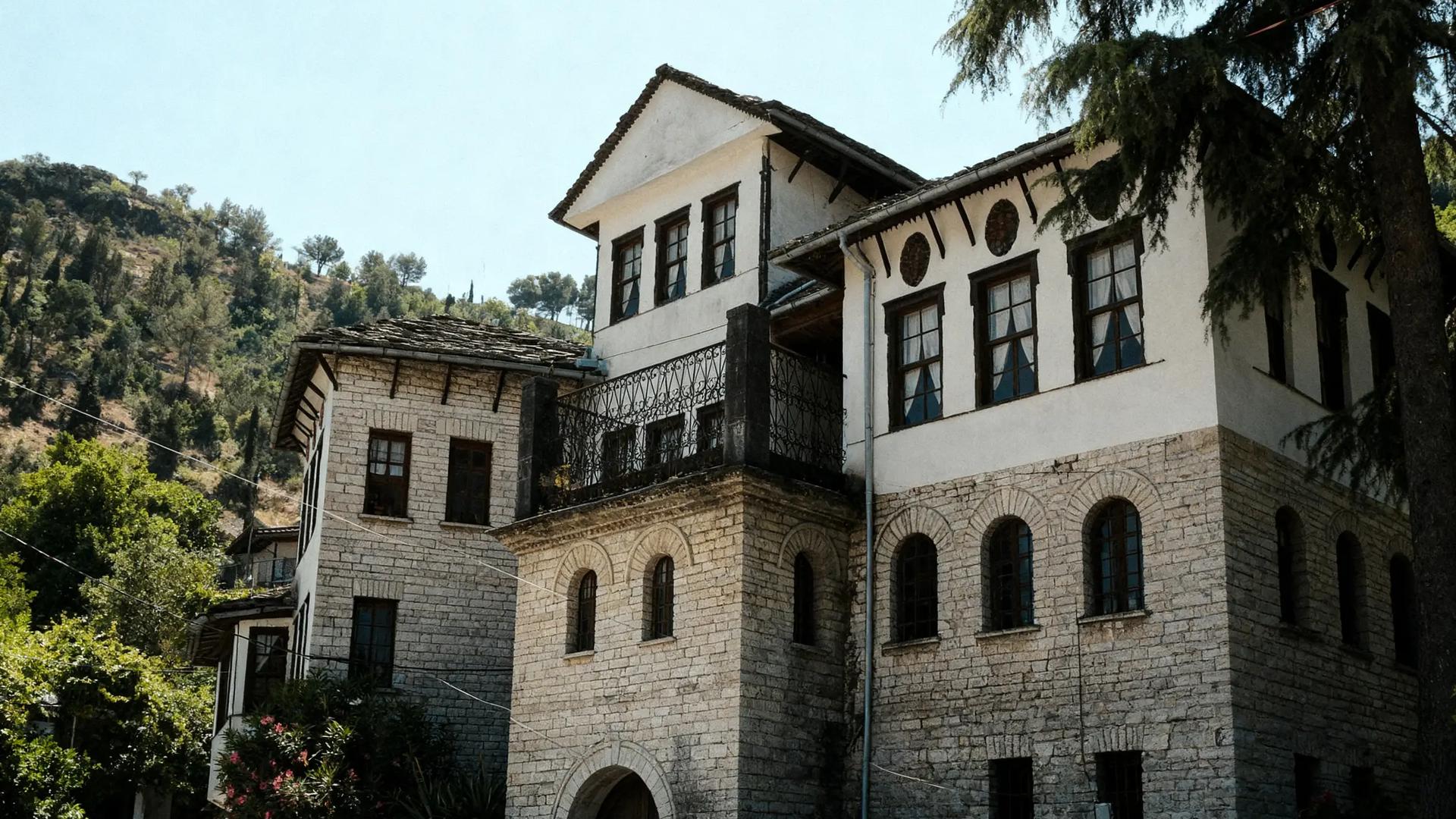
The Ethnographic Museum of Gjirokastër is located in the Palorto quarter of the old town of Gjirokastër. The building was constructed in 1964–1966 on the site of the burned-down birthplace of communist dictator Enver Hoxha. Despite this connection, nothing inside relates to Hoxha – the exhibition is entirely dedicated to the traditional domestic life of wealthy Gjirokastër families in the 19th century.
The museum is a 2-minute walk from Skenduli House and 10 minutes from the Old Bazaar. From Tirana, Gjirokastër is 227 km by bus (3.5–4 hours, 1,200 ALL / ~$13 USD).
Allow 30–45 minutes for a visit. Entry is 500 ALL (~$5.50 USD / ~5 EUR). All exhibit descriptions are in English.
The museum building is a two-story stone structure in the typical Ottoman style of Gjirokastër: symmetrical layout, carved wooden balconies, and local stonework. It's not a replica of Hoxha's house but a model home reproducing architectural elements from the city's finest 19th-century buildings. Cultural details were copied from various historic mansions across Gjirokastër.
The ground floor features stone walls that stay cool in summer and retain heat in winter. Upper floors have lower ceilings and smaller windows for temperature regulation. The top floor houses a spacious communal room – the "cameretta" – where women traditionally gathered. Rooms are furnished with authentic items: regional Albanian folk costumes, kitchenware, tools, and textiles. Each item is accompanied by an English-language description.
From 1966 to 1991, the building served as the Anti-Fascist Museum. After the fall of socialism in Albania, the exhibition was converted to ethnographic content. The museum provides a picture of what wealthy Gjirokastër interiors looked like before modernization – unlike Skenduli House, which preserves the authentic belongings of a single family, this museum presents a generalized collection representing the city's entire domestic culture.
Building – constructed 1964–1966 on the site of Enver Hoxha's birthplace, but not a replica of his house
Exhibition – recreated interiors of wealthy 19th-century Gjirokastër families with authentic objects
Folk costumes – collection of regional Albanian costumes with descriptions
Architecture – a model house incorporating elements from the city's finest Ottoman mansions
Labels – all exhibits described in English
Cameretta – traditional women's communal room on the upper floor
The original house where Enver Hoxha was born in 1908 was destroyed by fire in 1965. Between 1964 and 1966, a new building was erected on the site – not as a replica of Hoxha's home, but as a generalized model of a traditional 19th-century Gjirokastër mansion. Architectural elements and decor were copied from various historic buildings across the city. From 1966 to 1991, the building operated as the Anti-Fascist Museum, dedicated to the partisan movement.
Following the communist regime's collapse in 1991, the museum was reorganized as an ethnographic institution. All materials related to Hoxha and the partisan movement were removed. The exhibition was filled with household items, folk costumes, and domestic wares reflecting urban family life before socialist modernization. The museum operates year-round and is one of Gjirokastër's most foreigner-friendly museums thanks to its comprehensive English-language labels.
Entry fee:
– 500 ALL (~$5.50 USD / ~5 EUR)
– Student discounts – check on-site
Guided tours:
– English-speaking guides available on request
– All exhibits have English-language descriptions
– No audio guide
– Photography allowed
– Uphill walk on cobblestones to reach the museum – wear comfortable shoes
– Rooms are relatively small – can feel crowded during peak hours
– Exhibits behind glass – do not touch
– Restrooms on-site
– Nearest cafés in the Old Bazaar area (10 minutes)
– Parking: limited street parking in the Palorto quarter
– Partially accessible on the ground floor; upper floor only via stairs
From central Gjirokastër (on foot, 10–15 minutes):
– Walk uphill from the bazaar through the Palorto quarter
– The museum is next to Skenduli House
From Tirana (227 km, 3.5–4 hours):
– Bus: 11 daily departures, 1,200 ALL (~$13 USD / ~12 EUR)
– Car rental: from $22–27 USD / 20–25 EUR per day
– Taxi: ~$185 USD / ~170–180 EUR per car
From Sarandë (49 km, 1–1.5 hours):
– Bus: 500 ALL (~$5 USD)
– By car via SH8 highway
On the ground:
From Gjirokastër bus station – 20–25 minutes on foot or a taxi to the Palorto quarter for 300–500 ALL
Season: Year-round. Summer (July–August) makes the uphill walk tiring. In winter, some sources report closures on Mondays and Tuesdays (October–March).
Time of day: Morning (9:00–11:00) – fewer visitors. Museum closes around 4:00–5:00 PM.
Duration: 30–45 minutes.
Avoid: Mondays and Tuesdays in winter (confirm locally). Cruise ship group hours from Sarandë (11:00–1:00 PM).
Practical answers about visiting, routes and time on site.
No. Hoxha's original house burned down in 1965. The current building (1966) is a model Ottoman-style mansion. Nothing inside relates to Hoxha.
500 ALL (~$5.50 USD / ~5 EUR). Student discounts may be available – check on-site.
April–September: daily 9:00 AM – 5:00 PM (some sources say until 7:00 PM with a midday break). October–March: Wednesday–Sunday 9:00 AM – 4:00 PM. Confirm locally.
Yes. All exhibits have English-language labels and descriptions throughout.
30–45 minutes. The museum is compact – two floors with furnished rooms and display cases.
Yes, photography is permitted.
Skenduli House is a genuine private home with original belongings and family-led tours. The Ethnographic Museum is a reconstructed model mansion with a curated exhibition of city-wide domestic life. Both are 2 minutes apart.
Yes. Exhibits are visual – costumes, utensils, furniture. However, the display is static with no interactive elements.
Restaurants in the Old Bazaar area – 10 minutes downhill. Regional cuisine includes pita, suxhuk, and qofte.
Skenduli House – 2 minutes. Zekate House – 3 minutes. Gjirokastër Castle – 10 minutes uphill.