Ulcinj Salina
Ulcinj Salina
Former salt pans now protected wetlands and a prime birdwatching area.
About
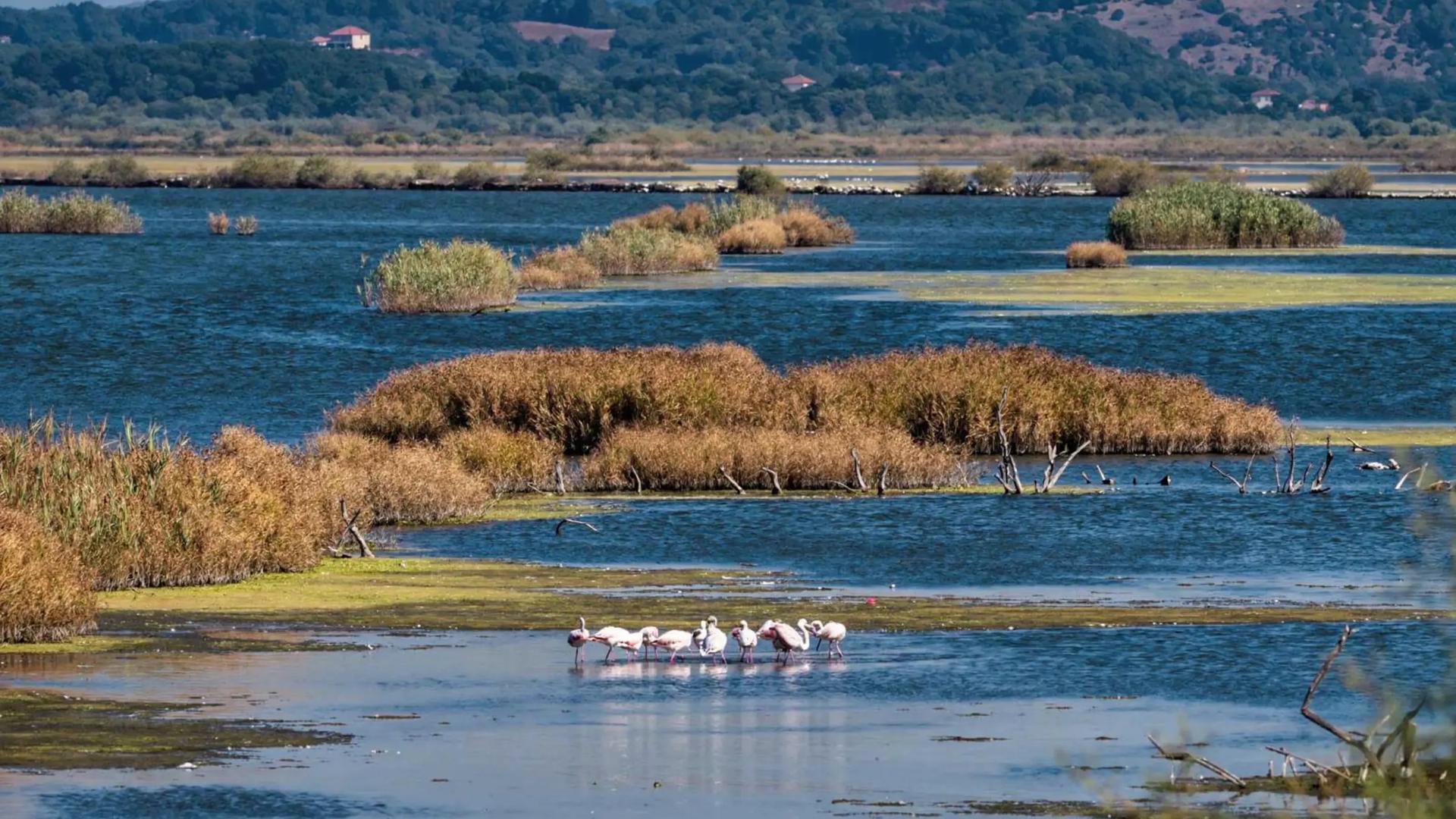
The evaporation ponds have evolved into important wetlands. Migratory flocks gather here in spring and autumn. Causeways and service tracks lead to simple viewing spots.
Transport
Travel time
On foot from Ulcinj center1 h 30 min. – 2 h 14 min.8 km
By car from Ulcinj12 min.11 km
From the airport Tivat · TIV2 h 27 min.98 km
On the map
Location
In detail
What's here
What is this place
Ulcinj Salina is a large saltpan and wetland complex on the outskirts of Ulcinj, southern Montenegro. It is one of the Adriatic’s key bird sites with diverse shallow-water habitats.
Key features
- About 250 bird species recorded – roughly 70% of Montenegro’s list and around half of Europe’s breeding species.
- Nineteen globally threatened species documented – a crucial node on the Adriatic–Balkan flyway.
- Recognized as an Important Bird Area by BirdLife International – international conservation importance.
- Regular sightings of Greater Flamingo, Dalmatian Pelican and Eurasian Spoonbill – flagship, easily observed species.
- Black-winged Stilt breeds only here in Montenegro – pairs declined from ~100 in the late 1980s to ~50 in 2017.
What to see
- Evaporation ponds, dikes and channels with extensive shallows.
- Birdwatching towers and platforms at key vantage points.
- Seasonal flocks of waders and herons, plus groups of flamingos and pelicans.
History
Developed as an industrial saltworks in the 20th century, the Salina shaped hydrology and created a mosaic of ponds ideal for birds. By the late 1980s, some breeding populations (e.g., Black-winged Stilt) numbered in the hundreds of pairs.
In subsequent decades, management changes and visitor pressure led to declines; by 2017 c. 50 pairs of Black-winged Stilt were documented. International conservation bodies designated the site an Important Bird Area, underscoring the need for careful stewardship.
Practical information
Location: eastern Ulcinj, Solanski Put area, by the old saltworks building.
Getting there: in Ulcinj, follow Solanski Put to the security gate near the former admin building; entry arranged on site.
Access: security may ask for an ID card/passport; cycling is the best way to cover the site – ask guards about bikes.
Visiting hours: from 7:00; birding possible year-round.
Visit duration: 2–4 hours for the main loop; a full day if cycling the dikes.
Best time: spring and autumn migrations; generally best in spring/autumn.
Notes: fully exposed terrain with no shade; bring water, sun protection and binoculars/scope; no shelters, toilets or shops inside; keep quiet near breeding areas.
Ulcinj Salina
Articles about this place
Nearby