Tickets & prices
Free entry. Donations welcome.
Guided tours from 50–80 GEL (~$18–30 / €17–28) per group (book through travel agencies in Tbilisi or on site).
სვეტიცხოველი
Georgia's principal 11th-century cathedral – burial site of Christ's Robe and Georgian kings
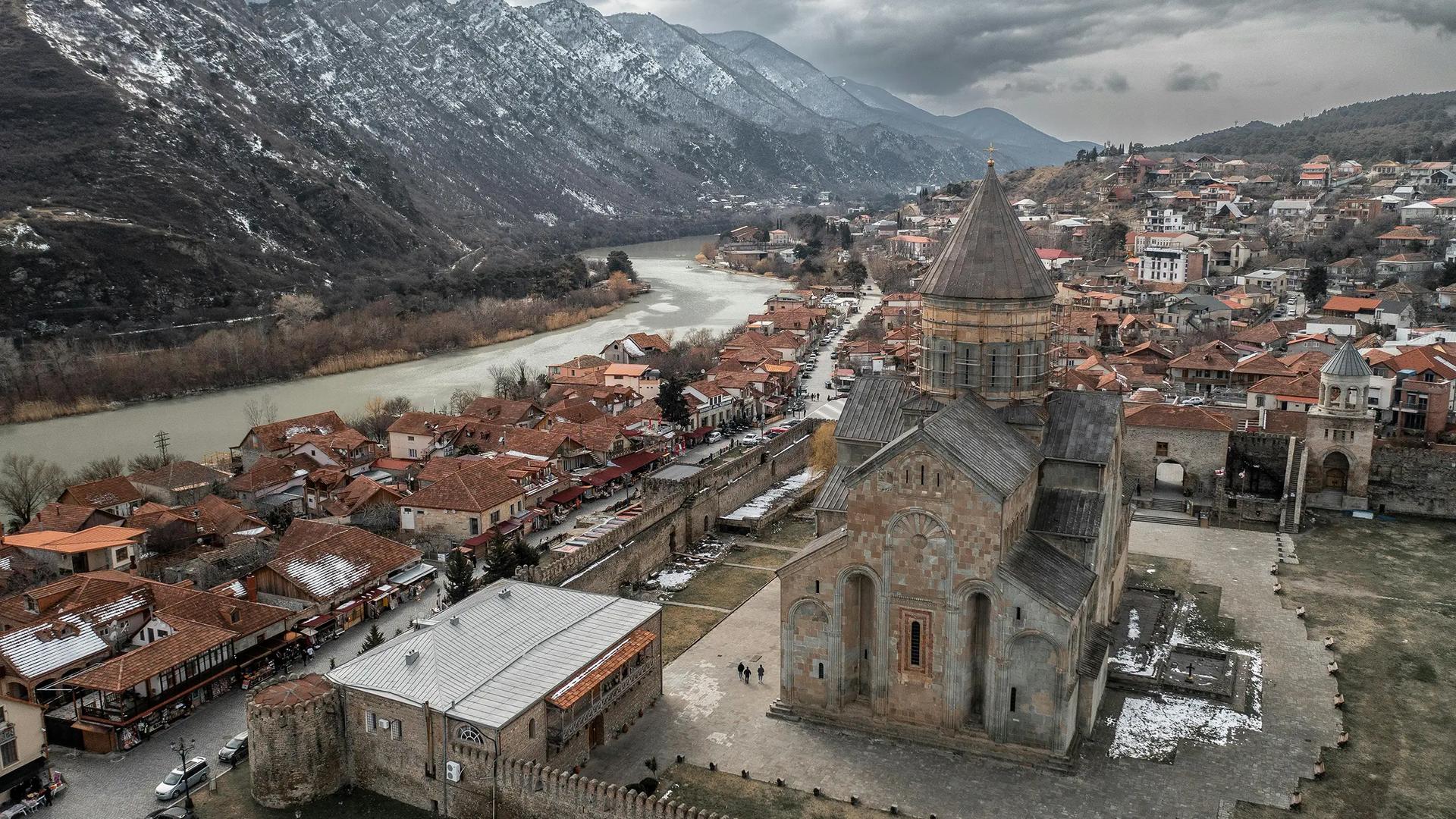
Svetitskhoveli Cathedral (სვეტიცხოველი) is the main Orthodox cathedral of Georgia, located in the centre of Mtskheta, 20 km from Tbilisi. The current building was constructed in 1010–1029 by architect Arsukidze on the site of Georgia's first church from the 4th century. A UNESCO World Heritage Site since 1994. Height under the dome is 54 m – the second largest church in Georgia after Sameba Cathedral.
Getting there is straightforward: marshrutka (shared minibus) from Didube metro station in Tbilisi – 2 GEL (~$0.75 / €0.70), 20–30 minutes. The cathedral is within walking distance of the marshrutka stop in central Mtskheta. Samtavro Monastery is 300 m away.
Free entry. Allow 30–60 minutes for a visit. Open daily during daylight hours.
The cathedral stands on flat ground in the very centre of Mtskheta – visible from nearly every point in town. The complex is enclosed by a tall 18th-century stone wall with bull heads above the entrance gates – a legacy of Mtskheta's pre-Christian, Mithraic past. The courtyard features a well-kept garden with lawns, olive trees, and rose bushes. From here, Jvari Monastery is clearly visible on the hill above.
Inside is a spacious cross-dome interior. The dome sits at the intersection of all four sides of the church. The walls were once fully covered in frescoes, but in the 1830s Russian authorities whitewashed them ahead of a planned visit by Emperor Nicholas I (who never came). After restoration, fragments from the 13th century survive – a depiction of the "Beast of the Apocalypse" and zodiac figures (the only zodiac circle in Georgian churches). Tombstones of Georgian kings from the Bagrationi dynasty are set into the floor. At the centre of the nave stands a stone canopy over the Life-Giving Pillar, beneath which Christ's Robe is said to be buried. Nearby is a small replica of the Holy Sepulchre of Jerusalem.
The western facade has the richest and best-preserved decoration: carved grapevines (a symbol of Georgian winemaking), 11th-century stone ornaments. On the exterior wall is Georgia's first sundial, shaped like a peacock. The cathedral is an active place of worship – on weekends, several weddings and baptisms often take place simultaneously.
Age – the first church on this site was built in the 4th century; the current structure dates to 1010–1029
Christ's Robe – tradition holds that Christ's garment, brought from Jerusalem in the 1st century, is buried beneath the Life-Giving Pillar
Size – 54 m under the dome, the second largest church in Georgia
Frescoes – surviving 13th-century fragments, including the only zodiac circle found in Georgian churches
Royal tombs – tombstones of Georgian kings from the Bagrationi dynasty are embedded in the floor
Architecture – cross-dome plan, carved 11th-century facade decoration, stone grapevine motifs
The first church on this site was built in the 4th century under King Mirian III after Saint Nino converted Georgia to Christianity. According to legend, in the 1st century a Georgian Jew named Elias brought Christ's Robe from Jerusalem. His sister Sidonia touched the robe and died – she was buried with the relic. A cedar tree grew over her grave, later becoming the "Life-Giving Pillar" (Svetitskhoveli translates as "life-giving pillar"). In the 5th century, King Vakhtang Gorgasali built a three-nave basilica on the site.
The present cathedral was built in 1010–1029 by architect Arsukidze, commissioned by Catholicos Melchizedek I. Over the centuries, the church was damaged by Arabs, Persians, Tamerlane, and earthquakes, but was restored each time. The dome collapsed and was rebuilt in the 15th century, then repaired again in the 17th century. In 1787, King Erekle II ordered a fortification wall built around the cathedral. In the 1830s, Russian authorities whitewashed medieval frescoes. A major restoration in 1970–71, led by Vakhtang Tsintsadze, uncovered the 5th-century basilica foundation beneath the current floor.
Free entry. Donations welcome.
Guided tours from 50–80 GEL (~$18–30 / €17–28) per group (book through travel agencies in Tbilisi or on site).
Strict dress code applies across the entire grounds, including the courtyard. Covered shoulders and knees required. Women must cover their heads (free headscarves available at the entrance). Men may not wear shorts. Photography is allowed; video without flash. Tourist access is limited during Sunday liturgy and weekday services.
The cathedral is an active church. Weddings and baptisms take place on weekends – be respectful and avoid disrupting ceremonies.
On site:
Souvenir shops at the entrance
Toilets available (basic condition)
Nearby (central Mtskheta):
Restaurants facing the cathedral (average meal 20–40 GEL / ~$7–15 / €6–14)
Wine and souvenir shops
Mtskheta Information Centre
Parking: Paid lots near the cathedral.
Connectivity: Stable 4G. Wi-Fi in some nearby restaurants.
Accessibility: Flat grounds, courtyard and church on the same level. Step-free entrance. Suitable for wheelchairs and strollers.
From Tbilisi (20 km, 20–40 min):
– Marshrutka from Didube metro station – 2 GEL (~$0.75 / €0.70), every 20–30 min (7:00–20:00). Get off in central Mtskheta – 5-minute walk to the cathedral
– Bolt taxi – 20–30 GEL (~$7–11 / €6–10)
– Car rental – parking available near the cathedral
– Train from central station – 2 GEL, 24 min, but Mtskheta railway station is 2 km from the centre
From Jvari Monastery (4 km):
– Taxi – 10–15 GEL, 10 min
Walking within Mtskheta:
From Samtavro Monastery – 300 m, 5 min. All main sites in town are within walking distance.
Season: Year-round. The cathedral is indoors, so weather is not critical. Spring (April–May) and autumn (September–October) are the most comfortable for walking around Mtskheta.
Time of day: Morning (9:00–11:00) – fewer tourists. Avoid weekends if you prefer to skip weddings and baptisms (though they can be an interesting experience).
Duration: 30–60 minutes for the cathedral. With the courtyard and souvenirs – up to 1.5 hours.
Avoid: Sunday liturgy – tourist access is limited. Summer weekends (June–August) – peak crowds.
Practical answers about visiting, routes and time on site.
Entry is free. Donations are welcome but not required.
Strict: covered shoulders and knees; women must cover their heads; men cannot wear shorts. Free headscarves at the entrance. The dress code applies across the entire grounds, not just inside the church.
Marshrutka from Didube metro station – 2 GEL (~$0.75), every 20–30 min, 20–30 min ride. Get off in central Mtskheta. The cathedral is a 5-minute walk from the stop.
Yes. Photography and video are allowed, but no flash. During services, be discreet and respectful of worshippers.
A stone canopy at the centre of the cathedral, beneath which Christ's Robe is said to be buried – a garment brought from Jerusalem in the 1st century. The frescoes on the canopy depict the legend of the pillar.
Yes. The grounds are flat with step-free entrance. The courtyard and church are on the same level. Suitable for wheelchairs and strollers.
Several restaurants face the cathedral – Georgian cuisine, average 20–40 GEL (~$7–15 / €6–14) per person. Khachapuri, khinkali, and fresh draft beer.
Samtavro Monastery – 300 m walk. Jvari Monastery – 4 km, taxi 20–25 GEL. Bebris Tsikhe fortress – 10 min walk north from Samtavro.
The best Georgia road trip depends on days available: 3 days covers the Military Highway to Kazbegi, 7 days adds Kakheti and the west, 10+ reach Svaneti. Actual 2026 prices, winter closures, and pitfalls explained.
April 24, 2026
June is Georgia's sweet spot – warm weather without peak crowds, Batumi sea reaching 23°C, and hotel prices 20–30% below midsummer peaks. Here's the honest picture.
March 20, 2026
Kazbegi, Kakheti wine country, Mtskheta, Vardzia – the day trips locals actually recommend, with honest prices, timing and pitfalls most guides skip.
April 21, 2026
A detailed comparison of Georgia and Turkey for your next vacation: flights, accommodation costs, food, beaches, mountains, culture and practical tips for 2026.
March 06, 2026
Practical first-timer's guide to Georgia: visas, budget, transport, accommodation, connectivity and hidden nuances. Everything you need before and after landing.
February 22, 2026
Georgia in May – a complete guide covering weather in Tbilisi and Batumi, sea temperature, up-to-date prices for accommodation and food, top things to do, and practical travel tips.
February 20, 2026