Tickets & prices
Free entry. Donations welcome.
Guided tours available as part of general Mtskheta tours (from 50 GEL / ~$18 / €17 per person).
სამთავროს მონასტერი
4th-century nunnery – burial site of King Mirian III who adopted Christianity for Georgia
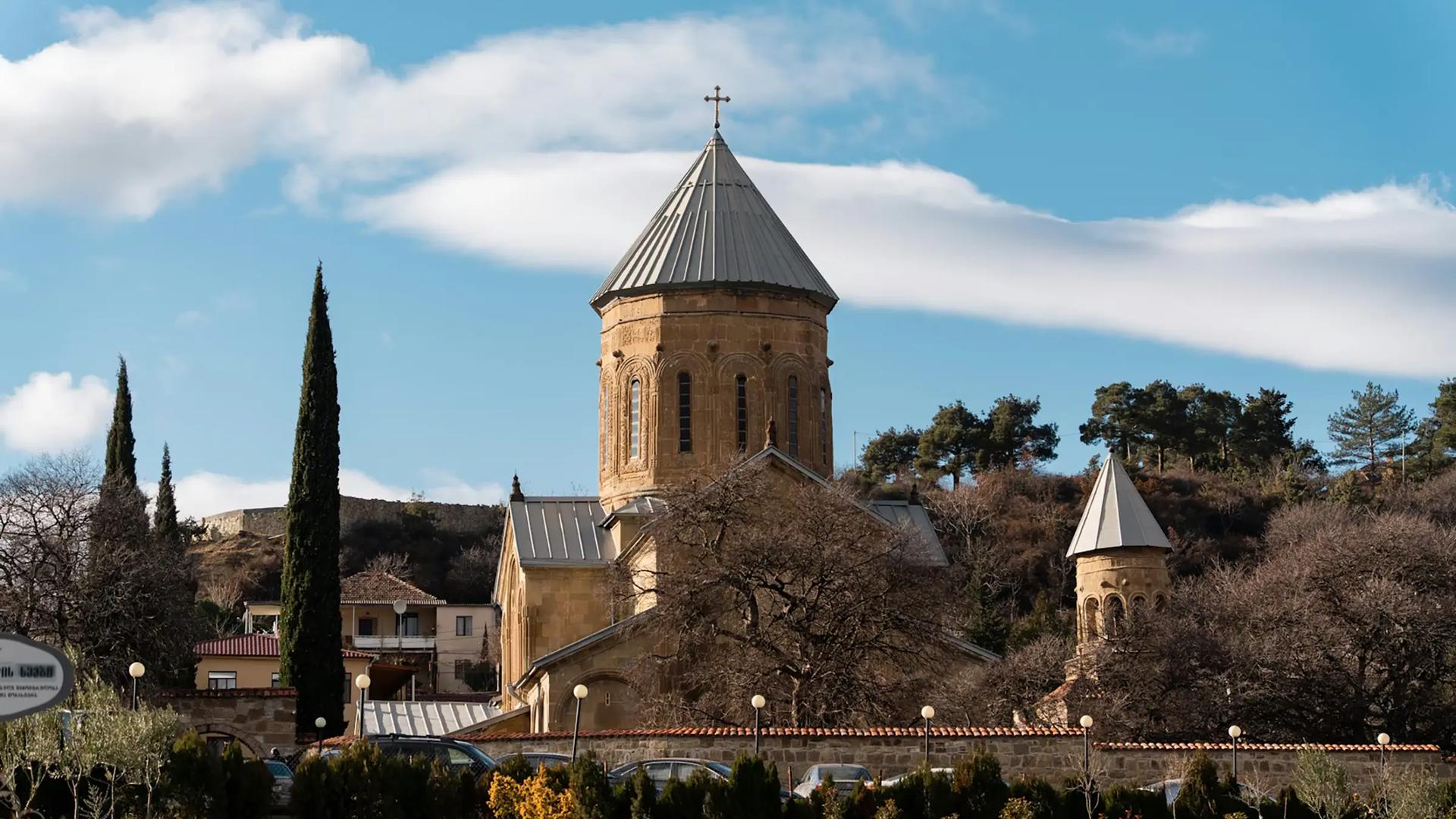
Samtavro Monastery (სამთავროს მონასტერი) is an Orthodox monastic complex in central Mtskheta, 300 m from Svetitskhoveli Cathedral. Founded in the 4th century by King Mirian III on the spot where Saint Nino – the woman who converted Georgia to Christianity – lived and prayed. A UNESCO World Heritage Site since 1994. Today it is an active nunnery with a resident community of nuns.
Samtavro is walkable from any site in central Mtskheta. From Tbilisi – marshrutka from Didube for 2 GEL (~$0.75 / €0.70), 20–30 minutes. The monastery is a 5-minute walk from the marshrutka stop.
Free entry. Allow 20–40 minutes for a visit.
Beyond the monastery gates lies a quiet, well-tended courtyard – a stark contrast to the tourist bustle around Svetitskhoveli. The nuns maintain the garden year-round: cypresses, firs, maples, rose bushes, and photinia shrubs (especially fragrant in May). Pathways are lined with roses and ornamental shrubs – the grounds feel more like a botanical garden than a monastic yard.
The main church is the 11th-century Transfiguration Church, a cross-dome structure with decorative stonework typical of Georgian architecture. The dome was destroyed by an earthquake in 1283 and rebuilt at the turn of the 13th–14th centuries. Inside are 16th–17th century frescoes (the originals did not survive), an 18th-century stone iconostasis, and numerous icons and relics. Sacred objects include Saint Nino's blackberry bush, a piece of the Life-Giving Pillar, and the miraculous Iverian Icon of the Mother of God. Set into the church floor are the tombs of King Mirian III and Queen Nana – Georgia's first Christian monarchs.
To the right of the entrance is the small Church of Saint Nino, presumably from the early medieval period, rebuilt multiple times. In the northwest corner of the wall stands a three-storey 15th–16th century bell tower: the ground floor serves as the entrance, the second was used for living and observation, and the third is an open belfry. In the courtyard is the grave of Saint Gabriel (canonised in 2012), now a pilgrimage site.
Founded – 4th century, built by King Mirian III where Saint Nino lived and prayed
Royal tombs – graves of King Mirian III and Queen Nana, Georgia's first Christian rulers
Church – 11th-century Transfiguration Church with 18th-century stone iconostasis and 16th–17th century frescoes
Relics – Saint Nino's blackberry bush, a piece of the Life-Giving Pillar, the Iverian Icon of the Mother of God
Gardens – beautifully maintained monastery grounds with cypresses, roses, and ornamental shrubs
Saint Gabriel – grave of a monk canonised in 2012, now a major pilgrimage site
The monastery was founded in the 4th century by King Mirian III. Saint Nino, who came from Cappadocia, found shelter here and lived under a blackberry bush while preaching Christianity. After Mirian and Queen Nana converted to Christianity, the monastery became the centre of the new faith. The king and queen were buried here – Samtavro became the burial vault for the church's highest hierarchs. The name translates as "ruler's place" (from Georgian mtavari – "ruler"). Generous donations made it one of the wealthiest monasteries in Georgia for centuries.
The present Transfiguration Church was built in the first half of the 11th century, likely shortly after Svetitskhoveli, under Catholicos Melchizedek I. The dome was destroyed by an earthquake in 1283 and rebuilt in the late 13th – early 14th century. The fortification wall dates to the late Middle Ages, the bell tower to the 15th–16th centuries. Original frescoes did not survive – the current ones date to the 16th–17th centuries. During the Soviet period, a group of nuns preserved the monastery by establishing textile workshops. Today Samtavro is an active nunnery.
Free entry. Donations welcome.
Guided tours available as part of general Mtskheta tours (from 50 GEL / ~$18 / €17 per person).
Dress code: covered shoulders and knees. Women should cover their heads (headscarves usually available at the entrance). Men may not wear shorts. Photography allowed in the courtyard; inside the church – no flash. Access may be limited during services.
This is an active nunnery – maintain silence and respect the nuns. Do not enter residential quarters.
On site:
Toilets available
Monastery shop with icons and candles
Nearby:
Svetitskhoveli Cathedral – 300 m
Restaurants and cafes in central Mtskheta – 5 min walk
Parking: Park at Svetitskhoveli and walk.
Connectivity: Stable 4G.
Accessibility: Relatively flat grounds. Entrance through the bell tower gate – no significant steps.
From Tbilisi (20 km, 20–40 min):
– Marshrutka from Didube metro station – 2 GEL (~$0.75 / €0.70), every 20–30 min. The marshrutka stop is close to the monastery
– Bolt taxi – 20–30 GEL (~$7–11 / €6–10)
Walking within Mtskheta:
From Svetitskhoveli Cathedral – 300 m, 5 min north along the main street. From the Tbilisi marshrutka stop – 5 min walk.
As part of a guided tour:
All standard Mtskheta tours include Samtavro alongside Svetitskhoveli and Jvari.
Season: Year-round. Spring (May) – the garden is in bloom, photinia bushes are especially fragrant. Autumn – warm leaf colours.
Time of day: Morning – quiet, minimal visitors, true monastic atmosphere. Midday (11:00–15:00 in summer) – tour group crowds.
Duration: 20–40 minutes. With the garden and small church – up to 1 hour.
Avoid: Sunday morning (services). Summer weekends – peak group tour traffic.
Practical answers about visiting, routes and time on site.
Free entry. Donations are welcome. The monastery shop sells candles and icons.
20–40 minutes. With the garden and the small Church of Saint Nino – up to 1 hour. Easily combined with Svetitskhoveli (300 m) and Jvari.
Samtavro is an active nunnery with a quiet garden and a resident community of nuns. It houses the tombs of Georgia's first Christian rulers. Svetitskhoveli is the main cathedral – larger and more crowded. They complement each other and are only 300 m apart.
Covered shoulders and knees. Women – headscarf. Men – no shorts. Headscarves are usually available at the entrance.
In the courtyard – freely. Inside the church – no flash. Be considerate towards the nuns – do not photograph them without permission.
Monk Gabriel Urgebadze (1929–1995) – one of Georgia's most revered saints, canonised in 2012. His grave in the Samtavro courtyard is a pilgrimage site.
Yes. The grounds are compact and flat with a beautiful garden. However, it is an active monastery – children should be kept quiet.
300 m north along Mtskheta's main street – 5-minute walk. Signs are posted. Both sites are in the pedestrian centre of town.