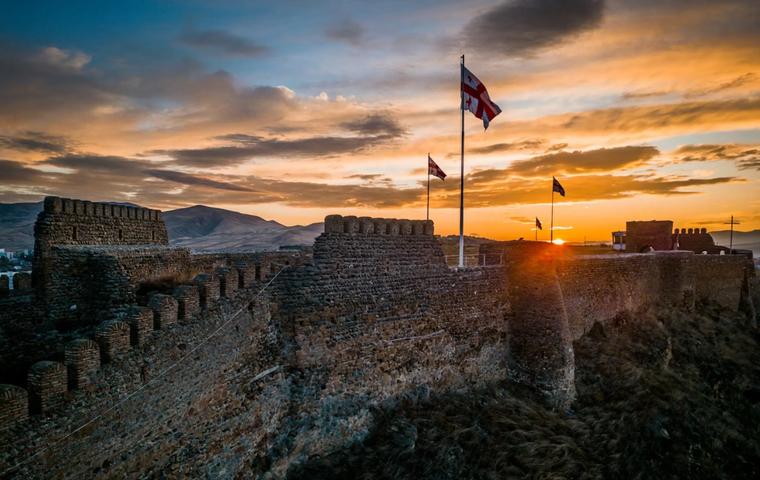
Hero background

Uplistsikhe

უფლისციხე

Rock-hewn city from the 1st millennium BC – Georgia's oldest urban settlement on the Mtkvari

Uplistsikhe (meaning "Lord's Fortress") is an ancient rock-hewn city on the left bank of the Mtkvari River, 10 km east of Gori. The earliest traces of settlement date to the late 2nd millennium BC. At its peak (6th–1st centuries BC), Uplistsikhe was one of the chief political and religious centres of pre-Christian Kartli. Across 8 hectares of rock, builders carved streets, temples, dwellings, a pharmacy, a winery, and a secret tunnel to the river.

From Tbilisi – 80 km (1–1.5 hours by car). From Gori – 15 km, taxi 30–35 GEL (~$11–13). Shared minibuses from Gori run to Kvakhvreli village (1 GEL), then 2 km on foot.

Admission – 15 GEL (~$5.50). Allow 1.5–2.5 hours. The site is fully exposed – bring water and a hat in summer.

Location

On the Map

About

What's Here

The complex occupies a rocky plateau above the Mtkvari River. From the car park to the entrance is a 5-minute walk. The old main entrance leads up a stone path through a gate with a tower. Inside, there are three zones: lower, central (the main area), and upper, connected by narrow rock-cut passages and stone stairways.

The central street passes the main structures. To the right – the "Theatre" (probably a 1st–2nd century AD temple) with a pointed arch carved in the rock. Further left – the pre-Christian Temple of Makvliani with an inner recess behind an arched portico. Higher up – Tamaris Darbazi (Hall of Queen Tamar), the largest and most elaborately decorated cave with a coffered ceiling imitating wooden beams, all carved from rock. Two stone pillars are cut from the cliff; behind them, a stone bench. At the hilltop – Prince's Church (10th century), the only above-ground building among the rock caves.

From the highest point – a panorama of the Mtkvari valley with green fields and mountains. In the southern section – a secret tunnel carved through rock all the way to the river (emergency exit and water supply). The tunnel entrance is behind a reconstructed wall near the old gate. At the exit – a winery offering tastings of local wines (included in the 20 GEL ticket).

Why Visit

The Highlights

Age – earliest settlement traces from the late 2nd millennium BC; stone structures from the 1st millennium BC

Area – 8 hectares total, 5 excavated and open to visitors, approximately 150 surviving caves

Hall of Queen Tamar – the largest cave, with a coffered ceiling imitating wooden beams, entirely carved from rock

Secret tunnel – an underground passage from the upper city to the Mtkvari River, cut through solid rock

Population – at its medieval peak, the city housed up to 20,000 residents across some 700 caves

Architectural style – a unique blend of Anatolian, Iranian, and Georgian rock-cut traditions

History

Past & Present

Uplistsikhe emerged as a fortified settlement at the end of the 2nd millennium BC. Between the 6th and 1st centuries BC, it grew into a major political and religious centre of the pre-Christian Kingdom of Kartli, housing temples to the sun goddess. With the adoption of Christianity in the 4th century, the city began losing ground to new centres – Mtskheta and later Tbilisi. Life continued, however: the first Christian basilica was built in the 6th century.

After the Arab capture of Tbilisi in 645 AD, Uplistsikhe became the residence of Christian Kartli kings and an important trading post on the caravan route from Asia to Europe. Its population reached 20,000. After David the Builder recaptured Tbilisi in 1122, the city began to empty. The Mongol invasions of the 13th century destroyed Uplistsikhe completely. By the 19th century, the city was entirely buried under sand. Excavations began in 1957.

For Visitors

Visitor Information

Tickets & Prices

Admission:

Adults – 15 GEL (~$5.50)

Schoolchildren and students – 1 GEL

Children under 6 – free

Services:

Guide – 45 GEL (~$17) per group

Audio guide – 15 GEL (~$5.50)

Ticket with wine tasting – 20 GEL (~$7.50)

Winter prices may be reduced (7 GEL for adults). Check at the ticket counter.

Rules & Restrictions

Sturdy shoes with non-slip soles are essential – surfaces are uneven, rocky, with steep staircases in places. To enter the church at the top: men should wear long trousers, women should cover shoulders and knees (shawls available at the entrance). Photography allowed. The site has no barriers at cliff edges – supervise children closely. Not suitable for wheelchairs or visitors with serious mobility limitations.

On-Site Facilities

On site:

Cafe at the entrance (light meals, drinks)

Winery with tastings at the exit

Toilets at the car park

Small museum and souvenir shop

Parking: Free lot at the entrance.

Connectivity: 4G coverage available.

Accessibility: Walking only. Uphill climbs, steep steps, uneven stone surfaces. Not suitable for visitors with limited mobility.

Getting There

Transport & Directions

From Gori (15 km, 20 minutes):

– Taxi – 30–35 GEL (~$11–13) return with 1.5 hours waiting

– Minibus to Kvakhvreli – 1–2 GEL, then 2 km walk to the entrance

From Tbilisi (80 km, 1–1.5 hours):

– Shared minibus (marshrutka) from Didube to Gori – 5–7 GEL (~$2), then taxi from Gori

– Bolt taxi direct – 70–90 GEL (~$26–33)

– Day tour from Tbilisi (Mtskheta + Gori + Uplistsikhe) – from 80–120 GEL

Car rental – free parking at the entrance

On site:

From the car park to the entrance – 5 minutes' walk. Inside the complex – walking routes along stone paths and stairways.

When to go

Best time to visit

Season: April–June and September–October for comfortable temperatures. Spring brings wildflowers around the site. Winter is cold and windy but crowd-free.

Time of day: Morning (arrive at 10:00 opening) or late afternoon (after 15:00) – fewer tour groups and softer light. Midday in summer is very hot – virtually no shade.

Duration: 1.5–2.5 hours for a thorough visit.

Avoid: Summer midday (11:00–15:00) – open site with no shade, temperatures up to 40°C (104°F). In rain, stone surfaces are slippery.

FAQ

Common Questions

15 GEL (~$5.50) for adults, 1 GEL for students and schoolchildren. Children under 6 – free. Ticket with wine tasting – 20 GEL (~$7.50).

Open daily. Summer (16 April – 30 September): 10:00–19:00. Shoulder season (15 March – 15 April, 1 October – 1 November): 10:00–18:00. Winter (2 November – 14 March): 10:00–17:00.

Shared minibus from Didube (Tbilisi) to Gori – 5–7 GEL (~$2). From Gori, taxi to Uplistsikhe – 30–35 GEL (~$11–13) return with waiting. Or minibus to Kvakhvreli (1–2 GEL) + 2 km walk. The easiest option is a day tour from Tbilisi.

Yes. Non-slip, sturdy shoes are essential – surfaces are rocky, uneven, with steep steps in places. In summer, also bring sun protection: a hat and water.

Active children aged 6–7+ will enjoy the caves and tunnels. Surfaces are uneven and cliff edges have no barriers – constant supervision is essential. Not stroller-accessible.

Recommended. On-site information signs are minimal. A guide costs 45 GEL (~$17) per group, audio guide – 15 GEL. Without explanations, many caves look similar.

Yes, at the exit there's a small winery. A tasting of 3 wines, 2 chachas, and snacks is included in the 20 GEL ticket (~$7.50). They also serve wine ice cream.

Gori Fortress and the Stalin Museum – 15 km away in Gori itself. All three sites fit comfortably in one day. On the way back, stop at Mtskheta (55 km) – a convenient route when returning to Tbilisi.

Travel insurance has been mandatory for entering Georgia since 2026 (minimum coverage 30,000 GEL). At Uplistsikhe, surfaces are uneven with steep climbs – coverage that includes injuries is recommended.

Distance

Travel Time

From Gori by taxi or transfer ~13 min.
From Mtskheta by car ~1 h 6 min.
From Borjomi by car ~1 h 26 min.
From TBS airport (Tbilisi Airport (TBS)) by car ~1 h 44 min.
From KUT airport (Kutaisi Airport (KUT)) by car ~3 h 33 min.
Social

Share