In detail
What's here
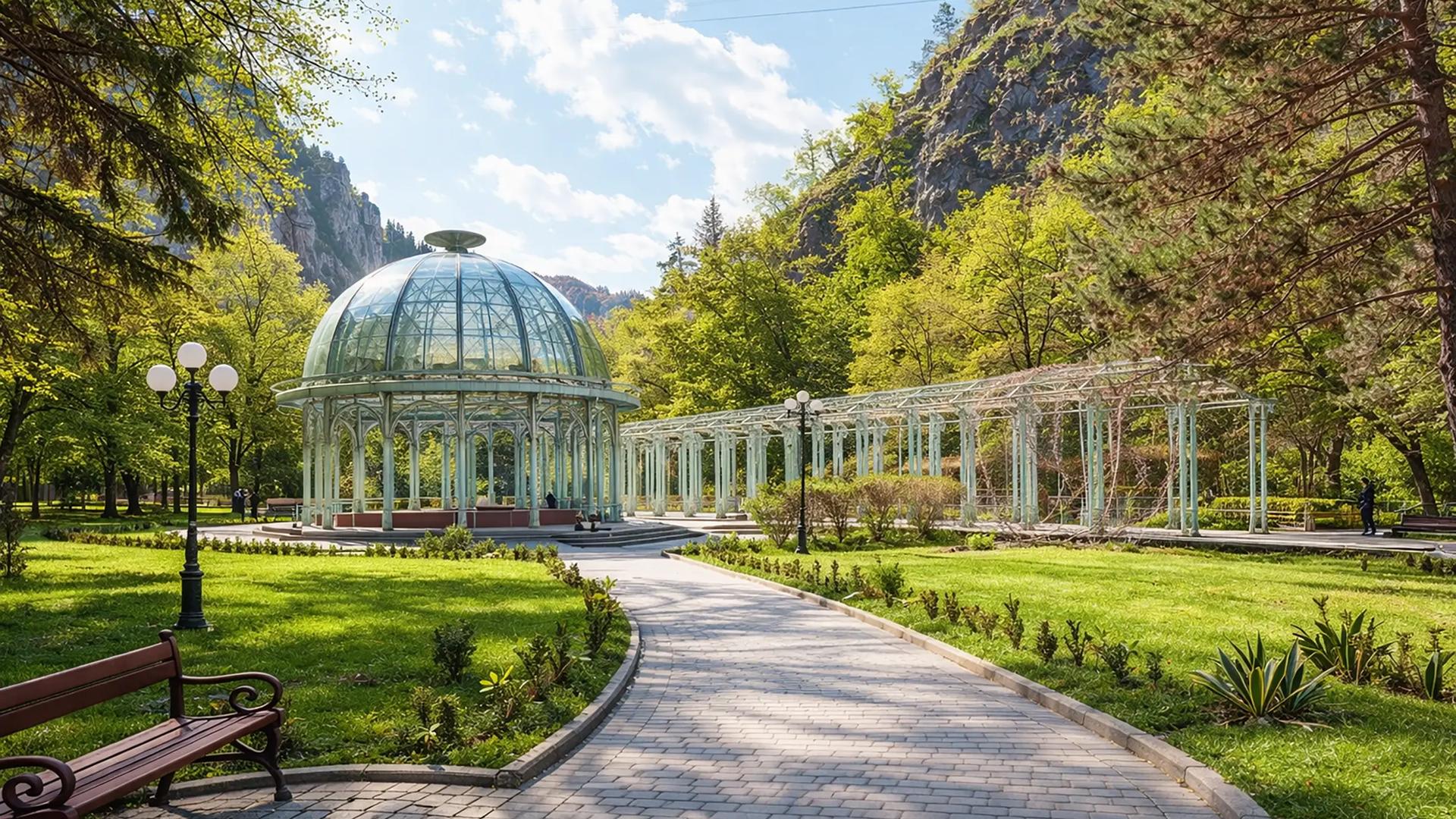
The park entrance is on 9 April Street – Borjomi's main tourist promenade. Just past the gate stands a domed glass pavilion with taps dispensing warm mineral water that rises from 8–10 km underground, pushed up by natural carbon dioxide pressure and containing over 60 minerals. The water has a distinctive salty-sulfuric taste. Nearby: ice cream kiosks, souvenir shops, and sand-brewed coffee stalls.
A 3 km tree-lined path leads deeper into the gorge along the river. Along the way: a Ferris wheel, rope adventure course, zipline, and children's rides. At the end of the path – a waterfall and a Prometheus statue framed by two cascades plunging from the cliff walls on either side. Another 2 km upstream – open-air sulfur pools with water at 27–38°C (entry 5 GEL).
To the right of the entrance is the cable car station. A single open-air cabin (no glass walls, wooden benches) ascends to a mountain plateau at 1,000 m in about 5 minutes. From the top – panoramic views over the gorge, the town, and surrounding pine forests. The upper station has a café and viewing platform.
Highlights
Why visit
Ekaterina Spring – mineral water from a 8–10 km deep borehole, +38°C at the surface, free to taste and fill bottles
Cable car – 15 GEL (~$6) one way, 5-minute ride to a plateau at 1,000 m elevation
Sulfur pools – 3 pools (1 children's, 2 adult), water 27–38°C, entry 5 GEL (~$2)
Prometheus sculpture – monument between two waterfalls at the gorge's end, 3 km from the entrance
Activities – Ferris wheel, zipline, rope course, playgrounds
History – park established in 1850 as a retreat for Russian aristocracy
History
Past & present
The healing properties of Borjomi water were discovered by chance in the early 19th century. In 1850, the Caucasus viceroy Count Vorontsov established a spa park around the spring. By the late 1800s, Borjomi had become a fashionable resort for Russian aristocracy and the imperial family. The Romanov Palace was built nearby in the 1890s, and in 1898, the first hydroelectric power plant in the Russian Empire was constructed in Likani to supply the palace with electricity.
During the Soviet era, the park became a public health resort, and Borjomi grew into one of the USSR's main balneological centers with state-funded sanatoriums. After the Soviet collapse, infrastructure deteriorated. Major renovations in the 2000s–2010s restored pathways, added amusement rides, and rebuilt the cable car. Borjomi mineral water production remains one of Georgia's most recognizable export brands.
Getting there
Transport & directions
From Tbilisi (160 km, 2–2.5 hours):
– Shared minibus (marshrutka) from Didube station – 10 GEL (~$4), every 30–60 min (8:00–18:00)
– Train from Central Station – 8–15 GEL (~$3–6), 4 hours, 2 departures daily. Get off at Borjomi-Park station
– Bolt taxi – 150–200 GEL (~$55–75)
– Car rental – via S1 highway, ~2 hours
From Bakuriani (30 km, 40 minutes):
– Taxi – 20–25 GEL (~$8–10)
– The narrow-gauge "Kukushka" railway is closed (since 2020)
In town:
From Borjomi bus station to the park entrance – 15–20 min walk along 9 April Street. From Borjomi-Park train station – 10 min walk.