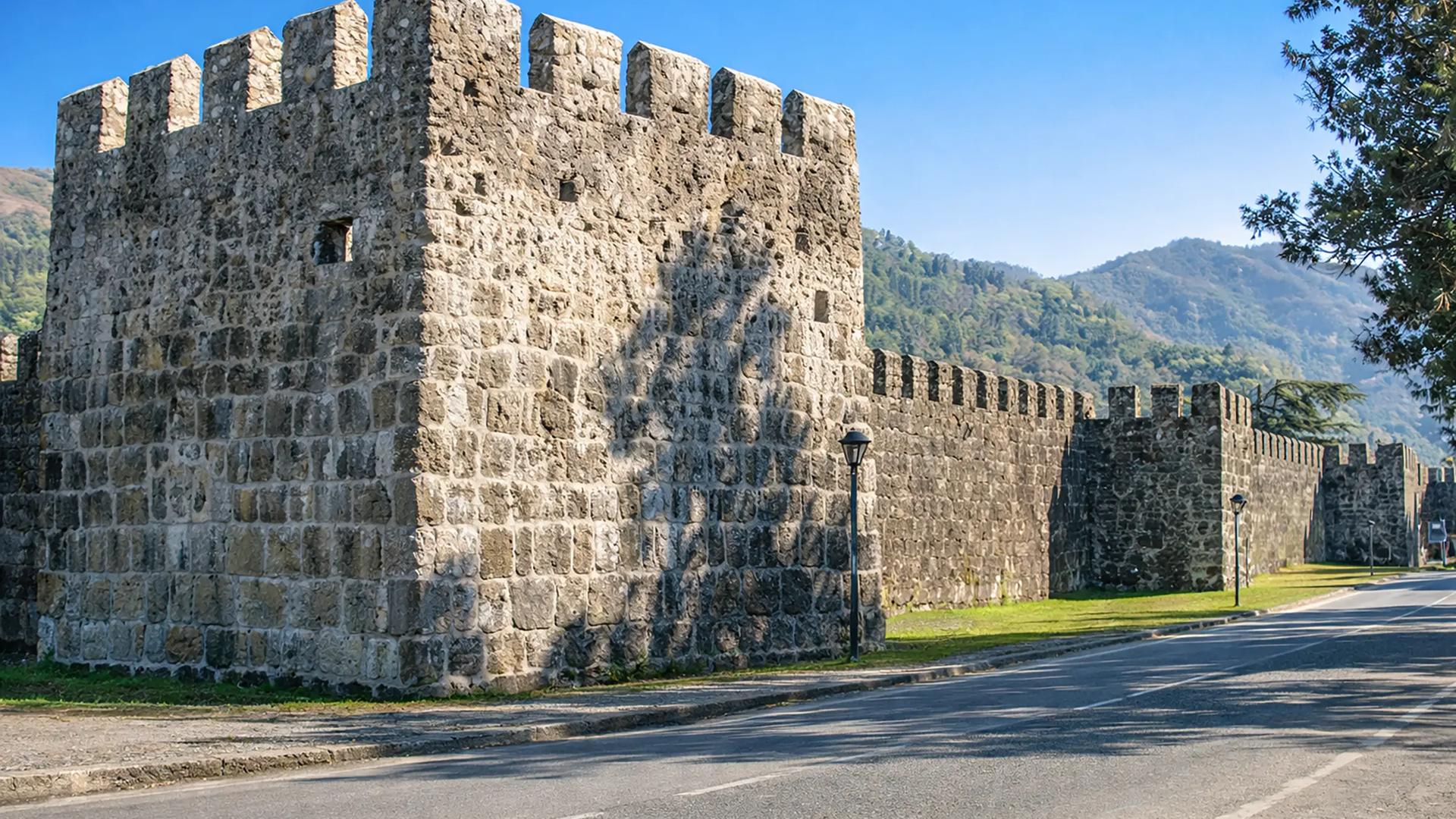
The fortress forms a rectangle of 222 by 195 meters, enclosed by massive stone walls up to 5 meters high. Eighteen towers rise up to 7 meters along the perimeter – originally there were 22. The masonry reveals three historical layers: Roman foundations from the 3rd–4th centuries, Byzantine rebuilding from the 6th–7th centuries, and Ottoman modifications from the 16th century. Inside the walls, foundations of barracks, two Roman bathhouses of different scales, a praetorium, and remnants of water supply and sewage systems are visible.
The interior is an open excavation site where archaeological work continues. At the center stands a symbolic tomb of the Apostle Matthias – church tradition places his burial here, though no archaeological evidence confirms this. Near the south gate, a small museum displays artifacts: ceramics, coins, and bronze items from various periods. The main find – the "Gonio Treasure" (gold jewelry from the 1st–3rd centuries) – is kept at the Adjara State Museum in Batumi.
The fortress walls offer views of the surrounding mountains, the Chorokhi River mouth, and the Black Sea coastline. The grounds are well-maintained with paved paths and information boards in Georgian, Russian, and English. In summer, themed events such as the Roman Festival with historical reenactments take place here.