Tickets & prices
Free entry. Active mosque – visits permitted outside prayer times.
Xhamia e Muradies
A 16th-century mosque attributed to architect Mimar Sinan – a Cultural Monument of Albania
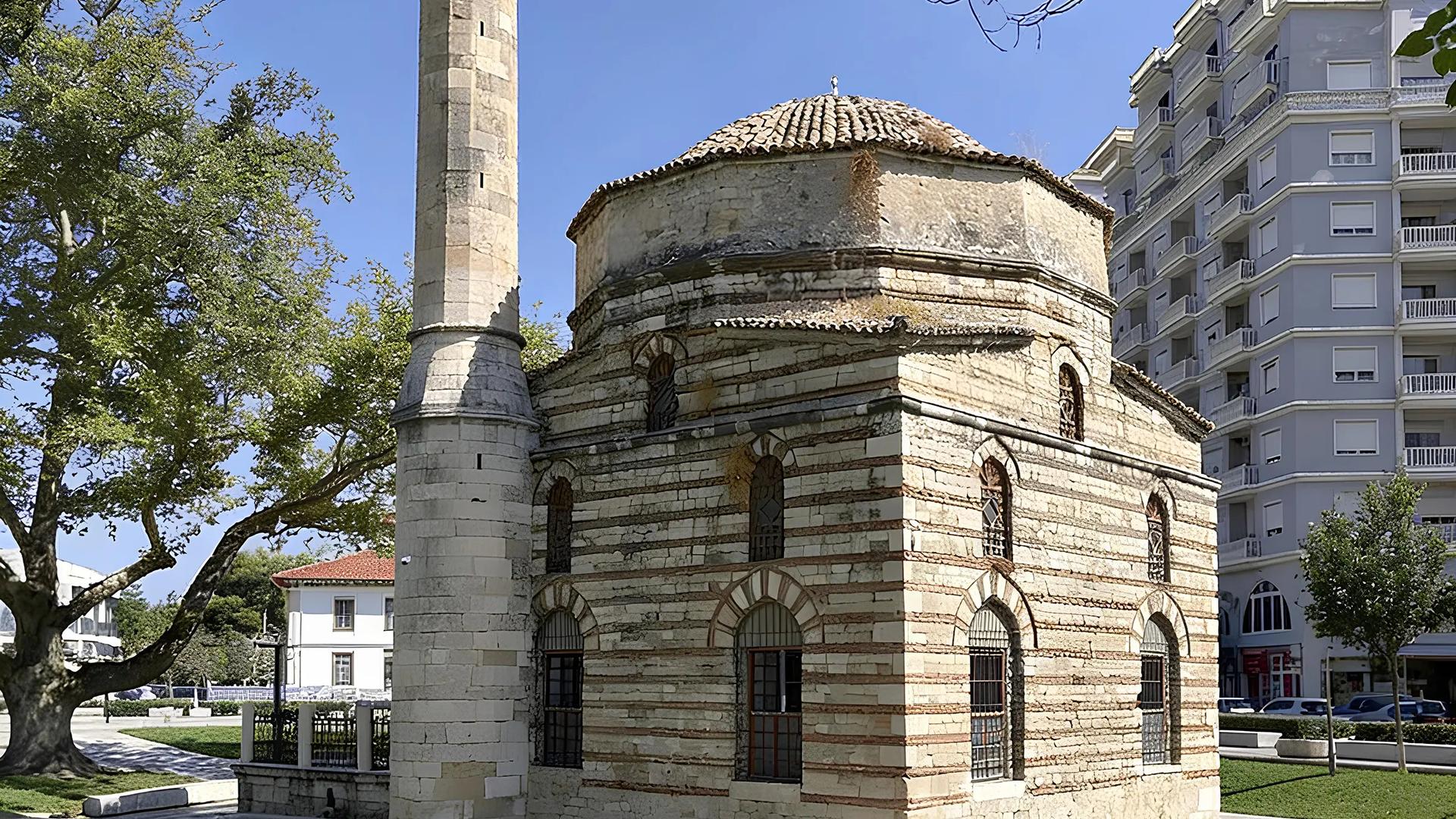
The Muradie Mosque (Xhamia e Muradies), also known as the Lead Mosque (Xhamia e Plumbit), is one of the oldest and best-preserved Ottoman structures in Vlora. It was built between 1537 and 1542 by order of Sultan Suleiman the Magnificent. The design is attributed to Mimar Sinan – the greatest architect of the Ottoman Empire.
The mosque stands in central Vlora at the intersection of Sadik Zotaj, Lef Sallata, and Papa Kristo Negovani streets. Flag Square is 300 m to the north; the Independence Museum is 200 m away.
Free entry. The mosque is active – visits are possible outside prayer times. Allow 15–20 minutes.
The Muradie Mosque is a compact, nearly square building with a prayer hall measuring 10 by 11 meters. The walls, about 8 meters high, are laid in alternating courses of stone and brick – this striped masonry, characteristic of the Sinan school, creates a pronounced decorative effect in red and white. Above the hall rises a twelve-sided drum topped by a dome roughly 10 m high, clad in dark red tiles.
An 18-meter carved stone minaret adjoins the western wall. Three walls (all except the northern) are pierced by three pointed arches with windows that admit soft light. The mosque originally had a portico (hajat), which has not survived. The interior is plain – painted decoration has been lost, except for the mihrab (the niche indicating the direction of Mecca).
An old well stands in the courtyard. Roads surround the mosque on all four sides, allowing visitors to walk around the building and examine the masonry and minaret from every angle. The atmosphere is quiet – far fewer visitors than at the larger mosques of Tirana or Shkodra.
Architect – attributed to Mimar Sinan, creator of Istanbul's Süleymaniye Mosque
Age – built 1537–1542, one of Albania's oldest mosques
Masonry – alternating stone and brick courses create a distinctive striped pattern
Minaret – 18 meters tall, carved stone, visible from several points in the city center
Status – designated Cultural Monument of Albania; survived the communist era as an architecture museum
The mosque was erected between 1537 and 1542 by order of Sultan Suleiman the Magnificent in honor of his predecessor Murad II. One theory holds that Sinan converted an earlier Byzantine church (11th–13th century) into a mosque, adding the minaret and dome structure. The mosque formed part of a fortress complex Suleiman built near Vlora's port to guard the Adriatic coast. During the Ottoman period, Vlora served as a sanjak center, and the mosque was its principal place of worship.
In 1967, Enver Hoxha's communist regime declared Albania "the world's first atheist state." Mosques and churches across the country were closed or demolished. The Muradie Mosque escaped destruction by being repurposed as the Architecture Museum of the Vlora district. After communism fell in the 1990s, the mosque was returned to the Muslim community. Today it functions both as an active mosque and a protected cultural monument.
Free entry. Active mosque – visits permitted outside prayer times.
Dress code: Shoulders and knees must be covered. Women should wear a headscarf. Remove shoes before entering the prayer hall.
Photography: Unrestricted outdoors. Inside – only between prayers, no flash.
Restrictions: During namaz (5 times daily) tourists are not admitted. The mosque is occasionally closed for renovations – check on arrival. The women's ablution area may be locked.
On-site:
Historic well in the courtyard
Shoe rack at the entrance
Nearby:
Cafés and restaurants on Ismail Qemali Street – 100 m
Restrooms in nearby establishments
Parking: Difficult in the old-town location. Best reached on foot.
Wi-Fi: None. 4G coverage is stable.
Accessibility: Level entrance, no steps. The prayer hall is on one floor.
From central Vlora:
From Flag Square – 300 m south along Ismail Qemali Boulevard (5-minute walk)
From the Independence Museum – 200 m
From the seafront – 7-minute walk
From Tirana (150 km, 2.5–3 hours):
– Bus to Vlora – 500–700 ALL (≈ €5–7 / $6–8), then a 5-minute walk from the bus station
– Car rental – look for street parking on side roads
Season: Year-round. The mosque is worth viewing in any weather.
Time of day: Morning (9:00–11:00 AM) or early afternoon (2:00–4:00 PM) – between prayers. Avoid prayer times (schedules vary by season).
Duration: 15–20 minutes for the exterior and prayer hall.
Avoid: Friday prayer (around 1:00 PM) – the mosque is closed to tourists.
Practical answers about visiting, routes and time on site.
No. The mosque is free to enter. It is an active place of worship – visits are welcome outside prayer times.
Yes. Cover shoulders and knees. Women should wear a headscarf. Remove shoes before entering the prayer hall. Headscarves are not provided – bring your own.
Outside – no restrictions. Inside – yes, but only between prayers and without flash.
The attribution to Sinan or his school is widely accepted but not documented. The architectural style and construction period (1537–1542) are consistent with his body of work.
15–20 minutes. The interior is modest – the main interest lies in the exterior masonry and the minaret.
In 1967, when the regime closed all religious institutions, the mosque was repurposed as an Architecture Museum. This saved it from demolition. It returned to religious use after 1991.
Flag Square – 300 m north. Independence Museum – 200 m. The Vlora seafront promenade – 7-minute walk.
The exterior is fine for all ages. Inside, quiet is expected, which may be difficult with small children. The visit is brief – about 15 minutes.