St. John’s Church
Crkva sv. Ivana Krstitelja
Church with a belfry that defines Budva’s skyline.
About
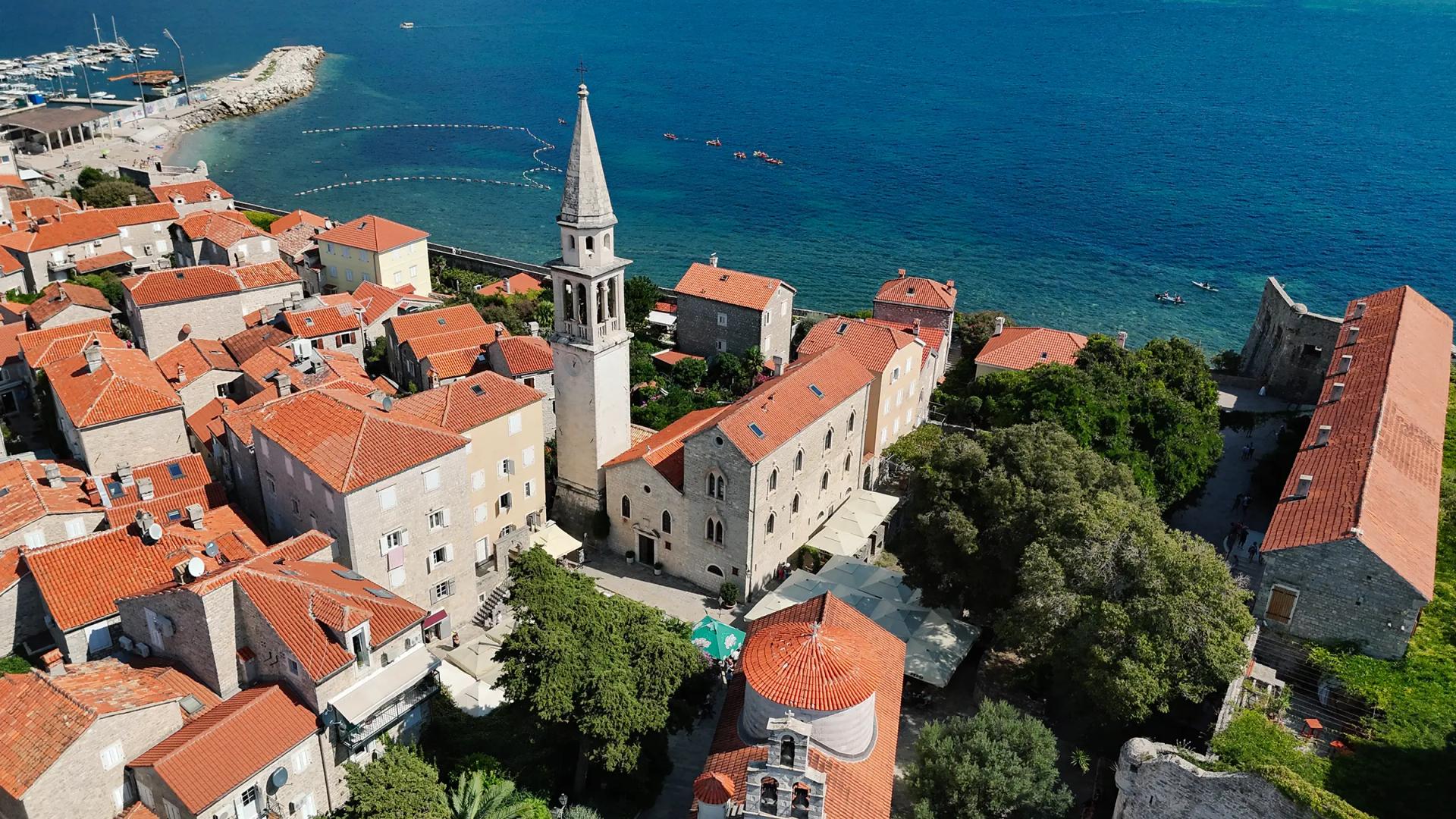
The church stands by a square within the walls. Its belfry is visible from the promenade and beaches and acts as a key landmark.
Transport
Travel time
On foot from Budva center14–20 min.1 km
By car from Budva4 min.2 km
From the airport Tivat · TIV40 min.24 km
On the map
Location
In detail
What's here
What is this place
The Church of St John the Baptist (Sv. Ivan) is the main Catholic church of Budva’s Old Town, crowned by a landmark bell tower. The ensemble on the central square comprises the church proper, a free-standing campanile and the former bishop’s palace.
Key features
- Tradition dates the first rotunda here to the 7th century, while scholarship places the earliest phase around c. 1200 – later expanded repeatedly.
- The present form took shape by the late 17th century after the 1667 earthquake – a single-nave basilica with side chapels, choir and sacristy.
- The c. 36 m northern bell tower was added in the 19th century, designed by architect Lucchini – Budva’s signature vertical.
- Until 1828 it served as the cathedral of the Budva diocese, with the bishop’s residence attached.
- The chief relic is the icon “Budvanska Gospa / Madona in Punta” (12th–14th c.) on the north altar, venerated as the city’s protectress.
What to see
- A single-nave interior with side chapels and surviving 14th-century fresco fragments.
- The 19th-century northern campanile and the ensemble with the bishop’s palace to the south.
- The “Budvanska Gospa” icon and a glass mosaic of St John by Ivo Dulčić in the presbytery.
History
According to tradition a rotunda church stood here in the 7th century; under the Benedictines in the 9th century Budva became a Christian centre and the shrine assumed a civic role. Around 1200 a single-nave structure arose, enlarged through the 12th–15th centuries.
The 1667 earthquake prompted a major rebuild completed by the late 17th century. In the 19th century the tall northern bell tower by Lucchini was added; in 1807 the famed icon from Santa Maria in Punta was transferred here. Until 1828 this was the cathedral church of Budva.
Practical information
Location: Budva Old Town, central church square, near the Citadel.
Getting there: on foot from the town gates; nearest parking by the marina and outside the walls.
Access: active Catholic church; entry generally free, donations welcome.
Visiting hours: daytime year-round; services may limit access.
Visit duration: 20–40 minutes.
Best time: morning or golden hour for softer light and fewer crowds.
Notes: modest dress and quiet; no flash photography; do not touch icons or artefacts.
Nearby