Blog · Transport
Self-Drive Desert Trip in Qatar: Which Car to Rent and Where to Go Without Getting Stuck
 Transport
In this article
- 01Which Car to Rent: Models and Classes
- 02Essential Gear: What to Bring
- 03Where to Drive: Routes from Easy to Hard
- 04Safety: Rules That Save Lives
- 05Driving Technique: Sand Driving Basics
- 06Trip Budget: Realistic Costs
- 07Insurance and Risk Coverage
- 08FAQ
- 09Conclusion
Some links are affiliate links. You pay the same, and we may earn a commission.
Complete guide to self-driving in Qatar's desert: choosing the right 4WD, routes from easy to advanced, rental costs, safety rules, and things rental companies won't tell you.
A self-drive desert trip in Qatar requires a proper 4WD vehicle – not a crossover SUV – or you'll get stuck within meters of soft sand. Renting a suitable car in Doha costs from 80 $ per day for a mid-size 4WD to 200+ $ for a Toyota Land Cruiser. The safest route for first-timers is Inland Sea (Khor Al Adaid) via the southern track through Mesaieed, where much of the journey follows established desert trails.
Key Facts
- Minimum requirement: 4WD with low-range gearing. Urban AWD crossovers cannot handle soft sand. You need a proper transfer case with low-range capability.
- Rental companies and off-road: read the fine print. Many companies prohibit off-road use – violations void your insurance entirely.
- Fuel costs just 0.55-0.60 $ per liter – filling up is cheap, but gas stations beyond Doha are extremely scarce.
- Season: October through March. Summer desert surface temperatures exceed 50 °C, making driving dangerous for both people and vehicles.
- Inland Sea (Khor Al Adaid) is Qatar's only point where desert meets sea, and the primary destination for most self-drive desert trips.
- Never drive alone – this is a survival rule, not a suggestion. Getting stuck 50 km from the nearest settlement at 45 °C is a real scenario.
- Tire deflation is mandatory. Drop pressure to 15-18 PSI on sand. Without a compressor to re-inflate for highway driving, you cannot safely return.
Which Car to Rent: Models and Classes
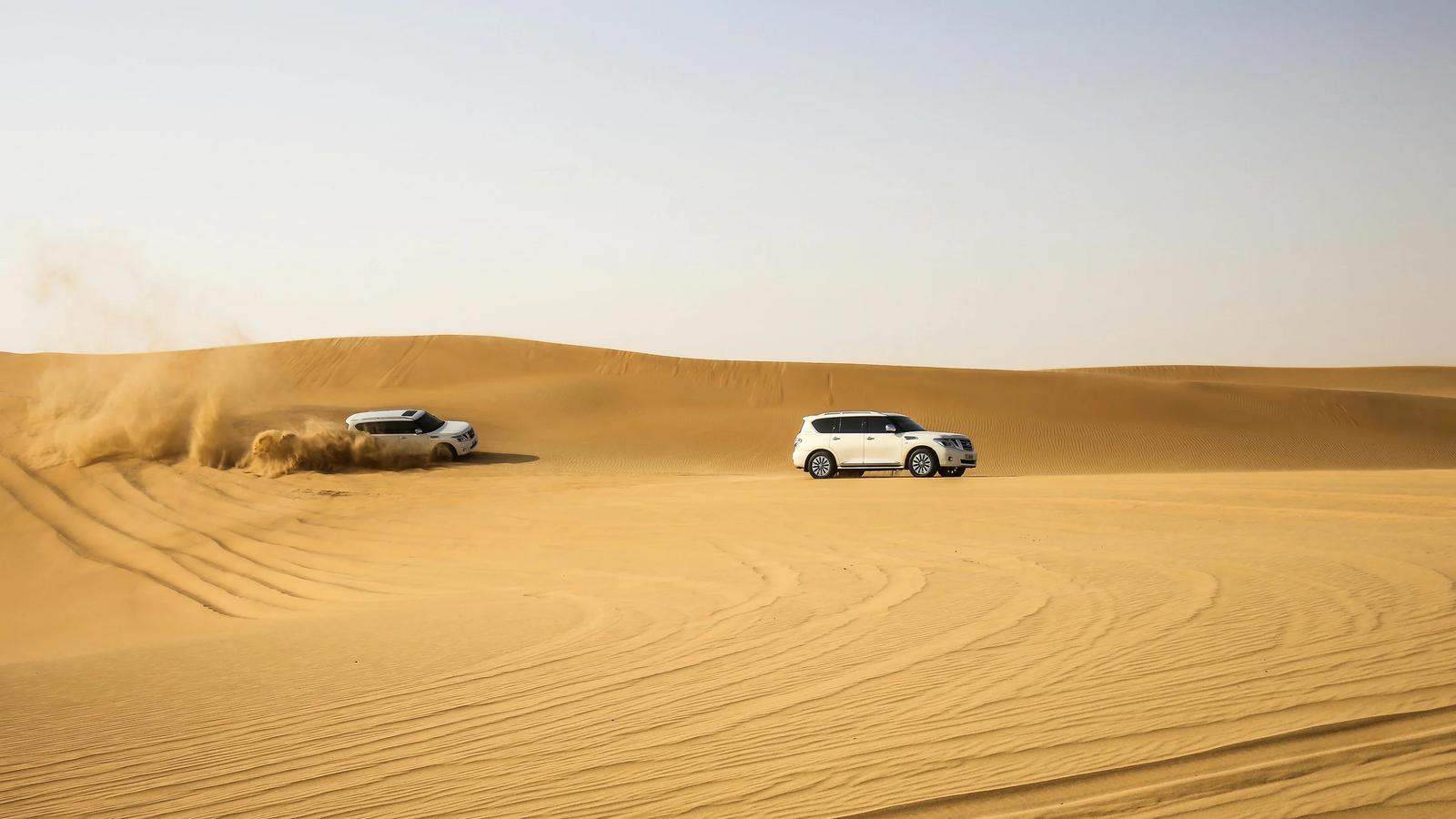
Not every "SUV" in a rental catalogue is suitable for desert driving. Here is what actually works in Qatar's dunes versus what merely looks capable.
| Class | Example Models | Desert-Ready? | Daily Rental |
|---|---|---|---|
Full-size 4WD SUV | Toyota Land Cruiser, Nissan Patrol | Yes – ideal choice | 150-250 $ |
Mid-size 4WD SUV | Toyota FJ Cruiser, Mitsubishi Pajero | Yes – best for beginners | 80-150 $ |
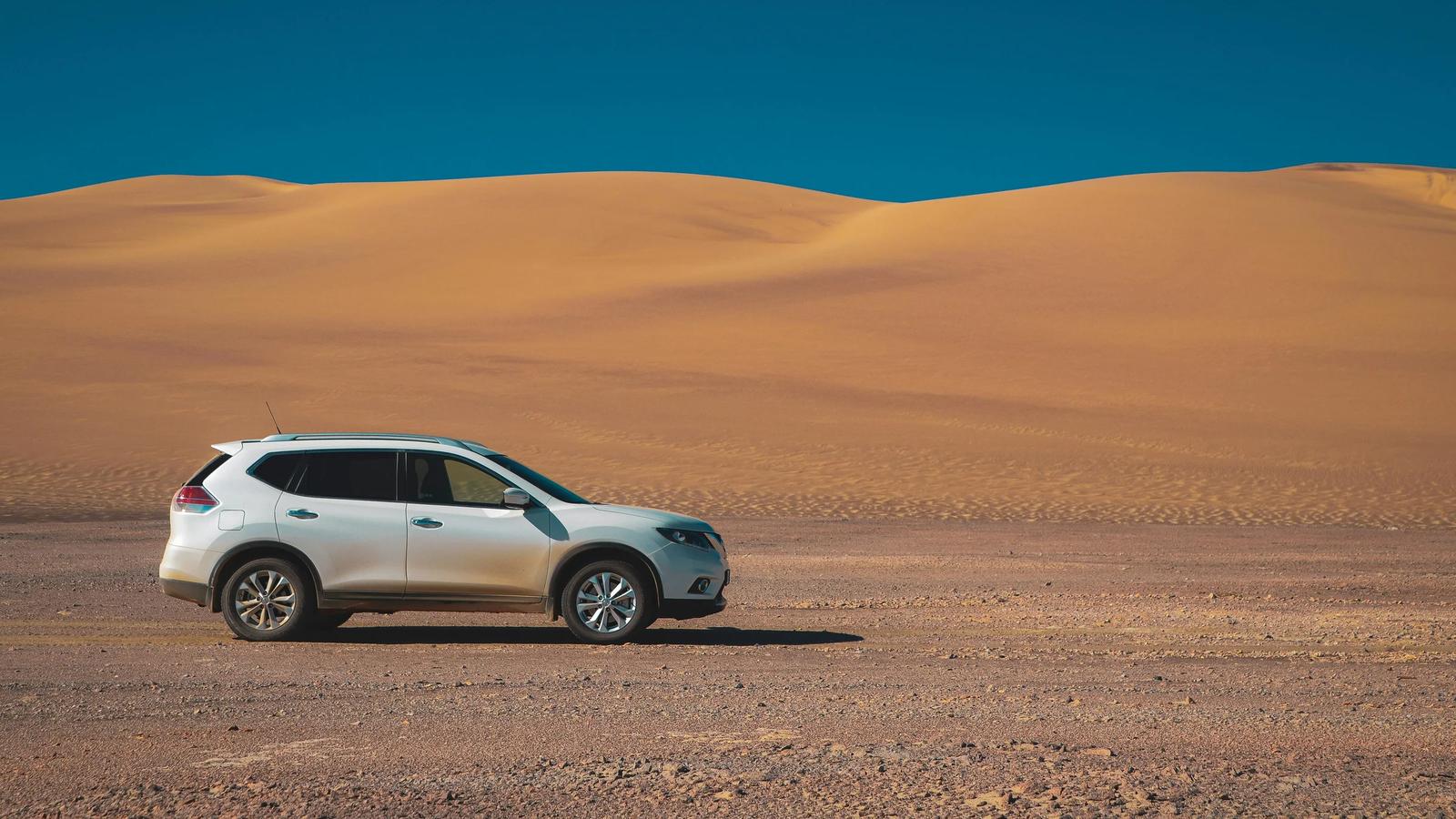
Urban crossover (AWD) | Hyundai Tucson, Kia Sportage | No – will get stuck | 40-70 $ |
4WD Pickup | Toyota Hilux, Ford Ranger | Yes – if 4WD equipped | 90-160 $ |
Sedan/hatchback | Any | Absolutely not | – |
For detailed information on deposits, insurance, and rental pitfalls, see the dedicated guide: Car rental in Qatar: where to book, prices and hidden pitfalls.
Compare prices and book through aggregators like Localrent and Economybookings, which display offers from local and international providers on a single page.
What to Check When Picking Up the Car
Before signing the rental agreement, ask three questions: is off-road driving permitted, does the insurance cover underbody and suspension damage, and is mileage unlimited. If any answer is "no," find another provider.
During vehicle inspection, verify the spare tire (essential for desert trips), jack, and tow strap are present. Photograph all existing damage before departure – standard practice everywhere, but particularly important in Qatar where some agencies may overlook existing scratches.
Essential Gear: What to Bring
The desert does not forgive poor preparation. Minimum kit:
- Tire compressor – essential for deflating on sand and re-inflating for the highway. Costs 15-30 $ at auto shops in Doha.
- Pressure gauge – to monitor PSI during deflation.
- Sand tracks (recovery boards) or thick planks – for self-recovery. Available at major auto shops for 40-60 $ per set.
- Tow strap – minimum 5-ton rated.
- Water – 5 liters per person per day. This is not comfort hydration; it is survival quantity if you break down.
- Fully charged phone and power bank – mobile coverage does not reach all desert areas, but offline navigation works via GPS.
- Shovel – a basic spade for digging out wheels.
Critical: Download offline maps before leaving. In areas without coverage, GPS continues functioning but map tiles will not load.
Where to Drive: Routes from Easy to Hard
Route 1: Doha – Mesaieed – Inland Sea (Beginners)
Distance: ~80 km one way from Doha. Time: 2-3 hours with stops. Difficulty: moderate.
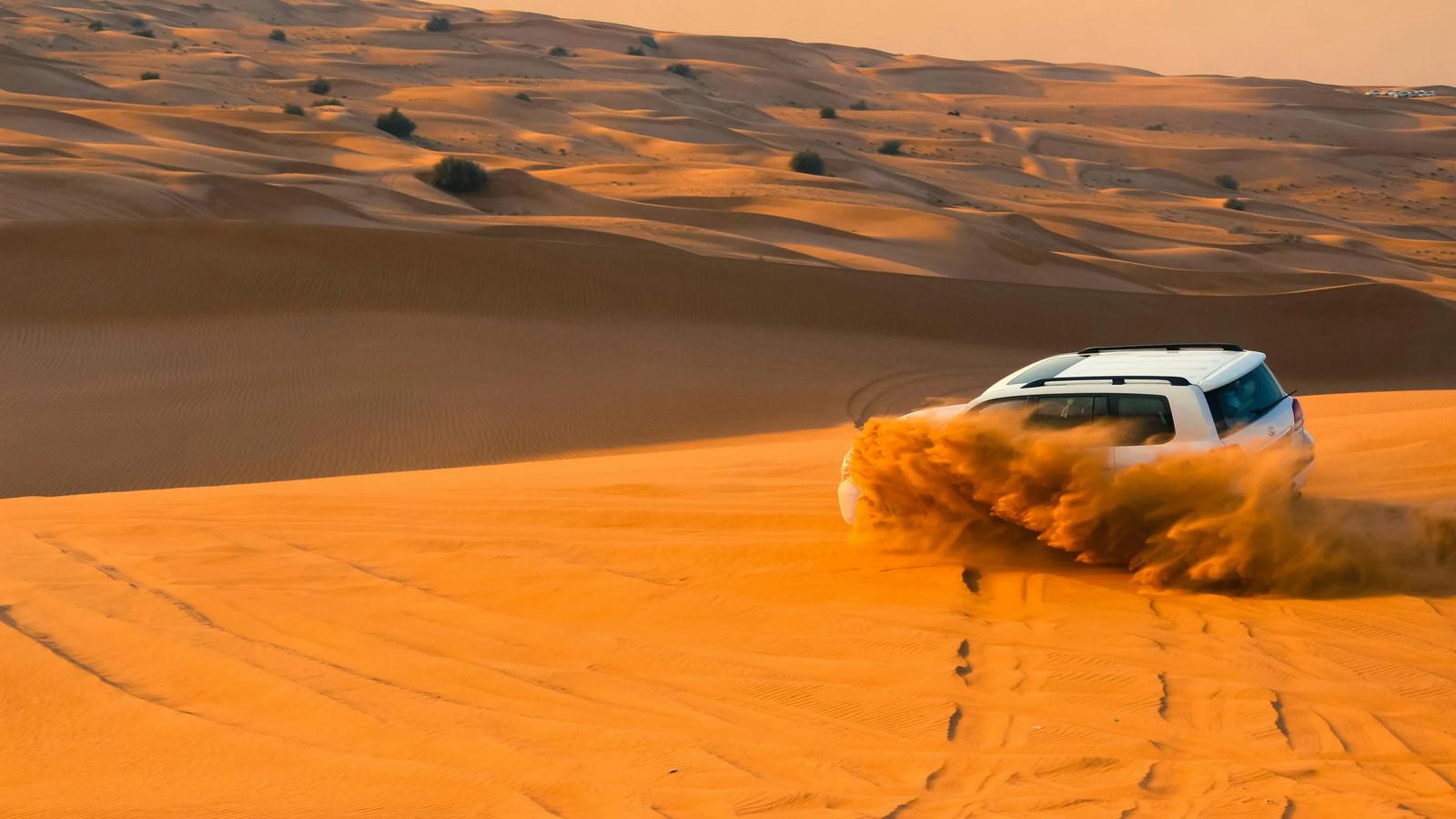
This is the most popular route. From Doha, drive south on the highway to Mesaieed – roughly 40 minutes on tarmac. The gravel track begins shortly after, and within 5-10 km you encounter the first dunes. This is where you stop, deflate tires to 15-18 PSI, and engage sand mode or low-range gearing.
The destination is Inland Sea (Khor Al Adaid), a protected area where the desert meets the sea. On weekends the route is busy with other vehicles – good for safety, as there is always someone to assist with recovery. On weekdays you may find yourself completely alone – beautiful but demanding more preparation.
Route 2: Northern Desert via Al Khor (Intermediate)
Distance: ~60-80 km from Doha. Time: 2-4 hours. Difficulty: moderate to hard.
The route toward Al Khor offers a different landscape: desert sections alternate with the mangrove forests of Al Thakira Mangroves and rocky flats. Dunes are smaller than in the south, but soft sand appears unexpectedly – which makes the route deceptive. After the off-road section, you can visit Purple Island, accessible by 4WD during low tide.
Route 3: Zekreet and the Abandoned Village (Advanced)
Distance: ~80 km west of Doha. Time: 3-5 hours. Difficulty: hard.
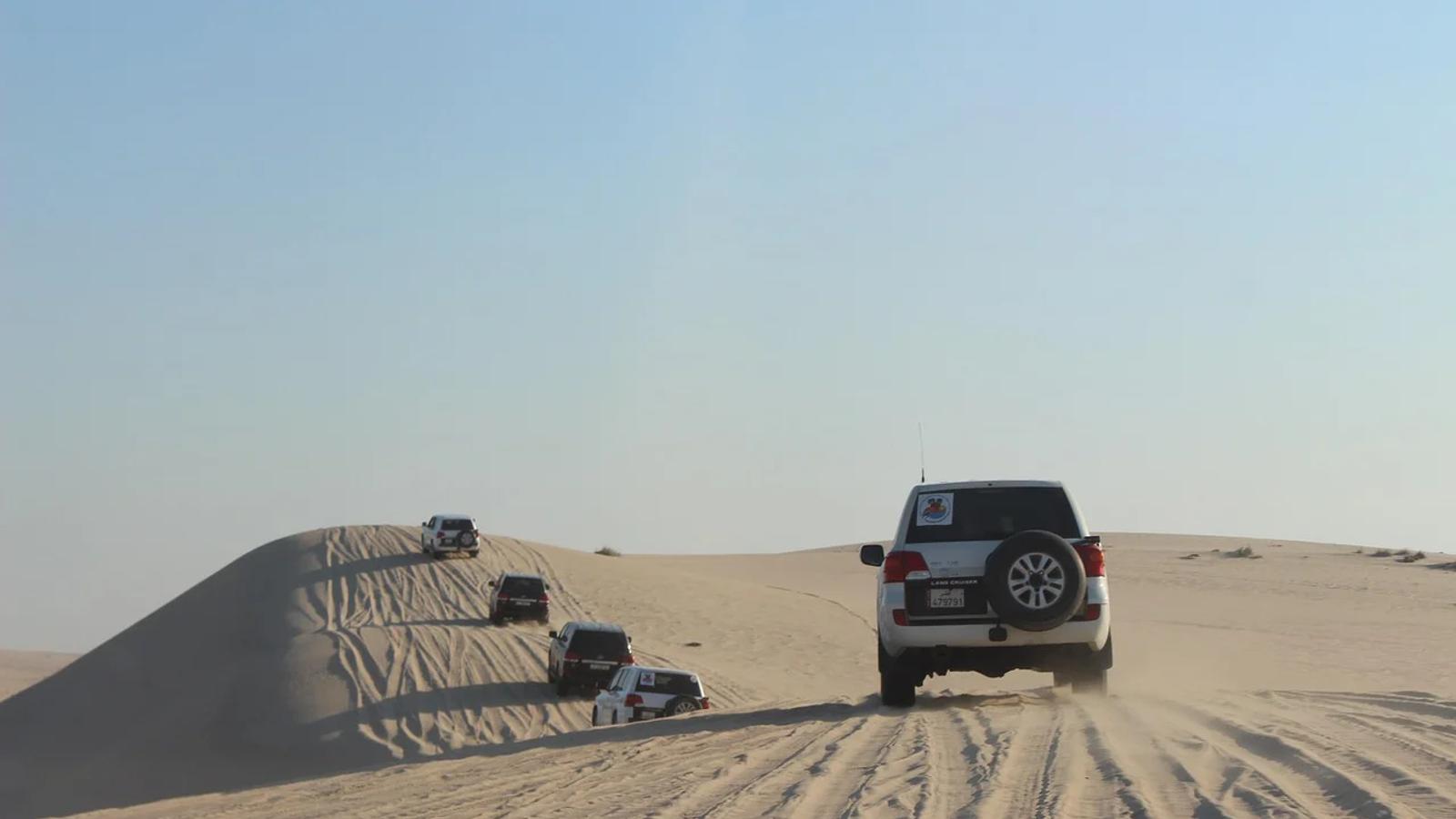
The western route leads to the Zekreet peninsula with its lunar landscapes, mushroom-shaped rock formations, and "Film City" – an abandoned movie set of a traditional Arab village. Much of the route crosses rocky terrain rather than sand, increasing the risk of tire punctures. The trade-off: far fewer vehicles and dramatically different scenery.
Safety: Rules That Save Lives
Qatar's desert is not an amusement park. Distances are deceptive, summer temperatures are lethal, and recovery costs hundreds of dollars and takes hours.
First, never drive alone. Two vehicles minimum. If you lack a second car, join a convoy – local off-road clubs organize regular group outings, typically coordinated through expat community groups.
Second, tell someone your route and estimated return time. In an emergency, rescuers need to know where to search.
Third, never accelerate over dune crests – there may be a drop-off or oncoming vehicle on the other side. The classic beginner mistake: see a sand hill, decide to jump it. Result: bent chassis and a multi-thousand-dollar bill from the rental company.
Emergency numbers: 999 (police), 997 (ambulance), 996 (fire). If critically stuck with no signal – stay with the vehicle, do not walk away.
Driving Technique: Sand Driving Basics
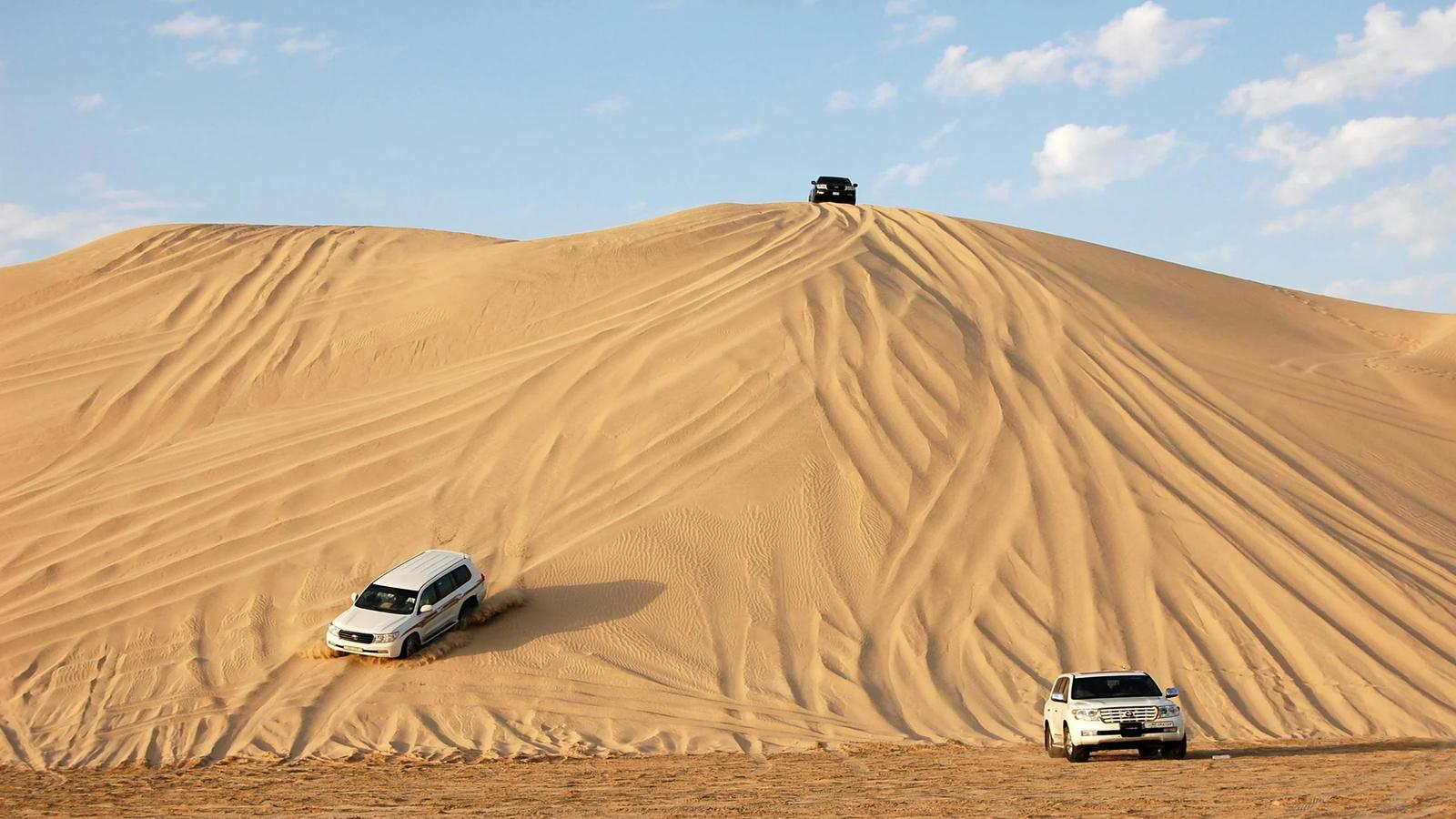
Desert driving is counterintuitive. Core principles: maintain steady speed (no jerky acceleration), follow existing tire tracks (compacted sand supports better), build momentum before dune ascents with steady throttle to the crest. If the vehicle begins to dig in – do not add more throttle; stop immediately and reverse along your own tracks.
Descending dunes: go slowly in first gear without braking (brakes lock wheels, causing the vehicle to slide sideways). Keep the steering wheel straight. Turning on steep slopes is the fastest way to roll over.
Trip Budget: Realistic Costs
| Expense | Cost |
|---|---|
4WD SUV rental (1 day) | 80-200 $ |
Fuel (full tank ~80 liters) | 35-48 $ |
Compressor (purchase) | 15-30 $ |
Sand tracks (purchase) | 40-60 $ |
Water and food for the day | 10-15 $ |
Total per trip | 180-350 $ |
The compressor and sand tracks are one-time purchases. If you plan multiple outings, they pay for themselves quickly. Alternatively, some outdoor equipment shops offer rental, though availability varies.
For comparison, an organized desert safari with a professional driver costs 50-120 $ per person and includes the vehicle, driver, and all risk. If traveling as a couple, a self-drive trip costs more but offers complete freedom over route and schedule.
Insurance and Risk Coverage
Standard CDW (Collision Damage Waiver) in rental agreements often excludes off-road damage. This means a punctured underbody panel or broken suspension component is your liability – repairs start from 500 $.
Two solutions: find a rental company that explicitly permits desert driving (they exist but are fewer), or purchase separate travel insurance with active recreation coverage. Check visa requirements for your nationality and ensure your insurance covers off-road activities.
FAQ
1. Can I drive into the desert with a regular crossover SUV? No. Urban crossovers with AWD systems (such as Hyundai Tucson or Nissan X-Trail) get stuck on the first soft sections. You need a proper 4WD with low-range gearing. These vehicles are fine on paved roads leading to the desert edge, but should not leave tarmac.
2. Do I need an International Driving Permit? Check the requirements for your specific nationality. Qatar accepts driving licenses from certain countries directly; others require an International Driving Permit. For full details, see: Car Rental in Qatar: Everything Tourists Need to Know.
3. What is the best time of year for desert driving? November through March, when daytime temperatures range from 20-28 °C. From May through September, sand surface temperatures can exceed 60 °C – dangerous for both people and vehicles. April and October are borderline months: drive early morning or near sunset only.
4. What should I do if my car gets stuck? First – do not add throttle (wheels dig deeper). Exit the vehicle and assess the situation. Dig sand away from the front of the wheels, place sand tracks or floor mats underneath. Deflate tires further (to 12-14 PSI). If nothing works, wait for assistance and stay with the vehicle.
5. Can I camp overnight in the desert? Technically, yes – many locals spend weekends camping in the desert. However, for tourists in rental vehicles, this carries additional risk: nighttime temperatures drop to 10-15 °C in winter, landmarks disappear in darkness, and rescue becomes significantly harder. Only camp with experienced off-road companions.
Conclusion
A self-drive desert trip is one of Qatar's most rewarding experiences – with proper preparation. A 4WD vehicle, compressor, water, and a convoy partner are not suggestions for the cautious; they are the standard that even experienced local drivers follow. If off-road driving seems too daunting, start with an organized desert safari – observe how professionals handle the terrain, and drive yourself next time.
Read also:
- Car rental in Qatar: where to book, prices and hidden pitfalls
- Desert Safaris in Qatar: Types, Prices, and How to Choose
- Best Tours in Doha: Desert Safaris, City Highlights and Dhow Cruises
Sources
Qatar Tourism Authority – access rules and zones
Qatar Ministry of Interior – driving license requirements
Qatar Meteorological Department – seasonal temperatures
Places to see in Qatar

You may also like

Khor Al Adaid (Inland Sea): How to Get There and Is It Worth It?
A practical guide to visiting Khor Al Adaid (Inland Sea) south of Doha: how to get there, tour vs self-drive, prices, best time to visit and whether it’s worth adding to your Qatar itinerary.
December 10, 2025
Car rental in Qatar: where to book, prices and hidden pitfalls
Complete guide to renting a car in Qatar: where to book, real 2025 prices, licence and deposit rules, insurance, fines and common mistakes.
November 23, 2025
Desert Safaris in Qatar: Types, Prices, and How to Choose
A practical guide to Qatar desert safaris: main formats, what’s included, updated 2025 price ranges, and a simple checklist to pick the right tour.
December 15, 2025
Qatar: how to reach the desert, Khor Al Adaid and Banana Island
Step-by-step guide from Doha to the desert, Khor Al Adaid (Inland Sea) and Banana Island, with transport options and prices.
November 24, 2025
Long Layover in Doha (8–24 Hours): Step-by-Step Plan to Visit the City and Return to the Airport
How to spend a long layover in Doha: free transit visa, metro to the city, Souq Waqif, Museum of Islamic Art, and getting back to Hamad Airport on time.
February 12, 2026
Best Tours in Doha: Desert Safaris, City Highlights and Dhow Cruises
A practical guide to the best tours in Doha: city sightseeing, desert safaris to the Inland Sea and evening dhow cruises along the Corniche. Prices, how to choose the right tour and where to book it.
December 10, 2025