Tickets & prices
Entry is free. Access 24/7. Mosaics are usually covered with sand – uncovered once every few years. Photographs of the mosaics are displayed on panels at the entrance and in the guard's hut.
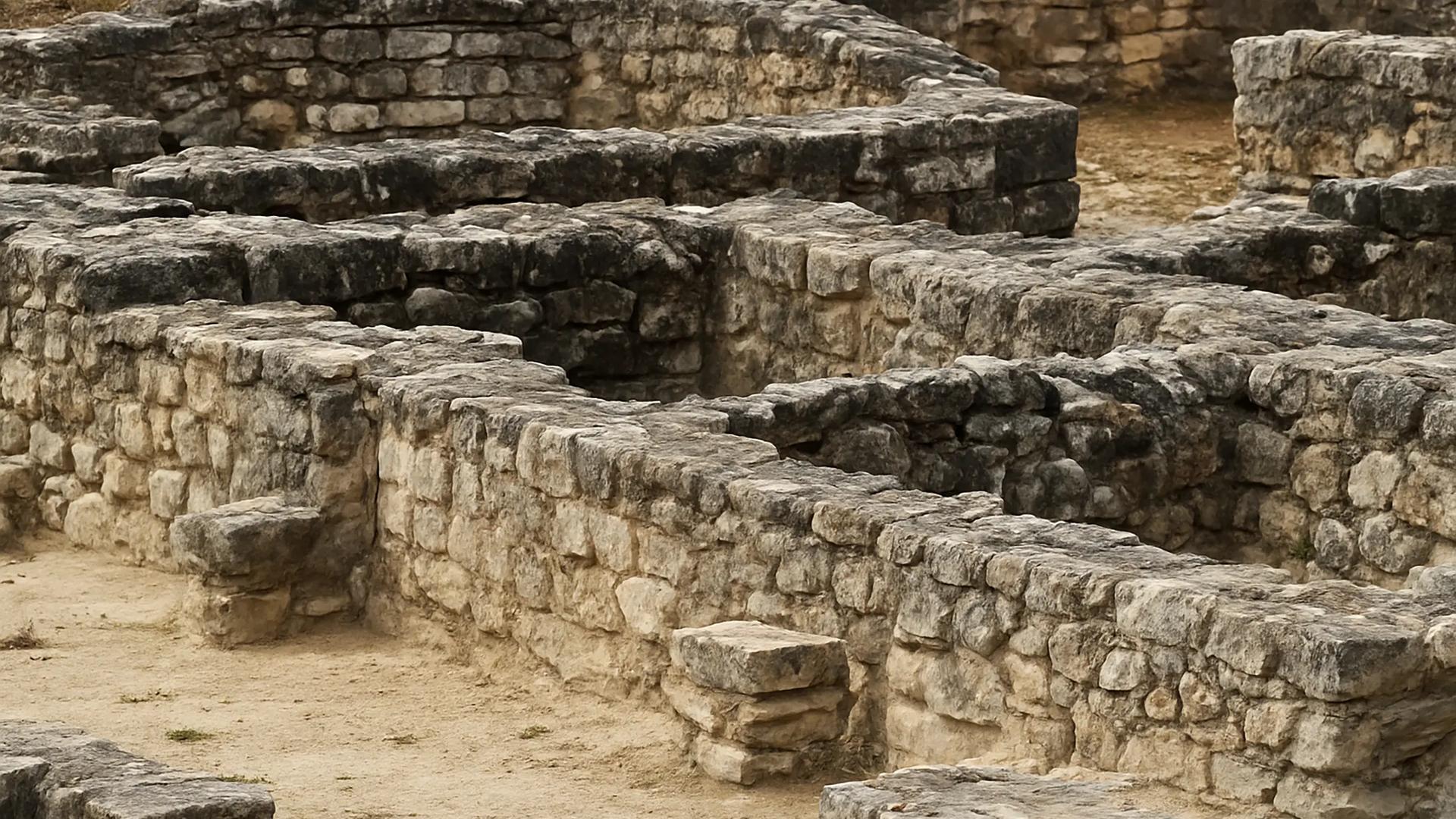
Sinagoga e Sarandës
Ruins of a 5th–6th century synagogue and basilica – the earliest evidence of Jewish presence in Albania
The Saranda Synagogue (Basilica-Sinagoga) is an archaeological complex in the centre of Saranda, on Rruga Skënderbeu, next to Friendship Park. The ruins include remains of a 4th-century early Christian basilica and a 5th–6th century synagogue. The complex sits within the walls of the ancient city of Onhezmus.
The site is an easy walk from anywhere in central Saranda – right next to the bus station and ferry terminal. Entry is free, access 24/7.
Allow 15–30 minutes for a visit. The mosaic floors are usually covered with sand for protection – photographs of the mosaics are displayed on information panels. Original mosaics from the site are held at the Saranda Archaeological Museum on Rruga Flamurit.
The ruins occupy a roughly 30 × 20 m rectangular plot enclosed by a low wall. Visible are the basilica's three-nave foundations, remnants of the synagogue hall walls, and stone masonry fragments from different periods – Roman (2nd–3rd century) through late antiquity (6th century). Five archaeological layers are stacked on top of each other: a Roman villa, an early synagogue, an expanded synagogue-basilica, and a Christian church.
The complex's greatest treasure is its mosaic floors. The most famous mosaic depicts a menorah (seven-branched candelabrum), a shofar (ram's horn), and an etrog (citrus fruit) – Jewish religious symbols. Other mosaics contain images of animals, trees, amphoras, and what may be the Holy Ark. The mosaics are typically covered with sand and uncovered only once every few years. Life-size photographs are displayed on panels at the entrance and inside a small guard's hut on-site.
Nearby, along the boulevard, other fragments of ancient Onhezmus survive: the city gate on the public beach and a section of fortification wall on the ground floor of Hotel Republika.
Age – five archaeological layers from a 2nd-century Roman villa to a 6th-century church
Mosaics – menorah, shofar, etrog, images of animals and plants. Usually covered with sand for preservation
Significance – the earliest direct evidence of Jewish presence in modern-day Albania
Excavations – discovered in the 1980s, joint research by the Albanian Academy of Sciences and the Hebrew University of Jerusalem (2003–2004)
Location – city centre, next to the bus station and ferry terminal
The complex went through five phases of use. In the 2nd–3rd centuries, a Roman villa stood on the site. By the 4th–5th centuries a synagogue had been established – its mosaic floor with menorah, shofar, and etrog dates to the 5th century. The synagogue was later expanded into a three-nave basilica. In its final phase (6th century), the building was converted into a Christian church. The complex belonged to a prosperous Jewish community, as evidenced by its central location and the quality of its mosaics.
The complex was destroyed around 580–585 CE – either by an earthquake or during Avaro-Slavic raids. The ruins were discovered in the 1980s under the communist regime. In 2003–2004, a joint expedition by the Albanian Academy of Sciences and the Hebrew University of Jerusalem carried out extensive excavations, uncovering additional rooms with mosaic pavements. Parts of the complex remain buried under modern buildings and streets. The site is currently administered by the archaeology department of Saranda Municipality.
Entry is free. Access 24/7. Mosaics are usually covered with sand – uncovered once every few years. Photographs of the mosaics are displayed on panels at the entrance and in the guard's hut.
Stay on marked paths – do not step on archaeological layers. Photography is allowed. Information panels may be damaged or faded – reading about the site's history beforehand is recommended.
Information panels at the entrance (may be in poor condition). Small guard's hut with photographs. No café, toilets, or shops on-site – all available within a short walk in central Saranda. The site is mostly flat and accessible for visitors with limited mobility.
From central Saranda:
The ruins are right in the city centre on Rruga Skënderbeu, next to Friendship Park. A 5-minute walk from the promenade, 2 minutes from the bus station.
By public transport:
All buses and shared minibuses (furgon) arriving in Saranda stop next to the ruins. The bus between the ferry terminal and Butrint passes by.
By car:
Street parking nearby. No dedicated parking at the site.
Season: Year-round. The ruins are open-air but a visit takes just 15–30 minutes, so weather is not critical.
Time of day: Early morning or sunset – soft light for photos and fewer people. Midday – a quick stop between other sights.
Duration: 15–30 minutes.
Avoid: Midday sun in summer – no shade on-site.
Practical answers about visiting, routes and time on site.
No, entry is free. The site is accessible 24/7.
The original mosaics are usually covered with sand for preservation and uncovered only once every few years. Life-size photographs are on panels at the entrance. Some mosaics are held at the Saranda Archaeological Museum.
15–30 minutes. The site is compact; information panels give a basic overview.
No official on-site tours. It's best to read about the complex's history beforehand, as the information panels may be damaged.
Onhezmus was the ancient city on the site of modern Saranda. Other traces include the city gate on the public beach and a wall section in Hotel Republika.
Yes, the site is flat and safe. However, children may find the ruins uninteresting without some background – explain the history beforehand.
A 5-minute walk to Saranda's promenade. Lekursi Castle is a 10-minute drive uphill. Butrint National Park is 20 minutes by bus.
First discovered in the 1980s. Major excavations in 2003–2004 by a joint Albanian–Israeli team. Parts of the complex remain unexcavated beneath modern streets and buildings.